Author name: Mind Boggling Studio

Mental Clarity, Burnout Recovery & Wellness Resources

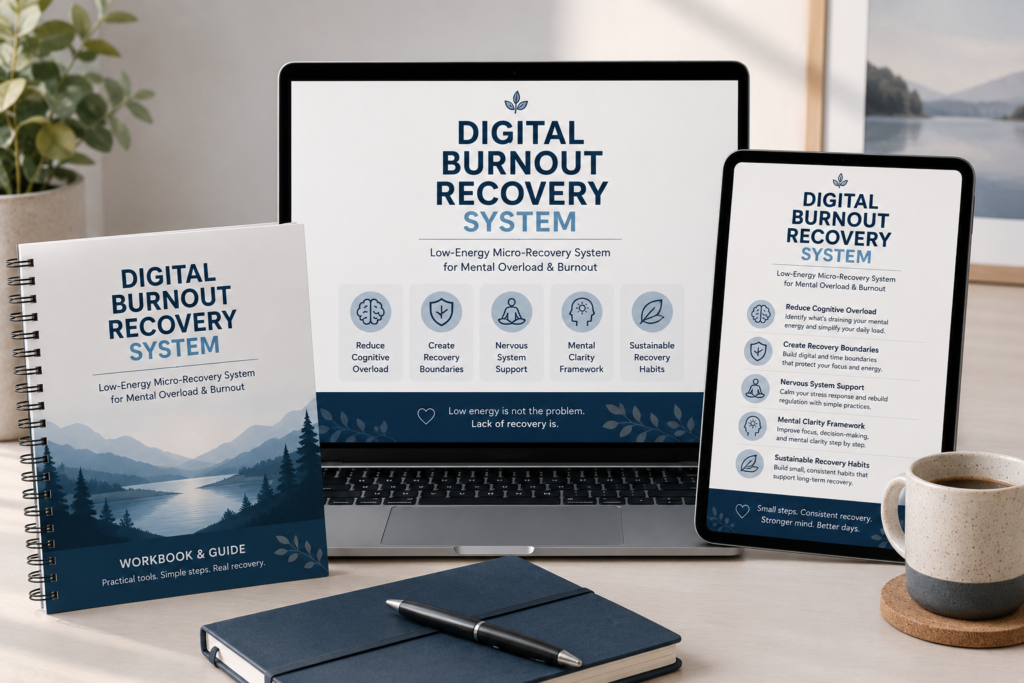
If you’re feeling mentally overloaded, emotionally exhausted, constantly distracted, or simply looking for practical tools to improve your focus and well-being, you’re in the right place. This resource hub brings together our most valuable recovery tools, burnout resources, wellness guides, and digital systems in one convenient location. Whether you’re experiencing digital burnout, cognitive fatigue, information overload, nervous system overwhelm, invisible mental labor, or everyday stress, these resources are designed to help you regain clarity, restore balance, and support long-term well-being. Some resources provide immediate relief. Others offer deeper recovery frameworks and step-by-step systems designed to create sustainable change over time. Not Sure Where to Start? Choose the resource that best matches what you’re experiencing right now. RECLAIM YOUR ENERGY → GET THE RESET → EXPLORE THE SYSTEM → DISCOVER THE GUIDE → DOWNLOAD FREE → GET THE CHECKLIST → Free Resources Free 2026 Feng Shui Wealth Corner Checklist Looking for a free resource to improve your environment and productivity? This checklist walks you through the key principles of Feng Shui wealth corner optimization so you can create a more supportive space for focus, abundance, and intentional living. Inside you’ll learn: Wealth corner basics Common Feng Shui mistakes Focus-enhancing placement tips Productivity-friendly room adjustments Simple improvements you can implement immediately This resource is ideal for entrepreneurs, creators, professionals, and anyone interested in creating a more intentional environment. 👉 Download the Free Checklist; Free 2026 Feng Shui Wealth Corner Checklist  Quick Relief Tools Sometimes you don’t need a complete system. You simply need immediate relief. The following resources are designed to help reduce overwhelm quickly and help you regain mental clarity. Stop Feeling Overwhelmed—Fast (The 5-Minute Cognitive Reset System) Stop Feeling Overwhelmed—Fast The 5-Minute Cognitive Reset System Mental overload often makes even simple decisions feel difficult. When your brain becomes overwhelmed, productivity declines, focus disappears, and stress levels increase. The 5-Minute Cognitive Reset System was designed to provide a practical and structured way to interrupt that cycle. This resource helps you: Reduce mental clutter Interrupt overthinking Regain focus Improve decision-making Create immediate cognitive relief Perfect for: Professionals Entrepreneurs Students Busy parents Anyone experiencing overwhelm 👉 Get the Reset System: Stop Feeling Overwhelmed—Fast (The 5-Minute Cognitive Reset System) Anti-Brain Fry Checklist (5-Minute Reset Audit) 5-Minute Reset Audit Mental exhaustion often develops gradually. As a result, many people don’t recognize the habits and patterns contributing to their cognitive fatigue. The Anti-Brain Fry Checklist helps you identify the hidden sources of mental overload so you can make meaningful adjustments before burnout becomes more severe. You’ll discover: What’s draining your mental energy Common information overload triggers Cognitive recovery opportunities Simple adjustments that support mental clarity If your brain feels overloaded, this is one of the easiest places to start. 👉 Get the Checklist Recovery Systems These systems are designed for people experiencing ongoing burnout, chronic overwhelm, and persistent mental fatigue. Rather than offering quick fixes, they provide structured frameworks for long-term recovery. Digital Burnout Recovery System – A Low-Energy Micro-Recovery System for Mental Overload & Burnout Digital burnout has become increasingly common. Constant notifications, information overload, screen exposure, and cognitive demands can gradually exhaust mental resources. The Digital Burnout Recovery System was created to help people recover without requiring high energy, complex routines, or unrealistic expectations. Inside you’ll learn how to: Reduce cognitive overload Support nervous system recovery Create healthier digital boundaries Improve mental clarity Build sustainable recovery habits The system is designed specifically for people who already feel exhausted. Recovery should feel achievable, not overwhelming. 👉 Explore the Recovery System Invisible Labor Recovery System Nervous System Reset for Overwhelmed Moms & Caregivers Nervous System Reset for Overwhelmed Moms & Caregivers Many caregivers carry a constant invisible workload. Managing schedules, responsibilities, emotional support, planning, and household demands can create a level of mental fatigue that often goes unrecognized. The Invisible Labor Recovery System helps caregivers understand the impact of invisible labor and provides practical recovery strategies. Topics include: Mental load recovery Emotional exhaustion Nervous system support Sustainable self-care Burnout prevention This resource was designed specifically for overwhelmed mothers and caregivers who need support, not more pressure. 👉 Explore the Recovery System Specialty Resources The Pet Bed Placement Mistake Why Your Pet Can’t Relax or Sleep Properly A pet’s environment can significantly influence their ability to relax and rest. This guide explains how bed placement affects: Comfort Sleep quality Stress levels Relaxation Overall well-being Small environmental adjustments can sometimes create surprisingly meaningful improvements. 👉 Learn More: The Pet Bed Placement Mistake (Why Your Pet Can’t Relax or Sleep Properly) Frequently Asked Questions Which resource should I start with? If you’re currently feeling overwhelmed, start with Stop Feeling Overwhelmed—Fast. If you’re unsure what’s causing your mental fatigue, begin with the Anti-Brain Fry Checklist. If burnout has become an ongoing issue, explore the Digital Burnout Recovery System. Are these resources suitable for beginners? Yes. Each resource is designed to be practical, approachable, and easy to implement regardless of experience level. Which resource is best for mental overload? The Anti-Brain Fry Checklist and Digital Burnout Recovery System are specifically designed to address mental overload, cognitive fatigue, and information exhaustion. Is there anything available for free? Yes. The Free 2026 Feng Shui Wealth Corner Checklist is available as a free download. Final Thoughts Recovery doesn’t always require a major life overhaul. In many cases, it begins with a small step taken consistently. Whether you’re looking for immediate relief, a burnout recovery framework, support for invisible labor, a practical mental reset, or a free wellness resource, the tools on this page are designed to help you create more clarity, balance, and sustainable well-being. Choose the resource that best matches your current situation. Start where you are. Small changes repeated consistently can create meaningful transformation. Affiliate Disclosure Affiliate Disclosure Some resources, products, or recommendations featured on this website may include affiliate links. This means we may earn a small commission if you make a purchase through those links, at no additional cost to you. We only recommend products, services, and resources that

Digital Burnout Recovery

Mental Clarity, Burnout Recovery & Wellness Resources Read Post »

Digital Burnout Recovery System low-energy recovery framework

Digital Burnout Recovery: Signs, Symptoms, Causes, and How to Recover

Digital burnout recovery is the process of restoring mental energy, reducing cognitive overload, and helping the nervous system recover from prolonged digital stimulation. This guide explains the signs, symptoms, causes, and recovery strategies that can help you reduce mental fatigue, improve focus, and regain clarity in a technology-driven world. Key Takeaways Digital burnout recovery focuses on restoring mental energy after prolonged digital overload. Common symptoms include brain fog, fatigue, irritability, and difficulty concentrating. Information overload and constant notifications are major contributors. Recovery requires reducing cognitive load and creating recovery periods. Structured recovery systems can help prevent recurring burnout. Introduction Digital burnout recovery is the process of restoring mental energy after prolonged exposure to screens, notifications, information overload, and constant digital stimulation. As work, communication, and entertainment increasingly move online, digital burnout recovery has become more important than ever. Many people feel mentally exhausted before the day is over. Others struggle to focus, remember information, or switch off at night. In some cases, even a full night’s sleep doesn’t seem to help. Unfortunately, digital burnout is becoming more common. Remote workers, students, entrepreneurs, parents, and professionals can all experience the effects of constant digital demand. The brain was never designed to process endless streams of information without adequate recovery time. As a result, many people find themselves stuck in a cycle of mental fatigue. They rest when they can. However, the exhaustion keeps returning. That’s because digital burnout often involves more than simple tiredness. Instead, it can reflect cognitive overload and nervous system stress that build over time. The signs can be subtle at first. Brain fog may appear. Concentration may become harder. Small decisions can feel surprisingly difficult. Meanwhile, motivation and mental clarity often begin to decline. The good news is that digital burnout recovery is possible. With the right strategies, you can reduce cognitive overload, support nervous system recovery, and rebuild mental energy. In this guide, you’ll learn the most common signs of digital burnout, what causes it, why traditional rest isn’t always enough, and the practical steps that support long-term digital burnout recovery. If persistent fatigue sounds familiar, you may also benefit from our guide on Why Your Brain Feels Tired Even After Sleeping, which explores another common cause of ongoing mental exhaustion. What Is Digital Burnout Recovery? Digital burnout recovery is the process of restoring mental energy, cognitive capacity, and emotional resilience after prolonged exposure to digital overload. It involves reducing the impact of constant notifications, excessive screen time, information overload, and the always-on expectations that have become common in modern life. Unlike temporary tiredness, digital burnout develops gradually. It often begins with mental fatigue, difficulty concentrating, and a feeling that your brain never truly switches off. Over time, these symptoms can affect productivity, decision-making, sleep quality, and overall well-being. As technology becomes more integrated into work and personal life, many people spend hours each day processing emails, messages, alerts, videos, news updates, and social media content. Consequently, the brain receives a continuous stream of stimulation with very few opportunities for recovery. Digital burnout recovery focuses on reversing this pattern. Rather than simply taking a break from work, recovery aims to reduce cognitive overload, support nervous system regulation, and rebuild mental clarity over time. To understand digital burnout recovery fully, it’s important to distinguish it from ordinary stress or fatigue. Stress vs. Fatigue vs. Burnout Although these terms are often used interchangeably, they describe different experiences. Stress is typically a short-term response to pressure or demands. While stress can feel uncomfortable, people experiencing stress often believe they can regain control once the situation improves. Fatigue is a state of physical or mental tiredness. In many cases, fatigue improves after adequate sleep, rest, or time away from demanding activities. Burnout, however, is more persistent. It involves ongoing exhaustion, reduced motivation, difficulty concentrating, emotional detachment, and a feeling that recovery never fully happens. Digital burnout is a specific form of burnout linked to prolonged digital stimulation and information overload. Therefore, digital burnout recovery is not simply about resting more. Instead, it involves helping the brain recover from a sustained period of cognitive demand. What Makes Digital Burnout Different? Digital burnout differs from traditional burnout because the source of the overload is often invisible. There may be no major crisis, extreme workload, or obvious stressor. Instead, the brain is gradually worn down by hundreds of small digital demands throughout the day. For example, notifications interrupt focus. Emails create decision fatigue. Social media encourages constant attention switching. Meanwhile, information overload forces the brain to process far more data than it was designed to handle. As a result, many people experience symptoms even when they are not working long hours. If this sounds familiar, you may also want to explore our guide on Information Overload Symptoms, which explains how excessive information consumption can contribute to mental exhaustion. Why Traditional Rest Often Doesn’t Help Many people assume that a weekend off or an extra hour of sleep will solve the problem. While rest is valuable, digital burnout often affects deeper systems involved in attention, stress regulation, and cognitive recovery. For instance, someone may sleep for eight hours and still wake up feeling mentally drained. Similarly, a vacation may provide temporary relief, yet the symptoms quickly return once normal routines resume. This happens because digital burnout recovery requires more than passive rest. The brain often needs reduced stimulation, better recovery boundaries, and intentional periods of mental downtime. Furthermore, prolonged screen exposure can make it difficult for the nervous system to fully disengage. Consequently, the mind remains in a heightened state of alertness even during periods of rest. If screen exposure is contributing to your symptoms, our upcoming article Is Screen Time Making You Mentally Exhausted? explores the connection in greater detail. Signs and Symptoms of Digital Burnout Recognizing the signs of digital burnout is one of the most important steps in digital burnout recovery. Unfortunately, many people assume their symptoms are caused by a lack of motivation, poor time management, or insufficient sleep.

Anxiety & Nervous System, Digital Burnout Recovery

Digital Burnout Recovery: Signs, Symptoms, Causes, and How to Recover Read Post »

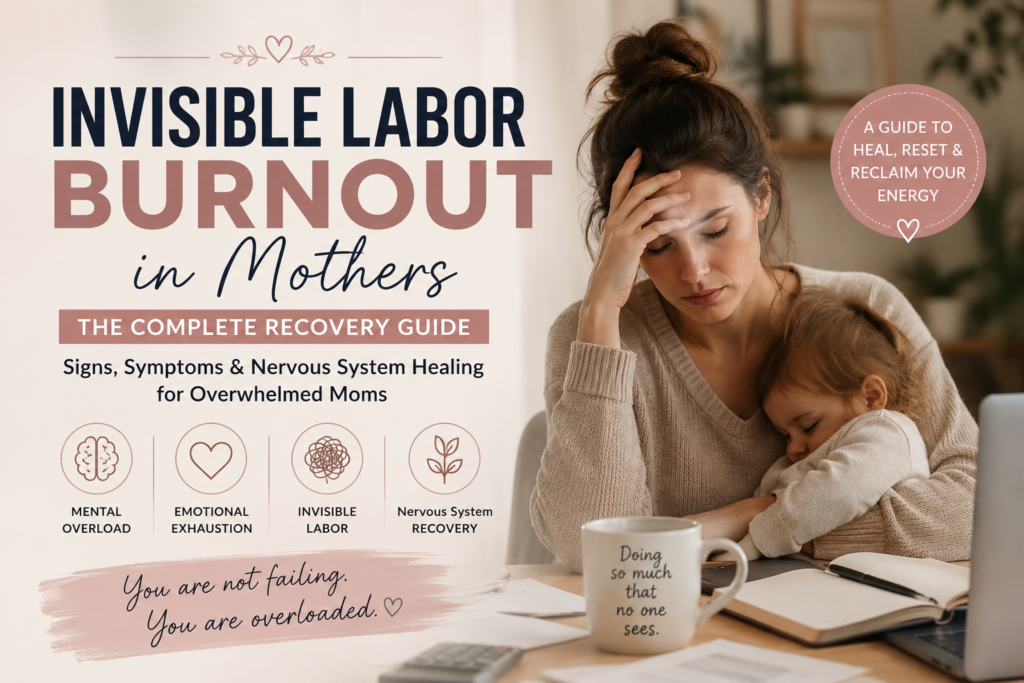
Overwhelmed mother experiencing invisible labor burnout and emotional exhaustion while caring for a child, illustrating mental load, nervous system overload, and burnout recovery.

Invisible Labor Burnout in Mothers: Signs, Symptoms & Recovery Guide

Invisible Labor Burnout in Mothers: The Complete Recovery Guide Many mothers experience invisible labor burnout without realizing it. Invisible labor refers to the mental load, emotional labor, planning, remembering, and caregiving responsibilities that often go unseen. Over time, this hidden workload can contribute to emotional exhaustion, chronic stress, nervous system overload, and burnout in overwhelmed moms. Invisible Labor Burnout in Mothers: The Complete Recovery Guide If you feel exhausted before the day even begins, struggle to switch off mentally at night, or carry a constant sense of responsibility for everyone around you, you are not alone. Many overwhelmed mothers are experiencing a form of burnout that often goes unrecognized: invisible labor burnout. Invisible labor refers to the mental load, emotional labor, planning, remembering, organizing, anticipating needs, and managing responsibilities that keep families functioning every day. While much of this work goes unseen, its impact on a mother’s emotional well-being, stress levels, and nervous system can be significant. Over time, carrying invisible labor without adequate support can lead to emotional exhaustion, chronic stress, mental overload, decision fatigue, and symptoms commonly associated with mom burnout. Many mothers begin to feel overwhelmed, overstimulated, and emotionally drained without fully understanding why. The good news is that burnout recovery is possible. Understanding how invisible labor affects the mind and nervous system is the first step toward healing. In this guide, you’ll learn what invisible labor is, the hidden signs of invisible labor burnout in mothers, how chronic mental load impacts the nervous system, and practical recovery strategies that help overwhelmed moms feel calmer, lighter, and more supported. This article is designed to help you move from survival mode toward sustainable emotional recovery—one small step at a time. What Is Invisible Labor? Invisible labor is the unseen work that keeps a household, family, and daily life running smoothly. Unlike physical tasks that people can easily observe, invisible labor happens largely behind the scenes. It includes the constant planning, remembering, organizing, anticipating needs, managing schedules, and carrying the emotional responsibility for everyone else’s well-being. For many mothers, invisible labor becomes such a normal part of daily life that it is rarely recognized as work at all. Yet over time, this hidden workload can contribute significantly to stress, emotional exhaustion, mental overload, and burnout. Understanding invisible labor is often the first step toward understanding why so many overwhelmed mothers feel exhausted even when they never seem to stop doing things for everyone around them. The Work Nobody Sees When people think about work, they often picture visible tasks such as cooking dinner, cleaning the house, doing laundry, driving children to activities, or helping with homework. While these responsibilities certainly require time and energy, they represent only part of the workload many mothers carry. Invisible labor includes the mental effort behind those tasks. Examples of invisible labor include: Remembering medical appointments Tracking school schedules and deadlines Planning meals for the week Monitoring household supplies Managing family calendars Anticipating children’s emotional needs Remembering birthdays and special events Coordinating childcare arrangements Keeping track of unfinished responsibilities This constant mental tracking often continues even during moments that appear to be rest. A mother may be sitting quietly on the couch while simultaneously running through tomorrow’s schedule, worrying about upcoming obligations, or mentally organizing household responsibilities. Because invisible labor happens internally, it is frequently overlooked by others. Yet the cognitive and emotional effort involved can be just as demanding as physical work. Mental Load vs Physical Tasks One of the most important distinctions to understand is the difference between the mental load and physical tasks. Physical tasks involve doing something visible: Washing dishes Folding laundry Preparing meals Driving children to school Cleaning rooms The mental load involves everything required to make those tasks happen: Remembering what needs to be done Deciding when it should happen Anticipating future needs Monitoring unfinished responsibilities Managing competing priorities Many mothers are not only completing physical tasks but also carrying responsibility for planning and coordinating them. This ongoing mental load can create a state of constant cognitive activity. The brain remains alert, scanning for potential problems, unfinished tasks, and future demands. Over time, this can contribute to decision fatigue, overwhelm, and chronic stress. Why Mothers Carry More Invisible Labor Although every family is different, research and lived experience consistently show that mothers often carry a disproportionate share of invisible labor. Many mothers become the default managers of household life. They remember appointments, anticipate needs, coordinate schedules, track responsibilities, and maintain emotional awareness for multiple family members at once. This role can develop gradually over time. Small responsibilities accumulate until one person becomes responsible for remembering nearly everything. As invisible labor increases, the nervous system may begin operating in a prolonged state of vigilance. Instead of experiencing regular periods of recovery, the brain remains focused on monitoring responsibilities and preparing for the next demand. This is where invisible labor becomes more than a productivity issue—it becomes a nervous system issue. When the mind is constantly tracking, anticipating, remembering, and managing, true rest becomes difficult. The nervous system receives fewer signals of safety and recovery, increasing the risk of emotional exhaustion, mental overload, caregiver burnout, and chronic stress. Understanding invisible labor is not about assigning blame. It is about recognizing a hidden burden that many overwhelmed mothers carry every day. Once that burden becomes visible, recovery becomes far more possible. The Hidden Signs of Invisible Labor Burnout Invisible labor burnout does not always look the way people expect. Many articles focus on physical exhaustion, but burnout in mothers often begins emotionally and mentally long before it becomes physically visible. A mother can continue caring for her family, meeting responsibilities, and functioning day-to-day while quietly experiencing emotional exhaustion, chronic mental overload, and nervous system strain. Because these symptoms develop gradually, they are often dismissed as normal stress or simply part of motherhood. Recognizing the hidden signs of invisible labor burnout is an important step toward recovery. Emotional Exhaustion One of the most common burnout symptoms in mothers is emotional exhaustion.

Motherhood Burnout Recovery

Invisible Labor Burnout in Mothers: Signs, Symptoms & Recovery Guide Read Post »

Morning Routine for Mental Clarity and Focus

Morning Routine for Mental Clarity and Focus (Stop Overthinking Fast). Learn how to reduce mental noise, stop overthinking, and start your day with a calm, clear mind using simple daily habits. Your mornings decide your focus. Not your motivation. Most people wake up and immediately overload their mind.As a result, overthinking starts early. However, a simple morning routine can change this. When your mind starts calm, everything feels easier. WHY YOUR MIND FEELS NOISY IN THE MORNING Your brain carries unfinished thoughts from the night. At the same time, new inputs begin immediately: phone notifications decisions Because of this, mental noise increases quickly. As a result: focus drops clarity disappears overthinking continues HOW A MORNING ROUTINE IMPROVES MENTAL CLARITY A structured routine reduces decision fatigue. Instead of reacting, your mind follows a pattern. Because of this: thoughts slow down attention improves stress reduces Over time, your brain learns: 👉 mornings = calm + control SIMPLE MORNING ROUTINE FOR FOCUS AND CLARITY 1. Avoid Instant Input Do not check your phone immediately. Instead, give your mind a few minutes of silence. This prevents early mental overload. 2. Slow Your Breathing Start with controlled breathing. For example: inhale slowly exhale gently As a result, your nervous system relaxes. 3. Keep Your Environment Calm Your surroundings affect your thoughts. A clean, minimal space reduces distraction. 👉 (Insert image here) Caption:A calm morning environment supports mental clarity and reduces overthinking. 4. Use a Simple Mental Reset Guide your thoughts instead of letting them run. For example: repeat a calming phrase focus on stillness Even so, consistency matters more than perfection. 5. Follow a Fixed Routine Your brain responds to repetition. When you follow the same steps daily: 👉 focus improves faster 💡 SIMPLE TOOL THAT HELPS  A small external support can improve your routine. For example, calming background sound can reduce mental noise and help your brain settle into a focused state. 👉 white noise machine for better focus and calm mornings Affiliate Disclosure:Some links in this article may be affiliate links. This means we may earn a small commission if you choose to make a purchase, at no additional cost to you.   WHY THIS WORKS This routine reduces cognitive load. Instead of reacting to stimuli, your brain follows a structure. As a result: decisions feel easier thoughts slow down clarity improves naturally                                                                                                                                                                This morning routine for mental clarity helps reduce overthinking, improve focus, and create a calm mind using simple daily habits For best results: 👉 Combine this with your night routine to reduce overthinking and improve sleep quality. 👉 Use a calm environment setup to support focus and reduce mental noise throughout the day. ❓ FAQ SECTION What is the best morning routine for mental clarity? A simple routine that avoids distractions, includes breathing, and maintains a calm environment works best. Can a morning routine reduce overthinking? Yes. A structured routine reduces mental noise and helps your brain focus on fewer inputs. How long does it take to see results? Most people notice small changes within a few days. However, consistent practice creates stronger results. Affiliate Disclosure:Some links in this article may be affiliate links. This means we may earn a small commission if you choose to make a purchase, at no additional cost to you. We only reference products that align with the topic and are presented for informational purposes.

Anxiety & Nervous System, Mental Clarity & Productivity, Mindset & Subconscious Psychology

Morning Routine for Mental Clarity and Focus Read Post »

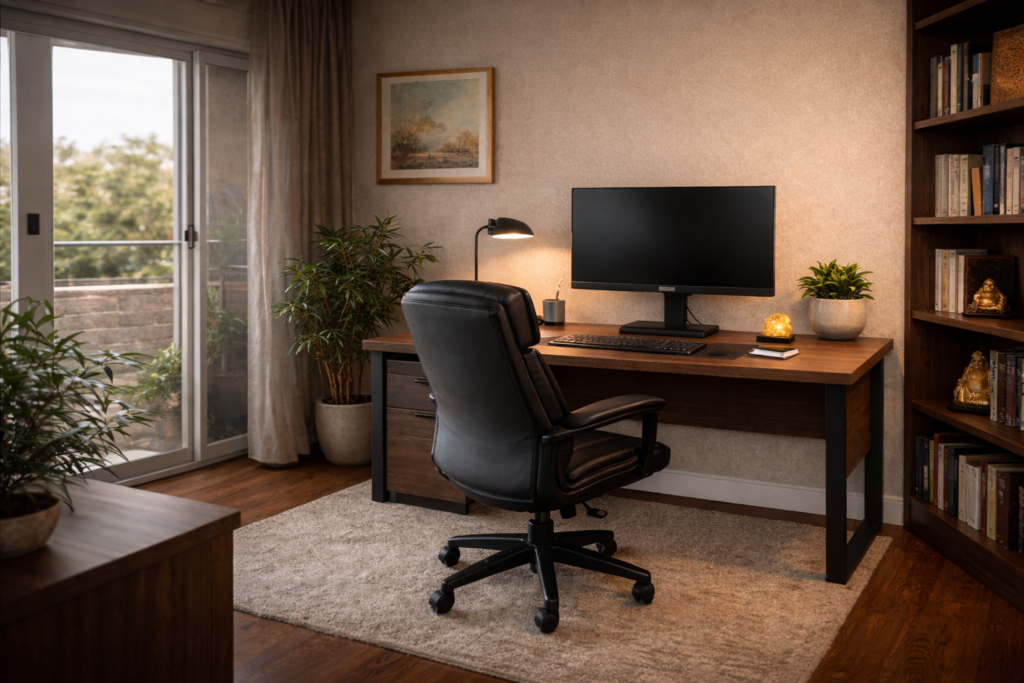
Feng Shui for career stability in India showing north-facing desk with solid wall backing in small apartment home office

The 1-Inch Shift: Small Desk Changes That Create Big Confidence and Income Results

The 1-Inch Shift: Small Desk Changes That Create Big Confidence and Income Results Small desk changes for confidence can improve posture, executive presence, and focus. Even a one-inch shift in desk angle or chair placement influences stability, tone, and authority during remote work. Most professionals think they need a full office redesign. They do not. Often, a one-inch adjustment changes how the body feels in the space. And how the body feels affects how you lead. This article focuses on small desk changes for confidence. Not renovation. Not decoration. Micro-adjustments. Because confidence is not always about motivation. Sometimes it is about angle. Why Micro-Adjustments Matter More Than Renovations   Large changes feel dramatic. However, the nervous system responds faster to subtle shifts. When your desk angle changes slightly, your perception of control changes. When your chair moves closer to a wall, stability increases. Small inputs. Measurable outputs. Environmental psychology shows that humans adapt quickly to spatial cues. Therefore, minor adjustments often produce immediate behavioral shifts. You do not need a new office. You need precision. The 1-Inch Angle Shift   If your desk sits parallel to the wall, try rotating it slightly toward the entrance. Not fully. Just enough to widen your field of view. This small desk change for confidence increases spatial awareness. When you can see more of the room, tension reduces. Reduced tension improves posture. Improved posture strengthens presence. Presence affects opportunity. The 3-Inch Backing Adjustment   Move your chair closer to a solid wall. Even three inches matter. When the back feels supported, the shoulders relax. Relaxed shoulders improve breathing. Breathing affects tone. Tone affects leadership perception. This adjustment costs nothing. Yet it alters authority signals. Raise the Monitor by One Inch   Eye level matters. If your screen sits too low, you look down during calls. Looking down reduces perceived confidence. Raise the monitor slightly so your gaze aligns naturally with the camera. Aligned gaze increases credibility. This is camera psychology. Not Feng Shui mythology. Clear 20% of Surface Area   Do not remove everything. Remove 20%. That small reduction creates visible negative space. Negative space signals order. Order signals control. Control increases confidence. This is not about minimalism trends. It is about cognitive signaling. Add One Vertical Element   Confidence is reinforced by vertical lines. Add a tall lamp. Or a narrow bookshelf. Or a vertical framed print. Vertical structure stabilizes the visual field. Stability reinforces grounded posture. Grounded posture reinforces authority. Adjust Lighting Direction   Lighting behind you creates silhouette instability. Shift your light source slightly forward or to the side. Balanced lighting improves facial clarity. Facial clarity increases trust. Trust increases professional opportunities. This is practical positioning. The 5-Minute Micro Audit   Before buying anything, test this: • Rotate desk slightly• Move chair closer to wall• Raise monitor• Remove 20% surface clutter• Adjust light angle Observe how your body feels. If posture improves, keep it. If not, adjust again. Micro-testing creates personalized optimization. India-Specific Application   In 1 BHK or 2 BHK apartments, space is tight. That is why micro-adjustments matter more. You may not move walls. But you can shift angles. You may not buy new furniture. But you can reposition. Small apartments amplify instability. Precision restores it. The Compound Effect of Small Desk Changes   A one-inch shift seems minor. However, repeated daily posture reinforcement compounds. Confidence becomes embodied. Embodied confidence changes how you speak. Speech changes perception. Perception changes opportunity flow. This is environmental leverage. Not decoration. Continue the Executive Workspace Series   Your workspace shapes your posture, presence, and professional performance. If you want to build a complete high-authority environment, continue with the full Executive Workspace Series:   1. The Invisible Script Learn how environmental psychology of the home office influences daily decisions, focus patterns, and behavioral momentum. This foundation explains how space quietly shapes habits and executive thinking.→ Read: How Your Home Environment Shapes Habits and Decisions   2. Desk Setup for Confidence (The Wealth Wall) Discover how physical backing, vertical stability, and command position placement strengthen authority, posture, and leadership presence during remote work.→ Read: Desk Setup for Confidence: The Wealth Wall Strategy   3. Feng Shui for Wealth & Focus (Hub Guide) Explore the complete framework connecting environmental psychology, workspace structure, and financial opportunity. This guide integrates focus, stability, and strategic spatial design into one cohesive system.→ Read: Feng Shui for Wealth & Focus: How Your Space Shapes Money, Work, and Opportunity   Small structural shifts create measurable professional impact. Build your environment deliberately.Then let your performance follow.   Conclusion: Precision Over Renovation   You do not need dramatic change. You need intentional calibration. Small desk changes for confidence influence posture, tone, and authority. And those influence career outcomes. Adjust your space. Then observe your presence. FAQ: Small Desk Changes for Confidence   Can small desk adjustments really change confidence? Yes. Minor changes influence posture and visual stability. Posture directly affects breathing and tone, which shape perceived authority.   How much should I rotate my desk? Even a slight diagonal shift toward the entrance improves spatial awareness. Avoid dramatic repositioning unless necessary.   What is the fastest change I can test? Move your chair closer to a wall and raise your monitor to eye level. These produce immediate posture improvements.   Do I need to buy new furniture? No. Start with repositioning existing elements. Purchase only if structural support is missing. Disclaimer: The content on Mind Boggling Studio is for informational and educational purposes only. Feng Shui results are highly personal and are not guaranteed to produce specific financial or life outcomes. Any wellness recommendations, such as weighted eye masks or mindset tools, are not a substitute for professional medical or psychological advice. Always consult with a qualified professional before beginning new health or lifestyle routines.

Feng Shui & Environmental Psychology, Home Office Optimization

The 1-Inch Shift: Small Desk Changes That Create Big Confidence and Income Results Read Post »

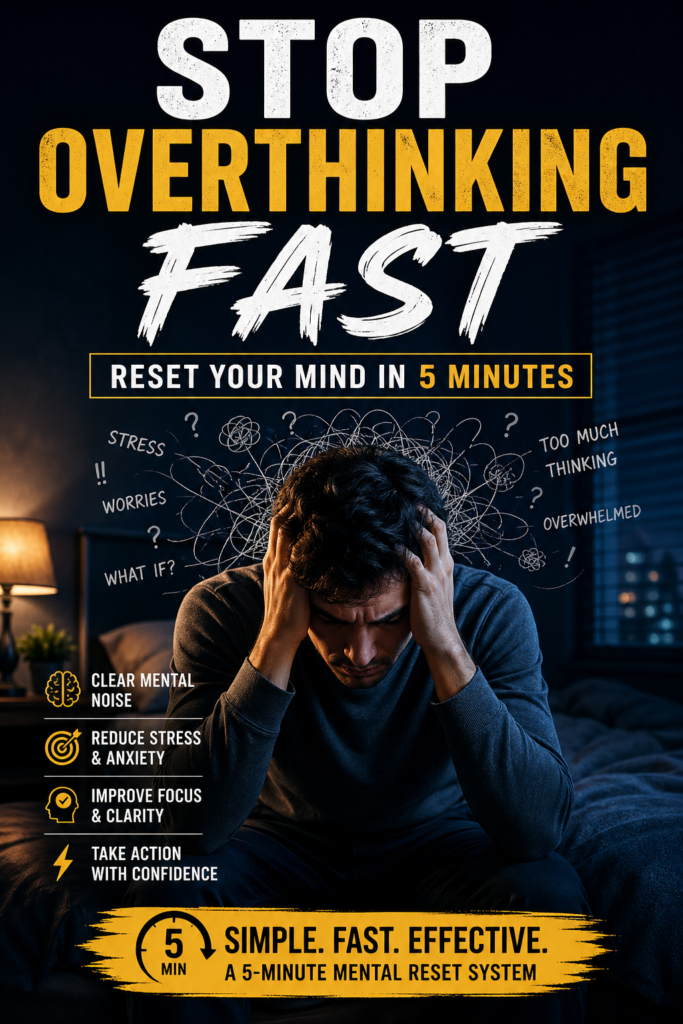
how to stop overthinking fast using a 5 minute mental reset system

How to Stop Overthinking Fast (5-Minute Mental Reset System)

Learn how to stop overthinking fast with a simple 5-minute mental reset system. Clear your mind, reduce stress, and regain control instantly. How to Stop Overthinking Fast (5-Minute Mental Reset System) How to stop overthinking fast isn’t about thinking more—it’s about resetting your mind. If your thoughts feel constant, overwhelming, and exhausting… you’re not alone. Most people today are dealing with: Too many decisions Too many unfinished thoughts Too much mental noise You wake up thinking.You go through the day thinking.And at night… your mind won’t stop. And the usual advice—“just relax,” “stay positive,” or “clear your mind”—doesn’t work. Because the real problem isn’t overthinking. 👉 It’s mental overload. In this guide, you’ll learn a simple 5-minute mental reset system that helps you: Clear your mind instantly Reduce mental overload Stop overthinking loops Take action without hesitation Why You Can’t Stop Overthinking (And Why It’s Not Your Fault) Overthinking is often misunderstood. You’re not “thinking too much.”You’re trying to process too much at once. Your brain has a limited processing capacity. It’s designed to:👉 Process → decide → release But modern life forces it to:👉 Hold → analyze → repeat When that capacity is exceeded: Thoughts repeat Decisions get delayed Actions get avoided This creates mental loops. These loops are: Unfinished tasks Unresolved decisions Open emotional triggers Your brain keeps revisiting them because it hasn’t “closed” them. That’s why: You replay conversations You rethink decisions You feel mentally stuck 👉 Overthinking is not a thinking problem.👉 It’s a processing failure. The Real Problem: Mental Overload, Not Overthinking Most people try to fix overthinking by: Thinking harder Analyzing deeper Searching for perfect clarity This makes things worse. Because your brain doesn’t need more thinking. 👉 It needs less load. Mental overload happens when: You have too many priorities You haven’t made decisions You’re holding everything internally This creates: Decision fatigue Anxiety Constant mental noise And the more you try to “figure it out”…the more overwhelmed you feel. 👉 The solution isn’t thinking better.👉 It’s resetting your system. How to Stop Overthinking Fast (The 5-Minute Reset Method) This is where everything changes. Instead of trying to control your thoughts,you reset your mental system. This method works because it: Reduces cognitive load Closes mental loops Forces action Step 1: Clear the Mental Noise Start by getting everything out of your head. Write down: Tasks Worries Ideas Decisions Don’t organize it. Don’t filter it. Just empty your mind completely. 👉 This is called cognitive offloading. And it works instantly. Why? Because your brain stops trying to hold everything. You’ll feel: Lighter Calmer More focused Step 2: Focus on What Actually Matters Now look at what you wrote. Most of it isn’t urgent. Use this simple filter: Critical → Do today Important → Schedule Noise → Eliminate This step reduces pressure immediately. 👉 You don’t need more time.👉 You need fewer priorities. Step 3: Lock One Decision Overthinking thrives on indecision. So you remove it. Use this rule: 👉 If it won’t matter in 30 days, decide in 30 seconds. This eliminates: Delays Doubt Mental loops The goal isn’t perfection. 👉 It’s progress. Step 4: Take One Action This is the most important step. You don’t think more. 👉 You act. Even a small action: Send a message Start a task Make a decision Action breaks the loop. Thinking keeps it alive. How to Stop Overthinking Everything (When Your Mind Won’t Shut Off) Overthinking becomes intense in specific situations. Let’s break them down. When You Can’t Sleep at Night Your brain is replaying unfinished thoughts. Solution: 👉 Write everything down before bed. This signals closure. Your brain stops looping. When You Feel Stuck You’re waiting for clarity. But clarity doesn’t come from thinking. 👉 It comes from action. Start small. Movement creates direction. When You’re Overanalyzing Decisions You’re trying to find the perfect answer. That doesn’t exist. 👉 Choose the next step, not the final outcome. How to Reset Your Mind From Stress and Burnout Burnout is not laziness. It’s mental and emotional overload. Signs: Constant fatigue Low motivation Avoidance behavior Irritability Most people respond by:👉 Pushing harder This leads to:👉 More burnout The Correct Approach You don’t fix burnout with effort. 👉 You fix it with recovery. What works: Remove unnecessary tasks Reduce mental input Add recovery gaps Recovery restores control. Signs You’re Mentally Overloaded (Most People Miss This) You might be overloaded if: You feel busy but get nothing done You keep thinking about the same things You avoid making decisions Your mind feels constantly active You feel drained without physical effort This isn’t lack of discipline. 👉 It’s overload. The Daily Mental Reset Habit (How to Stay Consistent) This system works best when repeated daily. Here’s the loop: Offload everything Choose one priority Decide quickly Take one action That’s it. Simple. Repeatable. Effective. Over time, you’ll notice: Less mental noise Faster decisions More consistent action Real-Life Example  Let’s say your mind is full of: Work deadlines Messages to reply Personal tasks Financial worries You feel stuck. Instead of thinking more: You: Write everything down Choose one priority Decide what to do Take one action Within minutes:👉 Clarity returns👉 Stress drops👉 Movement begins Why This System Works (Psychology Breakdown) This method works because it targets: 1. Cognitive Load Reduces mental pressure 2. Open Loops Closes unfinished thoughts 3. Decision Fatigue Limits choices 4. Behavioral Activation Forces action 👉 It’s not mindset. 👉 It’s system design. Want a Simple System to Stop Overthinking Instantly? If you’re tired of feeling stuck in your own head… I built a simple system you can use anytime your mind feels overwhelmed. It takes less than 5 minutes. No complicated routines.No theory. Just a clear process to: Stop overthinking Clear your mind Take action instantly 👉 Get the full system here: Stop Feeling Overwhelmed—Fast (The 5-Minute Cognitive Reset System) Final Thought: Clarity Doesn’t Come From Thinking More Most people believe: “If I think long enough, I’ll figure it out.” But that’s not how clarity works. 👉 Clarity comes from

Anxiety & Nervous System, self improvement

How to Stop Overthinking Fast (5-Minute Mental Reset System) Read Post »

Fire Horse Feng Shui 2026 home office with lucky bamboo, wealth bowl, warm lighting, and balanced desk setup for financial growth

Fire Horse Year 2026 Feng Shui Guide: Build Real Wealth with East Sector Alignment

Fire Horse Feng Shui 2026 focuses on balancing strong fire energy with grounding elements while activating the East wealth sector. This year can bring wealth, transformation, or warning signals depending on your environment. Structured space reduces stress, improves focus, and supports consistent financial growth. Fire Horse Feng Shui 2026 requires balancing strong fire energy with grounding earth elements while activating the East wealth sector. Place your desk in command position, reduce visual heat (red/harsh light), and add one wood + one earth anchor to stabilize focus, improve decisions, and support consistent wealth growth. 2026 is fast. More visibility.More pressure.More decisions. As a result, most people will feel busy—but not stable. The Fire Horse Year has begun. And it is not subtle. Speed increases.Decisions accelerate.Patterns become visible. Instead of random outcomes, this year reveals patterns already present in your environment and behavior. The Problem: Why Your Space Is Blocking Wealth in 2026 Your environment is sending signals. Constantly. If your space has: • Harsh lighting• Excess red tones• Cluttered desk• No clear wealth anchor Then your brain shifts into reactive mode. Instead of strategic thinking, you respond to pressure. As a result: • You rush decisions• You lose consistency• You feel “busy but stuck” Fire energy amplifies this effect. The Three Outcomes of Fire Horse 2026 Most people will experience one of these three shifts. 1️⃣ Unexpected Wealth This shows up as: • Sudden opportunities• New income channels• Increased visibility However, without structure: Opportunity becomes overwhelm. 2️⃣ Powerful Transformation For some, this year is not about money. It is about: • Identity shifts• Career changes• Letting go of outdated systems Fire exposes what no longer works. As a result, adaptation becomes necessary. 3️⃣ A Warning You Can’t Ignore This appears as: • Burnout• Repeated mistakes• Financial inconsistency• Decision fatigue This is not bad luck. It is feedback. Your system is overloaded. The Explanation: Fire Horse Energy + East Wealth Sector In 2026: • Fire = speed, visibility, expansion• East sector = growth, wealth development (Wood element) Fire feeds on wood. But excess fire burns it. That is why balance is critical. Environmental Psychology Layer Your brain responds to: • Heat (light, color, stimulation)• Stability (structure, backing)• Flow (clear pathways) When heat is high without grounding: Stress increases.Focus drops.Decisions weaken. Over time, income consistency suffers. The First 7 Days Set the Tone The first week of this cycle matters. Not magically. Neurologically. Your brain builds: • Attention patterns• Decision rhythm• Work structure If the first 7 days are chaotic: The pattern repeats. If structured: Stability compounds. The Solution: 3 Low-Cost Adjustments (High Impact) 1️⃣ Activate the East Wealth Sector Locate the East area of your space. Then: • Add ONE healthy plant• Keep it clean and accessible• Avoid overcrowding Instead of adding more, remove friction. 2️⃣ Reduce Visual Heat Fire is already dominant in 2026. Do not amplify it. Adjust: • Replace harsh white light → warm-neutral• Reduce excessive red tones• Limit reflective clutter As a result: Your nervous system stabilizes. 3️⃣ Command Position Your Desk This is essential. • Face the entrance• Keep a solid wall behind• Avoid direct alignment with door If not possible: • Use a mirror• Use a high-back chair This improves: • Confidence• Decision quality• Authority perception A Simple Reset You Can Apply Today Start small. • Clear your workspace• Adjust lighting• Add one grounding element• Improve desk positioning Small changes create immediate stability. Fire Horse 2026 Mistakes to Avoid • Overusing red or bright lighting• Adding too many Feng Shui items• Ignoring desk placement• Cluttering the wealth corner• Mixing too many symbolic fixes Instead: Simplify.Stabilize.Then scale. 🎥 Watch: Fire Horse Year 2026 + Period 9 Feng Shui = the most powerful wealth energy in 20 years. ✨ https://youtu.be/hIp_5Rn1CLE Want to understand what this year is activating for you personally? Tap your zodiac sign to find out The first 7 days set the tone for your entire year 🧩 Supportive Tools (Optional) 🌿 Lucky Bamboo (East Sector Growth Anchor) Supports: • Growth mindset• Visual stability• Consistent progress 💡 Warm Desk Lamp (Fire Balance Tool) Supports: • Reduced eye strain• Balanced lighting• Lower fatigue Internal Linking 👉 Feng Shui for Wealth & Focus (Hub)👉 The Invisible Script: How Environmental Psychology of Your Home Office Shapes Success👉 The 1-Inch Shift: Small Desk Changes That Create Big Confidence and Income Results FAQ What is Fire Horse Feng Shui 2026? Fire Horse Feng Shui 2026 focuses on balancing strong fire energy with grounding elements while activating the East sector for stable wealth and focus. How do I activate the East wealth sector in 2026? Keep the East area clean, add one healthy plant, and avoid clutter to support growth without overwhelming the space. Can Feng Shui improve financial outcomes? Indirectly, yes. It improves focus, emotional control, and decision-making, which influence long-term financial results. What is the biggest mistake in Fire Horse year? Overstimulating the environment with excessive light, color, or objects, which increases stress instead of stability. Final Thought Fire Horse 2026 is not about luck. It is about exposure. What is stable will grow. What is weak will surface. Your environment decides which direction you move. Affiliate Disclosure Some of the links on this page may be affiliate links. This means that if you choose to make a purchase through these links, we may earn a small commission at no additional cost to you. These tools and products are shared as optional resources to support workspace clarity, environmental balance, and focus. They are not required, and results depend on individual habits, consistency, and decision-making. Disclaimer The information provided on this website is for educational and informational purposes only. Content related to Feng Shui, environmental psychology, mindset, and behavioral patterns is intended to offer general guidance on improving focus, clarity, and lifestyle structure. It should not be considered financial, legal, medical, or professional advice. We do not guarantee specific outcomes, including financial results, career growth, or personal success. Individual results vary based on personal circumstances, effort, and consistency. Readers are

Feng Shui · Wealth & Focus, Feng Shui & Abundance, Feng Shui & Environmental Psychology, Feng Shui for Indian Homes

Fire Horse Year 2026 Feng Shui Guide: Build Real Wealth with East Sector Alignment Read Post »

Blue Lighting Setup for Focus and Stress Reduction (Calm Your Mind Fast)

Blue lighting setup for focus and stress reduction. Learn how to create a calm environment, reduce mental noise, and improve productivity using simple lighting changes. Blue Lighting Setup That Improves Focus and Reduces Stress Your focus is not the problem. Your environment is. Most people try to push harder.However, their surroundings keep working against them. Lighting, in particular, plays a powerful role. Change the lighting—and your mental state begins to shift. HOW BLUE LIGHTING SETUP AFFECTS FOCUS AND STRESS Your brain constantly reacts to visual signals. Bright and harsh lighting increases stimulation.As a result, your mind stays active and restless. In contrast, softer lighting creates stability. Because of this: mental noise reduces attention improves stress levels decrease This is why a blue lighting setup for focus and stress reduction can be effective when used correctly. WHY BLUE LIGHTING CREATES A CALM ENVIRONMENT A controlled blue lighting setup helps reduce visual overload. Instead of multiple colors, a single tone creates consistency.At the same time, softer intensity prevents overstimulation. As a result: your environment feels calmer your thoughts become clearer distractions decrease naturally Therefore, the goal is not brightness—but balance. COMMON MISTAKES IN LIGHTING SETUP Many people try to improve focus, yet they unknowingly increase stress. For example, they use: very bright overhead lights mixed color temperatures too many light sources However, more light does not improve focus. In fact, it often increases visual pressure. SIMPLE BLUE LIGHTING SETUP FOR FOCUS AND STRESS REDUCTION 1. Reduce Harsh Overhead Lighting Start by lowering intensity. Instead of strong ceiling lights, use softer alternatives.This immediately reduces visual strain. 2. Add Soft Ambient Blue Lighting Next, introduce a gentle blue glow. It should not dominate the room.Rather, it should support the background. 3. Keep Your Environment Minimal Lighting works best in a clean space. Clutter increases cognitive load.Therefore, simplify your setup. For instance: remove unnecessary objects maintain consistent colors keep surfaces clean As a result, your mind processes less information. 4. Create a Consistent Focus Zone Your brain responds to repetition. When you use the same setup daily, it adapts faster.Because of this, focus becomes easier over time. SIMPLE UPGRADE THAT IMPROVES YOUR SETUP A small change can make a noticeable difference. For example, a controlled lighting source can: reduce visual stress improve mood support longer focus sessions 👉 calm ambient lighting setup for better focus and reduced stress WHAT RESULTS TO EXPECT At first, the change feels subtle. However, within a few days:👉 your mind feels less scattered Soon after:👉 focus becomes more stable Over time:👉 your environment begins to support your thinking WHY THIS METHOD WORKS This approach works because it reduces cognitive load. Instead of forcing discipline, it removes distractions.As a result: your brain processes less input decisions feel easier attention becomes more consistent Therefore, the improvement feels natural rather than forced. For stronger results: 👉 Combine this setup with a structured calm mind routine to improve daily focus and clarity. ❓ FAQ SECTION Does blue lighting improve focus? Yes. A controlled blue lighting setup can reduce visual noise and support concentration when used with low intensity. Can lighting reduce stress? Yes. Softer, consistent lighting helps signal calm and reduces overstimulation in the brain. What is the best lighting setup for productivity? A minimal setup with soft ambient lighting works best. It reduces distractions and supports mental clarity. 1. General Information The content on this website is intended to provide insights related to: Mindset and personal growth Behavioral psychology Environment and lifestyle improvements (including Feng Shui concepts) We do not make any guarantees about the completeness, reliability, or accuracy of this information. Affiliate Disclosure:Some links in this article may be affiliate links. This means we may earn a small commission if you choose to make a purchase, at no additional cost to you. We only reference products that align with the topic and are presented for informational purposes.

Environment & Focus

Blue Lighting Setup for Focus and Stress Reduction (Calm Your Mind Fast) Read Post »

Night Routine That Stops Overthinking and Improves Sleep (Calm Your Mind Fast)

Night routine to stop overthinking and improve sleep. Learn how to calm your mind at night, reduce stress, and improve sleep quality with a simple routine designed for mental clarity and recovery. Night routine to stop overthinking and improve sleep is not about forcing your mind to be quiet. It’s about creating the right conditions for your brain to slow down naturally. If your mind becomes more active at night instead of calmer, you’re not alone. Your thoughts repeat.Scenarios build.Sleep gets delayed. However, this is not random. 👉 It’s a pattern.👉 And patterns can be changed. WHY OVERTHINKING HAPPENS AT NIGHT During the day, your brain stays occupied.At night, however, it begins to process everything. Because of this shift: unresolved thoughts surface mental noise increases emotional loops repeat As a result, your mind remains active when it should be resting. SIGNS YOU’RE OVERTHINKING AT NIGHT You may not always realize it, but overthinking at night often shows up in patterns like: replaying the same thoughts repeatedly feeling tired but mentally active difficulty falling asleep despite exhaustion constant mental “what if” scenarios waking up in the middle of the night thinking 👉 These are not sleep problems.👉 They are signs of mental overload. WHY THIS AFFECTS YOUR SLEEP Poor sleep is not just about feeling tired.In fact, it directly affects how you think and act. For example: focus becomes inconsistent decisions feel harder emotional control weakens Over time, this creates a loop. 👉 overthinking → poor sleep → low focus → more overthinking WHAT MAKES OVERTHINKING WORSE AT NIGHT Certain habits amplify mental noise before sleep: excessive screen time unresolved tasks late-night decision making emotional stress without release Because of this, your brain remains active when it should slow down. 👉 Reducing these triggers is the first step to improving sleep. THE FIX: SHIFT YOUR ENVIRONMENT FIRST You don’t need to force sleep. Instead, you need to reduce stimulation. At the same time, your environment should signal calm. When both change together, your brain receives a clear message: 👉 it’s safe to slow down NIGHT ROUTINE TO STOP OVERTHINKING AND IMPROVE SLEEP 1. Reduce Input Before Bed Start by limiting stimulation 30–60 minutes before sleep. This includes: scrolling heavy thinking constant noise Instead, shift to: dim lighting quiet surroundings As a result, your brain begins to disengage. 2. Create a Calm Sleep Environment Your surroundings influence your mental state more than you think. A minimal setup helps: reduce visual stress improve relaxation support deeper sleep 3. Support Physical Relaxation Your body also needs signals to unwind. For instance, a simple sleep setup can: reduce discomfort support relaxation improve sleep quality A comfortable pillow setup can significantly improve how quickly your body relaxes.👉 adjustable memory foam pillow that supports proper alignment and reduces nighttime discomfort 4. Use a Simple Mental Reset Instead of letting thoughts run freely, guide them. You can: slow your breathing repeat a calming phrase focus on stillness Even so, consistency matters more than perfection. Over time, this reduces cognitive overload. guided brainwave audio programs that help calm your mind and reduce overthinking MENTAL RESET VS NIGHT ROUTINE (IMPORTANT DIFFERENCE) A night routine prepares your environment. A mental reset prepares your mind. You need both. Routine → reduces external stimulation Reset → reduces internal noise When combined, your brain receives a clear signal to relax. COMMON MISTAKES THAT KEEP YOU STUCK Many people unintentionally make overthinking worse: trying to force sleep overanalyzing thoughts staying on screens too long expecting instant results Because of this, the cycle continues. 👉 The goal is not control—it’s reduction. A QUICK 2-MINUTE RESET YOU CAN TRY TONIGHT Before you sleep: Write down everything on your mind Choose one thing for tomorrow Take a slow breath and let the rest go 👉 This small shift can immediately reduce mental noise. WHAT TO EXPECT OVER TIME At first, changes may feel subtle. However, within a few days:👉 your mind begins to slow down faster After about a week:👉 sleep feels deeper and more stable As a result, your focus improves naturally during the day. WHY THIS ROUTINE WORKS This routine works because it targets the root cause. Specifically, it: reduces cognitive load creates safety signals in the brain builds consistent patterns Because of this, your mind learns to relax without effort. WANT A FASTER WAY TO CALM YOUR MIND? If your mind still feels active even after improving your routine, the issue may be mental overload. You may need a structured system to reset your thoughts. 👉 A simple 5-minute mental reset method can help you clear your mind instantly and regain control. 👉 Get the full system here: Stop Feeling Overwhelmed—Fast (The 5-Minute Cognitive Reset System) If you want stronger results, combine this with a daily system. 👉 A structured calm mind routine can improve focus and clarity throughout the day. FREQUENTLY ASKED QUESTIONS (HOW TO STOP OVERTHINKING AT NIGHT) What causes overthinking at night?Overthinking happens when the brain processes unresolved thoughts without distraction. How can I calm my mind before sleep?Reducing input, improving your environment, and following a simple routine helps your mind slow down. Why does my brain think more at night?At night, distractions decrease, allowing unresolved thoughts to surface. How long does it take to see results?Most people notice improvements within a few days, but consistency creates lasting change. Affiliate Disclosure:Some links in this article may be affiliate links. This means we may earn a small commission if you choose to make a purchase, at no additional cost to you. We only reference products that align with the topic and are presented for informational purposes. Disclaimer:This article is for educational and informational purposes only. Feng Shui symbols and placement suggestions are discussed from a psychological and environmental perspective. They are not guarantees of financial or business outcomes and should not replace professional, financial, or business advice.

Anxiety & Nervous System

Night Routine That Stops Overthinking and Improves Sleep (Calm Your Mind Fast) Read Post »

7 Day Calm Mind Routine for Focus and Productivity (Stop Overthinking Fast)

Overthinking is not just a mental habit.It is a performance problem. Most people try to fix focus using discipline.However, focus is rarely the real issue. Instead, mental noise is what creates the problem. When your mind is overloaded: decisions slow down distractions increase energy drops quickly As a result, even simple tasks begin to feel heavy. Here’s the shift: 👉 A calm mind creates clarity👉 Clarity improves decisions👉 Better decisions improve results That is exactly what this 7 day calm mind routine for focus and productivity is designed to do. Instead of forcing productivity, it removes what blocks it. At first, thinking more feels useful.However, it often creates more friction. The brain is not designed for constant input.Because of this, it shifts into a stress-driven loop. As a result: focus becomes inconsistent tasks feel harder avoidance increases More importantly, decision quality drops over time. So the goal is not to think more.It is to think clearly and intentionally. Clarity changes how you act. When your mind is calm: decisions become faster actions feel lighter consistency improves On the other hand, stress leads to hesitation and impulsive choices. This is why mental state matters more than motivation. This is where most people get productivity wrong. They chase motivation.Yet performance is driven by mental state. A calm internal state supports: better judgment long-term thinking stable progress Including better financial decisions over time. The 7 Day Calm Mind Routine for Focus and Productivity This system is intentionally simple. Instead of adding complexity, it removes friction. Each step is designed to be: easy to follow low effort repeatable Over time, these small changes create a stable mental state. Day 1 – Reduce Mental Noise Start by cutting unnecessary input. Limit: excessive scrolling random content constant notifications Less input creates more clarity. Day 2 – Improve Sleep Quality Sleep directly affects focus. Before bed: reduce screen exposure dim your environment slow your mental pace Better sleep stabilizes your mind. Day 3 – Create a Calm Environment (Blue Setup) Your environment affects your brain faster than willpower. A calm environment setup for focus and productivity should feel: minimal controlled visually soft Many people find that a blue aesthetic routine for calm mind helps reduce stimulation. Even small changes can shift your state quickly. Day 4 – Focus Reset Habit Introduce a short reset period. 5–10 minutes no phone no input This trains your brain to pause instead of react. Day 5 – Reduce Distractions Distractions are not always external. Simplify your space: fewer objects cleaner layout defined work area Clarity outside supports clarity inside. Day 6 – Mental Clarity Routine Create a simple structure: one priority task one focused session one intentional break A simple routine for mental clarity prevents overload. Day 7 – Build Consistency Consistency matters more than intensity. Repeat what works.Remove what doesn’t. Over time, your mind becomes naturally calm. Simple Habits That Keep Your Mind Calm Daily Long-term clarity comes from small actions. For example: starting your day without noise limiting multitasking taking intentional pauses At the same time, consistency matters more than intensity. Because of this, simple habits work better than complex systems. Tools That Make This Routine Easier to Follow You don’t need to change everything at once. However, even one small upgrade can reduce mental noise significantly. While the routine works on its own, certain tools make it easier to stay consistent. Some of the links on this page are affiliate links. This means that if you choose to make a purchase, I may earn a small commission at no additional cost to you. These recommendations are based on research and are intended to support your experience. 1. Calm Environment Setup (Lighting) A busy environment keeps your brain active. Soft ambient lighting helps signal your mind to slow down. 👉 Many people improve focus quickly by using a simple calm ambient lighting setup that reduces visual stress. A simple lighting upgrade can: reduce visual stress improve focus duration create a calm atmosphere 👉 Even a small change in your lighting can instantly make your space feel more controlled and less These tools are not required. However, they make the routine easier to follow and more consistent 2. Sleep Support (Night Reset) Most overthinking begins at night. A better sleep setup can: reduce mental restlessness improve recovery support next-day focus 👉 This is why many people rely on a simple sleep support setup to calm their mind faster at night. Small changes here create noticeable impact. 👉 Even a small upgrade in your sleep environment can make it easier to stop overthinking and fall asleep faster  3. Focus Tools (Noise Control) Removing noise helps your brain settle faster. Focus tools can: block distractions improve deep work support attention control 👉 Many people use noise-reducing focus tools to create a distraction-free environment without extra effort. This directly supports your Day 5 habit. 👉 Reducing background noise often leads to immediate improvements in concentration and mental clarity  4. Workspace Setup (Clarity Environment) Your workspace reflects your mental state. A clean setup can: reduce friction improve posture increase focus time 👉 A minimal and ergonomic workspace setup can make it easier to stay focused for longer periods without mental fatigue. Even small adjustments make a difference. 👉 Upgrading just one part of your workspace can noticeably improve how you think and work throughout the day  5. Optional Calm Ritual (Daily Reset) Small rituals help your brain transition into a calmer state. While not required, adding a simple daily ritual can make it easier to stay consistent with this routine. For example: a calming tea a quiet moment before bed a short reset during the day 👉 Many people use a simple calming tea ritual to signal their mind to slow down naturally. These small cues help your brain associate certain moments with relaxation. 👉 Even a 5-minute calming ritual can reduce mental noise and make it easier to stay focused throughout the day  👉 You don’t need everything listed here. Even one small change can make a

Mental Clarity & Productivity

7 Day Calm Mind Routine for Focus and Productivity (Stop Overthinking Fast) Read Post »

7 horse painting vastu direction placed on south wall in modern Indian office for career growth

7 Horse Painting for Career Growth in Indian Offices (Vastu Direction & Placement Guide)

7 Horse Painting for Career Growth in Indian Offices (Vastu Direction & Placement Guide) The 7 horse painting vastu direction for career growth recommends placing seven running horses on the south or east wall of an office, facing inward. When aligned correctly, the painting reinforces visual momentum, leadership identity, and professional consistency in Indian office and work-from-home setups. The 7 horse painting vastu direction is one of the most searched career-related Feng Shui topics in India. When placed correctly in an office or work-from-home setup, the seven running horses symbol reinforce momentum, leadership energy, and forward movement. However, incorrect placement quietly weakens its effect. This is not about superstition. It is about visual momentum and environmental psychology. Your brain responds to movement. It responds to direction. And repeated visual cues shape professional identity. This guide explains: • Correct wall placement• Ideal direction• Office vs home office rules• North-facing flat adjustments• Common mistakes• Why seven horses — not six or eight Why the 7 Horse Painting Is Linked to Career Growth In traditional symbolism, horses represent speed, strength, stamina, and victory. Seven is associated with completion and balanced movement. But psychologically, the reason this works is simpler: Running horses represent forward motion. Forward motion reduces stagnation thinking. Stagnation thinking reduces career confidence. When placed intentionally, the 7 running horse painting becomes a visual cue for: • Progress• Authority• Direction• Consistency The brain associates repeated imagery with identity. Identity influences action. Best Direction for 7 Horse Painting (Vastu + Practical Logic) Search volume in India heavily focuses on: “7 horse painting vastu direction” Here is the practical breakdown: ✅ South Wall (Facing North) Most recommended for career growth. Why? South represents recognition and visibility in many traditional frameworks. Facing north symbolizes incoming opportunity. ✅ East Wall (Facing West) Good for growth and new beginnings. Best for entrepreneurs and freelancers. ⚠️ Avoid North Wall Facing South This may symbolically indicate energy moving away. Even psychologically, forward movement should face inward — not outward. Structured Placement Rule (Simple Version) • Horses must run inside the room — not toward a door or window• Avoid placing in bedroom• Avoid behind you in workspace• Avoid broken or distressed images• Ensure all 7 horses are visible Partial imagery weakens symbolic clarity. Clarity improves reinforcement. 7 Horse Painting in Office vs Work From Home (India Context) Indian offices often have: • Limited wall space• Shared cabins• Glass partitions If placing in corporate office: • Use framed canvas• Position in front wall• Keep at eye level For home office: • Place above main desk sightline• Not directly above head• Maintain clean surrounding space If working from 1BHK: • Use smaller size• Avoid cluttered gallery walls• Let it remain focal point Small apartments amplify visual impact. Psychological Impact: Why Running Horses Improve Focus Movement images increase alertness. Research in environmental psychology shows that dynamic imagery increases cognitive activation. When your mind sees motion, it primes readiness. Readiness improves follow-through. Follow-through improves career stability. This is not mystical. It is visual conditioning. For deeper behavioral explanation, read:👉 The Invisible Script: How Your Environment Shapes Habits Common 7 Horse Painting Mistakes (High CTR Section) • Placing in bedroom• Facing outward toward main door• Hanging too high• Using cheap pixelated prints• Choosing abstract unclear horses• Mixing with too many other symbols The image must feel strong, clear, and forward. Confused imagery creates cognitive friction. North-Facing Office? Here’s What To Do Many Indian flats are north-facing. If your office wall orientation limits south placement: • Use east-facing wall instead• Ensure horses move toward interior• Keep lighting balanced Direction matters less than forward alignment. Forward alignment matters more than compass. What Size 7 Horse Painting Is Ideal? Too small → loses visual authority.Too large → dominates aggressively. Ideal range for office: • 24 to 36 inches width• Eye-level placement• Horizontal orientation preferred Proportion matters. Balance improves integration. Laughing Buddha (Hotei with Gold) The Laughing Buddha represents contentment, optimism, and emotional abundance. In Feng Shui, it is associated with easing financial anxiety and reinforcing a positive relationship with success. From a behavioral perspective, symbols of joy reduce stress-driven decision making, helping the mind approach work and opportunity with calm confidence. 👉 Explore this Feng Shui support item Can 7 Horse Painting Really Improve Career? Directly? No. Indirectly? Yes. It improves: • Momentum thinking• Visual reinforcement of growth• Identity alignment• Confidence cues Career growth comes from: • Consistency• Visibility• Communication• Decision-making Environmental cues influence all four. For full wealth framework: 👉 Feng Shui for Wealth & Focus (Main Hub)👉 Feng Shui Dragon Placement for Career Authority👉 Desk Setup for Confidence (Wealth Wall)👉 Feng Shui for Career Stability in Indian Offices 7-Step Quick Setup Checklist Choose clear 7-horse artwork Confirm all horses visible Select south or east wall Ensure horses run inward Hang at eye level Keep surrounding space uncluttered Review lighting balance Simple rules outperform complex rituals. FAQ  What is the correct vastu direction for 7 horse painting? South wall facing north is commonly recommended for career visibility and recognition. Can I place 7 horse painting in bedroom? It is not recommended. Bedrooms are for rest, not momentum symbols. Is 7 horse painting good for north-facing flats? Yes, but ensure horses move toward interior space and maintain balanced lighting. How many horses should be in the painting? Exactly seven. Partial or unclear horses weaken symbolic clarity. Can freelancers use 7 horse painting at home? Yes. It works well in work-from-home setups when placed in front-facing wall. Disclosure: As an Amazon Associate, I earn from qualifying purchases. This post contains affiliate links for products I recommend for your wellbeing. If you click and buy through these links, I may receive a small commission at no extra cost to you. Disclaimer: The content on Mind Boggling Studio is for informational and educational purposes only. Feng Shui results are highly personal and are not guaranteed to produce specific financial or life outcomes. Any wellness recommendations, such as weighted eye masks or mindset tools, are not a substitute for professional

Feng Shui · Wealth & Focus

7 Horse Painting for Career Growth in Indian Offices (Vastu Direction & Placement Guide) Read Post »

Feng Shui for career stability in India showing north-facing desk with solid wall backing in small apartment home office

Global Ambition, Local Peace: Feng Shui for Career Stability in Indian Offices & WFH Setups

Global Ambition, Local Peace: Feng Shui for Career Stability in Indian Offices & WFH Setups Feng Shui for career stability in India combines Vastu direction principles with environmental psychology. Proper desk placement, solid backing, and visual balance reduce stress signals and support long-term professional focus in Indian home offices and hybrid workspaces. Why Indian Workspaces Need Cultural Adaptation   Feng Shui for career stability in India cannot ignore local context. Many professionals work from 1 BHK or 2 BHK flats. At the same time, they serve global companies and clients. This creates a tension. Global ambition.Local spatial constraints. Therefore, workspace design must integrate both psychological structure and directional traditions such as Vastu. This is not about belief. It is about stability. Why Career Stability Is a Spatial Issue   Career growth depends on consistent performance. Consistent performance depends on focus. Focus depends on nervous system regulation. In compact Indian homes, visual density increases quickly. Because rooms serve multiple functions, boundaries blur. As a result, the brain remains semi-alert. Semi-alert states reduce deep thinking. Deep thinking supports strategic growth. Therefore, spatial order becomes a professional asset. Vastu and Feng Shui: What Actually Overlaps   Many assume Vastu and Feng Shui are identical. They are not. However, both emphasize: • Directional alignment• Stable backing• Balanced visual flow Vastu focuses strongly on cardinal directions. Feng Shui emphasizes command position and energy flow. When combined practically, they create a structured framework for Indian professionals. Best Desk Direction for Career Stability in India   Direction influences perception. According to Vastu tradition, facing north or east is considered supportive for professional growth. These directions are associated with clarity and opportunity. From a psychological lens, facing a direction with open visual depth reduces compression. However, direction alone is not enough. Backing matters more. The Command Position Within Indian Layouts   Even in Indian flats, apply command position. See the entrance. Avoid sitting directly in line with it. Have a solid wall behind you. Because when your back feels exposed, subconscious vigilance increases. While you may not notice it, your posture tightens. Tight posture reduces vocal stability during calls. Vocal stability influences authority perception. North-Facing Desk Benefits: A Practical View   North-facing desk benefits are often discussed symbolically. However, the practical advantage is lighting and orientation. North light tends to be softer and consistent. Consistent light reduces visual fatigue. Reduced fatigue supports sustained focus. Therefore, direction should support comfort first. Symbolism comes second. Small Apartment Application: 1 BHK & 2 BHK Adaptation   Indian apartments present real constraints. You may not control room direction. You may share space with family. You may work from a bedroom corner. Therefore, precision matters. If a north-facing desk is impossible, prioritize: • Solid backing• Clear front view• Minimal overhead clutter• Vertical stability behind chair Because stability is more important than perfection. The Survival Wall Principle   In compact homes, many desks float in open rooms. This creates subtle instability. Instead, move against a wall whenever possible. If walls are limited, use: • Tall bookshelf• Folding partition• High-back ergonomic chair Visual solidity reduces subconscious scanning. Scanning reduces focus. Visual Density and Career Momentum   Indian homes often contain: • Multiple storage units• Decorative elements• Open shelves Visual density increases cognitive tension. Reduce 20% of visible surface clutter. This is not minimalism. It is visual relief. Visual relief increases calm. Calm supports consistent output. Hybrid Professionals: Global Meetings, Local Rooms   Indian professionals often attend global calls. Your background becomes part of your brand. Ensure: • Stable wall behind• Neutral tone• Balanced lighting• No chaotic movement behind you Because global teams interpret background stability as leadership presence. Leadership presence supports career growth. The Wealth Corner in Indian Context   Traditionally, the far-left desk corner represents wealth. Instead of over-decorating, place one structured anchor. For example: • Small citrine stone• Minimal Laughing Buddha• Framed professional certificate This acts as a cognitive cue. When stress rises, the eye lands on achievement symbolism. Symbolism interrupts scarcity thinking. Scarcity thinking weakens negotiation. Feng Shui Citrine Stone Compact Citrine Desk Stone   A small citrine stone placed intentionally in the far-left desk area can serve as a visual anchor for professional focus. Keep the surrounding space clean for maximum psychological clarity. 👉 Explore this Feng Shui support item Balancing Tradition with Performance   Blindly following direction rules creates rigidity. Ignoring tradition creates internal conflict. Balance both. Use direction when practical. Prioritize stability when necessary. Because career stability comes from sustained clarity, not symbolic perfection. Conclusion: Structured Space, Sustainable Growth   Feng Shui for career stability in India is not about ritual. It is about structure. Solid backing.Clear direction.Reduced visual density.Stable lighting. When space feels grounded, performance stabilizes. Stability compounds. And career growth follows consistency. Continue the Executive Workspace Serie Strengthen your full workspace strategy: • Read: The Invisible Script – How Home Environments Shape Habits & Decisions• Read: Desk Setup for Confidence – The Wealth Wall Strategy• Read: The 1-Inch Shift – Small Desk Changes That Create Big Results • Read: Feng Shui for Wealth & Focus: How Your Space Shapes Money, Work, and Opportunity • Read: Feng Shui Dragon Placement for Career Success FAQ   What is the best desk direction for career stability in India? Facing north or east is traditionally considered supportive. However, stable backing and visual clarity matter more than strict directional perfection.   Can Vastu and Feng Shui be combined? Yes. Vastu provides directional guidance, while Feng Shui emphasizes command position and spatial balance. Together, they create a structured approach.   What if my flat does not allow ideal direction? Prioritize solid backing, stable lighting, and reduced clutter. Practical stability outweighs ideal direction.   Does desk placement really affect career growth? Indirectly, yes. Structured space reduces stress signals and improves consistent performance, which supports long-term professional advancement. Disclosure: As an Amazon Associate, I earn from qualifying purchases. This post contains affiliate links for products I recommend for your wellbeing. If you click and buy through these links, I may receive a small commission

Feng Shui for Indian Homes, Home Office Optimization

Global Ambition, Local Peace: Feng Shui for Career Stability in Indian Offices & WFH Setups Read Post »

Desk setup for confidence showing high back chair against solid wall with clean command position layout and minimal clutter

Desk Setup for Confidence: The Wealth Wall Strategy for Executive Authority

A desk setup for confidence begins with solid backing and proper wall placement. When your chair is supported and your visual field is open, your nervous system stabilizes. As a result, posture improves, authority increases, and executive presence strengthens. Desk Setup for Confidence: The Wealth Wall Strategy for Executive Authority   Confidence is rarely discussed as an environmental variable. However, physical backing directly influences how stable you feel during high-stakes conversations. In leadership psychology, presence matters. Tone matters. Micro-expressions matter. And all of those begin with posture. Your desk setup for confidence is not about decoration. It is about embodied authority. The Content Gap: Why Most Feng Shui Advice Misses the Executive Layer   Most workspace advice focuses on productivity. Few discuss status signaling. Even fewer explain how physical stability influences how others perceive you. Executives understand backing in business terms. Investors provide backing. Boards provide backing. Yet physical backing — the wall behind you — is rarely examined. This is where the Wealth Wall concept becomes practical. Not symbolic. Structural. 🎁 [AUDIT YOUR SPACE] Free Executive Desk setup for confidence & Productivity Checklist Stop guessing and start engineering. Download our 5-minute audit to see if your office setup is helping or hurting your bottom line. [Download the Free Spatial Audit PDF] Physical Backing and Embodied Cognition   Embodied cognition explains that posture influences psychology. When your back is exposed to open space, your shoulders subtly tense. Even small tension affects breathing. Breathing influences vocal stability. Vocal stability influences authority perception. On video calls, micro-instability becomes visible. However, when you sit with a solid wall behind you, your body relaxes. Your spine aligns naturally. Your shoulders lower. Your jaw unclenches. These micro-adjustments create macro-impact in leadership presence. That is the real function of a desk setup for confidence. Desk setup for confidence The Wealth Wall: Creating Vertical Stability   A Wealth Wall is simple. It is the solid surface directly behind your chair. This surface should feel: • Stable• Neutral• Structured• Uncluttered Avoid chaotic artwork. Avoid open doorways behind you. Avoid windows that create backlighting instability. Vertical elements matter. Bookshelves, framed credentials, or structured wall panels reinforce psychological grounding. Vertical lines signal authority. Horizontal clutter signals instability. This is visual dominance psychology. The High-Back Chair: Portable Authority   If you cannot position your desk against a wall, your chair must compensate. A high-back ergonomic chair provides vertical containment. It creates a visual boundary around your upper body. Because your back feels protected, posture strengthens. Because posture strengthens, your energy stabilizes. Look for: • Backrest extending above shoulders• Neutral professional color• Strong frame• Structured silhouette Avoid soft lounge chairs for executive work. They communicate relaxation. Not authority. Laughing Buddha (Hotei with Gold) High-Back Executive Ergonomic Chair A structured high-back chair acts as portable wall support. It reinforces posture, stabilizes presence, and strengthens a desk setup for confidence during long work sessions. 👉 Explore this Feng Shui support item Camera Psychology: Your Wall Is Your Brand   In remote work, your background is part of your authority. A cluttered or open background reduces visual grounding. A solid wall with subtle structure increases perceived stability. Research in perception psychology shows that symmetrical, structured environments increase trust ratings. On video calls: • Sit centered• Ensure vertical lines behind you• Avoid busy décor• Maintain balanced lighting When your visual field appears grounded, you appear grounded. That influences negotiations. It influences pricing conversations. It influences promotions. Your desk setup for confidence becomes public-facing branding. Eliminating Friction in Wealth Flow   Wealth flows where decisions are clean. Clutter introduces friction. Friction increases hesitation. Hesitation reduces momentum. Exposed cables, uneven stacks, and disorganized surfaces fragment visual continuity. The brain interprets fragmentation as disorder. Disorder increases subtle stress. Subtle stress compounds into avoidance. Expanding Forward Space: Desk setup for confidence Requires Vision Backing stabilizes you. Forward space expands you. Your desk should not feel visually compressed. If facing a wall, create depth using: • Landscape artwork• Subtle mirror placement• Light color tones Depth perception influences mental expansiveness. Expansiveness influences strategic thinking. Strategic thinking influences income growth. Confidence is not loud. It is spatially supported. The Wealth Corner Reframed: Anchor, Not Superstition   The traditional Wealth Corner sits in the far-left desk area. Rather than mystical activation, treat this as a psychological anchor. Place a single intentional object. For example: • A small Laughing Buddha• A symbolic ship model• A framed achievement This becomes a visual reset cue. When stress rises, your eyes land on a symbol of success. Symbols interrupt scarcity narratives. Scarcity narratives distort executive judgment. This is associative psychology, not superstition. Laughing Buddha (Hotei with Gold) The Laughing Buddha represents contentment, optimism, and emotional abundance. In Feng Shui, it is associated with easing financial anxiety and reinforcing a positive relationship with success. From a behavioral perspective, symbols of joy reduce stress-driven decision making, helping the mind approach work and opportunity with calm confidence. 👉 Explore this Feng Shui support item India-Specific Application: Desk setup for confidence in Small Flats, High Ambition   In 1 BHK or 2 BHK apartments, wall placement can be challenging. If space is tight: • Avoid sitting in center of room• Use tall bookshelf as backing• Add folding screen if necessary• Keep wall visually solid Small spaces amplify instability. Intentional backing restores it. Even in compact setups, a desk setup for confidence is achievable. Build Your Wall, Build Your Authority   Your office either stabilizes you or subtly destabilizes you. Physical backing influences posture. Posture influences tone. Tone influences perception. Perception influences opportunity. The Wealth Wall is not decorative. It is structural psychology. Design your desk setup for confidence. Then let your presence carry the rest. Protection and Stability Guides For full wealth framework: 👉 Feng Shui for Wealth & Focus (Main Hub)👉 Feng Shui Dragon Placement for Career Authority👉Why This Laughing Buddha Placement Attracts Money Within 30 Days 👉 Feng Shui for Career Stability in Indian Offices 👉 Bagua Mirror Placement Rules👉 Metal Wind Chimes Placement Guide👉 Feng Shui for Indian

Feng Shui · Wealth & Focus, Feng Shui & Environmental Psychology

Desk Setup for Confidence: The Wealth Wall Strategy for Executive Authority Read Post »

Feng Shui for career stability in India showing north-facing desk with solid wall backing in small apartment home office

The 1-Inch Shift: Small Desk Changes That Create Big Confidence and Income Results

The 1-Inch Shift: Small Desk Changes That Create Big Confidence and Income Results Small desk changes for confidence can improve posture, executive presence, and focus. Even a one-inch shift in desk angle or chair placement influences stability, tone, and authority during remote work. Most professionals think they need a full office redesign. They do not. Often, a one-inch adjustment changes how the body feels in the space. And how the body feels affects how you lead. This article focuses on small desk changes for confidence. Not renovation. Not decoration. Micro-adjustments. Because confidence is not always about motivation. Sometimes it is about angle. Why Micro-Adjustments Matter More Than Renovations   Large changes feel dramatic. However, the nervous system responds faster to subtle shifts. When your desk angle changes slightly, your perception of control changes. When your chair moves closer to a wall, stability increases. Small inputs. Measurable outputs. Environmental psychology shows that humans adapt quickly to spatial cues. Therefore, minor adjustments often produce immediate behavioral shifts. You do not need a new office. You need precision. The 1-Inch Angle Shift   If your desk sits parallel to the wall, try rotating it slightly toward the entrance. Not fully. Just enough to widen your field of view. This small desk change for confidence increases spatial awareness. When you can see more of the room, tension reduces. Reduced tension improves posture. Improved posture strengthens presence. Presence affects opportunity. The 3-Inch Backing Adjustment   Move your chair closer to a solid wall. Even three inches matter. When the back feels supported, the shoulders relax. Relaxed shoulders improve breathing. Breathing affects tone. Tone affects leadership perception. This adjustment costs nothing. Yet it alters authority signals. Raise the Monitor by One Inch   Eye level matters. If your screen sits too low, you look down during calls. Looking down reduces perceived confidence. Raise the monitor slightly so your gaze aligns naturally with the camera. Aligned gaze increases credibility. This is camera psychology. Not Feng Shui mythology. Clear 20% of Surface Area   Do not remove everything. Remove 20%. That small reduction creates visible negative space. Negative space signals order. Order signals control. Control increases confidence. This is not about minimalism trends. It is about cognitive signaling. Add One Vertical Element   Confidence is reinforced by vertical lines. Add a tall lamp. Or a narrow bookshelf. Or a vertical framed print. Vertical structure stabilizes the visual field. Stability reinforces grounded posture. Grounded posture reinforces authority. Adjust Lighting Direction   Lighting behind you creates silhouette instability. Shift your light source slightly forward or to the side. Balanced lighting improves facial clarity. Facial clarity increases trust. Trust increases professional opportunities. This is practical positioning. The 5-Minute Micro Audit   Before buying anything, test this: • Rotate desk slightly• Move chair closer to wall• Raise monitor• Remove 20% surface clutter• Adjust light angle Observe how your body feels. If posture improves, keep it. If not, adjust again. Micro-testing creates personalized optimization. India-Specific Application   In 1 BHK or 2 BHK apartments, space is tight. That is why micro-adjustments matter more. You may not move walls. But you can shift angles. You may not buy new furniture. But you can reposition. Small apartments amplify instability. Precision restores it. The Compound Effect of Small Desk Changes   A one-inch shift seems minor. However, repeated daily posture reinforcement compounds. Confidence becomes embodied. Embodied confidence changes how you speak. Speech changes perception. Perception changes opportunity flow. This is environmental leverage. Not decoration. Continue the Executive Workspace Series   Your workspace shapes your posture, presence, and professional performance. If you want to build a complete high-authority environment, continue with the full Executive Workspace Series:   1. The Invisible Script Learn how environmental psychology of the home office influences daily decisions, focus patterns, and behavioral momentum. This foundation explains how space quietly shapes habits and executive thinking.→ Read: How Your Home Environment Shapes Habits and Decisions   2. Desk Setup for Confidence (The Wealth Wall) Discover how physical backing, vertical stability, and command position placement strengthen authority, posture, and leadership presence during remote work.→ Read: Desk Setup for Confidence: The Wealth Wall Strategy   3. Feng Shui for Wealth & Focus (Hub Guide) Explore the complete framework connecting environmental psychology, workspace structure, and financial opportunity. This guide integrates focus, stability, and strategic spatial design into one cohesive system.→ Read: Feng Shui for Wealth & Focus: How Your Space Shapes Money, Work, and Opportunity   Small structural shifts create measurable professional impact. Build your environment deliberately.Then let your performance follow.   Conclusion: Precision Over Renovation   You do not need dramatic change. You need intentional calibration. Small desk changes for confidence influence posture, tone, and authority. And those influence career outcomes. Adjust your space. Then observe your presence. FAQ: Small Desk Changes for Confidence   Can small desk adjustments really change confidence? Yes. Minor changes influence posture and visual stability. Posture directly affects breathing and tone, which shape perceived authority.   How much should I rotate my desk? Even a slight diagonal shift toward the entrance improves spatial awareness. Avoid dramatic repositioning unless necessary.   What is the fastest change I can test? Move your chair closer to a wall and raise your monitor to eye level. These produce immediate posture improvements.   Do I need to buy new furniture? No. Start with repositioning existing elements. Purchase only if structural support is missing. Disclaimer: The content on Mind Boggling Studio is for informational and educational purposes only. Feng Shui results are highly personal and are not guaranteed to produce specific financial or life outcomes. Any wellness recommendations, such as weighted eye masks or mindset tools, are not a substitute for professional medical or psychological advice. Always consult with a qualified professional before beginning new health or lifestyle routines.

Feng Shui & Environmental Psychology, Home Office Optimization

The 1-Inch Shift: Small Desk Changes That Create Big Confidence and Income Results Read Post »

Scroll to Top
Mind Boggling Studio logo with brain design representing mindset and thinking
Privacy Overview

This website uses cookies so that we can provide you with the best user experience possible. Cookie information is stored in your browser and performs functions such as recognising you when you return to our website and helping our team to understand which sections of the website you find most interesting and useful.