Feng Shui & Abundance

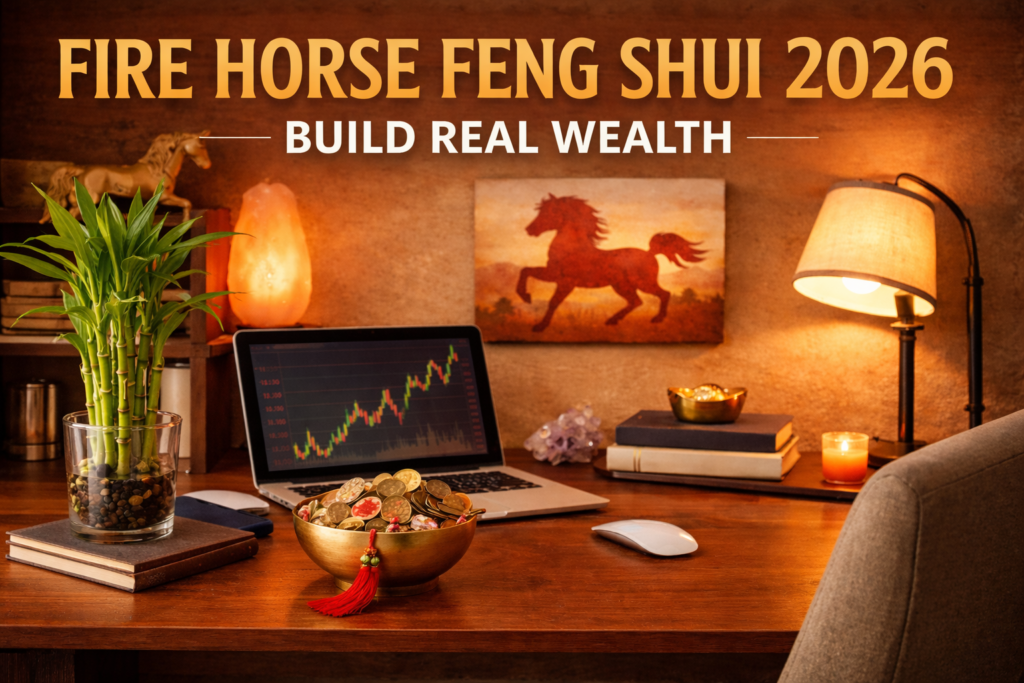
Fire Horse Feng Shui 2026 home office with lucky bamboo, wealth bowl, warm lighting, and balanced desk setup for financial growth

Fire Horse Year 2026 Feng Shui Guide: Build Real Wealth with East Sector Alignment

Fire Horse Feng Shui 2026 focuses on balancing strong fire energy with grounding elements while activating the East wealth sector. This year can bring wealth, transformation, or warning signals depending on your environment. Structured space reduces stress, improves focus, and supports consistent financial growth. Fire Horse Feng Shui 2026 requires balancing strong fire energy with grounding earth elements while activating the East wealth sector. Place your desk in command position, reduce visual heat (red/harsh light), and add one wood + one earth anchor to stabilize focus, improve decisions, and support consistent wealth growth. 2026 is fast. More visibility.More pressure.More decisions. As a result, most people will feel busy—but not stable. The Fire Horse Year has begun. And it is not subtle. Speed increases.Decisions accelerate.Patterns become visible. Instead of random outcomes, this year reveals patterns already present in your environment and behavior. The Problem: Why Your Space Is Blocking Wealth in 2026 Your environment is sending signals. Constantly. If your space has: • Harsh lighting• Excess red tones• Cluttered desk• No clear wealth anchor Then your brain shifts into reactive mode. Instead of strategic thinking, you respond to pressure. As a result: • You rush decisions• You lose consistency• You feel “busy but stuck” Fire energy amplifies this effect. The Three Outcomes of Fire Horse 2026 Most people will experience one of these three shifts. 1️⃣ Unexpected Wealth This shows up as: • Sudden opportunities• New income channels• Increased visibility However, without structure: Opportunity becomes overwhelm. 2️⃣ Powerful Transformation For some, this year is not about money. It is about: • Identity shifts• Career changes• Letting go of outdated systems Fire exposes what no longer works. As a result, adaptation becomes necessary. 3️⃣ A Warning You Can’t Ignore This appears as: • Burnout• Repeated mistakes• Financial inconsistency• Decision fatigue This is not bad luck. It is feedback. Your system is overloaded. The Explanation: Fire Horse Energy + East Wealth Sector In 2026: • Fire = speed, visibility, expansion• East sector = growth, wealth development (Wood element) Fire feeds on wood. But excess fire burns it. That is why balance is critical. Environmental Psychology Layer Your brain responds to: • Heat (light, color, stimulation)• Stability (structure, backing)• Flow (clear pathways) When heat is high without grounding: Stress increases.Focus drops.Decisions weaken. Over time, income consistency suffers. The First 7 Days Set the Tone The first week of this cycle matters. Not magically. Neurologically. Your brain builds: • Attention patterns• Decision rhythm• Work structure If the first 7 days are chaotic: The pattern repeats. If structured: Stability compounds. The Solution: 3 Low-Cost Adjustments (High Impact) 1️⃣ Activate the East Wealth Sector Locate the East area of your space. Then: • Add ONE healthy plant• Keep it clean and accessible• Avoid overcrowding Instead of adding more, remove friction. 2️⃣ Reduce Visual Heat Fire is already dominant in 2026. Do not amplify it. Adjust: • Replace harsh white light → warm-neutral• Reduce excessive red tones• Limit reflective clutter As a result: Your nervous system stabilizes. 3️⃣ Command Position Your Desk This is essential. • Face the entrance• Keep a solid wall behind• Avoid direct alignment with door If not possible: • Use a mirror• Use a high-back chair This improves: • Confidence• Decision quality• Authority perception A Simple Reset You Can Apply Today Start small. • Clear your workspace• Adjust lighting• Add one grounding element• Improve desk positioning Small changes create immediate stability. Fire Horse 2026 Mistakes to Avoid • Overusing red or bright lighting• Adding too many Feng Shui items• Ignoring desk placement• Cluttering the wealth corner• Mixing too many symbolic fixes Instead: Simplify.Stabilize.Then scale. 🎥 Watch: Fire Horse Year 2026 + Period 9 Feng Shui = the most powerful wealth energy in 20 years. ✨ https://youtu.be/hIp_5Rn1CLE Want to understand what this year is activating for you personally? Tap your zodiac sign to find out The first 7 days set the tone for your entire year 🧩 Supportive Tools (Optional) 🌿 Lucky Bamboo (East Sector Growth Anchor) Supports: • Growth mindset• Visual stability• Consistent progress 💡 Warm Desk Lamp (Fire Balance Tool) Supports: • Reduced eye strain• Balanced lighting• Lower fatigue Internal Linking 👉 Feng Shui for Wealth & Focus (Hub)👉 The Invisible Script: How Environmental Psychology of Your Home Office Shapes Success👉 The 1-Inch Shift: Small Desk Changes That Create Big Confidence and Income Results FAQ What is Fire Horse Feng Shui 2026? Fire Horse Feng Shui 2026 focuses on balancing strong fire energy with grounding elements while activating the East sector for stable wealth and focus. How do I activate the East wealth sector in 2026? Keep the East area clean, add one healthy plant, and avoid clutter to support growth without overwhelming the space. Can Feng Shui improve financial outcomes? Indirectly, yes. It improves focus, emotional control, and decision-making, which influence long-term financial results. What is the biggest mistake in Fire Horse year? Overstimulating the environment with excessive light, color, or objects, which increases stress instead of stability. Final Thought Fire Horse 2026 is not about luck. It is about exposure. What is stable will grow. What is weak will surface. Your environment decides which direction you move. Affiliate Disclosure Some of the links on this page may be affiliate links. This means that if you choose to make a purchase through these links, we may earn a small commission at no additional cost to you. These tools and products are shared as optional resources to support workspace clarity, environmental balance, and focus. They are not required, and results depend on individual habits, consistency, and decision-making. Disclaimer The information provided on this website is for educational and informational purposes only. Content related to Feng Shui, environmental psychology, mindset, and behavioral patterns is intended to offer general guidance on improving focus, clarity, and lifestyle structure. It should not be considered financial, legal, medical, or professional advice. We do not guarantee specific outcomes, including financial results, career growth, or personal success. Individual results vary based on personal circumstances, effort, and consistency. Readers are

Feng Shui · Wealth & Focus, Feng Shui & Abundance, Feng Shui & Environmental Psychology, Feng Shui for Indian Homes

Fire Horse Year 2026 Feng Shui Guide: Build Real Wealth with East Sector Alignment Read Post »
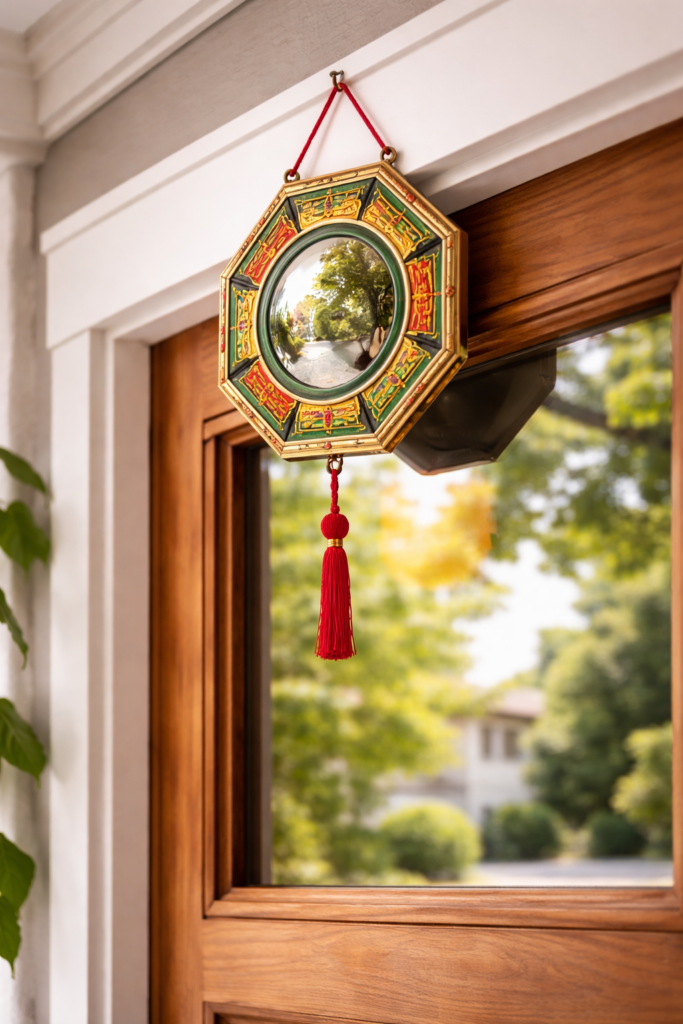
Bagua mirror placement above a front door for protection and emotional stability, showing a traditional Feng Shui bagua mirror reflecting outdoor light

Bagua Mirror Placement Rules for Protection and Stability

Bagua Mirror Placement Rules for Protection and Stability Most people think protection comes from strength. In reality, it comes from reducing exposure. That is exactly why understanding bagua mirror placement rules matters—not as a belief system, but as a way to manage visual stress, perceived threat, and environmental overload. A bagua mirror does not “block energy.” Instead, it works as a boundary cue. And boundaries are essential for stability. What a Bagua Mirror Actually Does (Psychology First)   A bagua mirror is placed outside the home, not inside. That rule exists for a reason. From a behavioral psychology perspective, mirrors redirect attention.They signal the brain to pause, reassess, and disengage. This matters because: Constant visual stimulation increases nervous system vigilance Perceived intrusion raises stress hormones Over time, this affects focus, sleep, and emotional regulation The bagua mirror acts as a visual stop sign. Not magical.Not symbolic. Just effective environmental design. Where to Place a Bagua Mirror for Protection   The most important rule is this: A bagua mirror is only used outside the home. Never indoors. Correct placements include: Above the main entrance door Outside a window facing sharp corners or heavy traffic On external walls facing aggressive visual structures These placements help reduce: Visual pressure Environmental overstimulation Constant subconscious scanning As a result, the mind feels safer. And safety supports stability. A Simple Protective Tool (Optional) A bagua mirror is sometimes used as a boundary-setting tool in environments with strong visual pressure. When chosen, simple, flat bagua mirrors are generally preferred.They are less visually aggressive and reduce the risk of overstimulation. This tool is not required for most homes.It is best used only when external visual stress is clearly present. 👉 View a simple flat bagua mirror option here ⚠️ Where Bagua Mirrors Should Never Be Placed   This is where most mistakes happen. A bagua mirror should never be placed: Inside living spaces Facing beds, desks, or seating areas In bedrooms or workspaces Facing neighbors directly Why? Because mirrors amplify attention. Indoors, this creates hyper-awareness, not protection. Instead of calming the nervous system, it keeps it alert. That leads to: Restlessness Poor focus Emotional fatigue Protection becomes pressure. Flat vs Convex vs Concave: What Actually Matters   There are three common types. Here’s how to think about them simply. Flat Bagua Mirror Neutral redirection Best for general boundary setting Least visually aggressive Convex Bagua Mirror Pushes attention outward Useful in visually crowded environments Should be used sparingly Concave Bagua Mirror Draws attention inward Rarely recommended Can increase psychological tension For most homes, flat mirrors are sufficient. Subtlety works better than force. 🧩 Protection Is About Reducing Cognitive Load   Protection is not about fighting the outside world. It is about limiting how much of it enters your awareness. When the environment feels contained: Decisions become clearer Emotions stabilize faster Energy is conserved instead of drained This is why bagua mirrors are classified as protective tools, not wealth tools. They protect your ability to function calmly. 🔗 How This Connects to Wealth and Focus   Stability comes before growth. Always. If the mind feels exposed or overstimulated, consistency drops. That affects: Work output Financial discipline Long-term planning This is why protective Feng Shui tools support wealth indirectly. They reduce friction. They protect attention. They make focus sustainable. 👉 For a complete system, read:Feng Shui for Wealth & Focus: How Your Space Shapes Money, Work, and Opportunity 🧘 A Calm Approach to Using a Bagua Mirror   If you choose to use one: Keep the design simple Avoid overly ornate or aggressive styles Use only one per entrance Less is more. Protection works best when it feels invisible. ❓ Frequently Asked Questions (FAQ)   ❓ Can I place a bagua mirror inside my house? No. Bagua mirrors are designed for external placement only. Indoors, they increase visual stress and mental alertness. ❓ Does a bagua mirror bring good luck? A bagua mirror does not create luck. It reduces environmental pressure, which helps emotional regulation and stability. ❓ Should a bagua mirror face a neighbor’s door? No. This creates unnecessary tension. The goal is boundary setting, not confrontation. ❓ Is a bagua mirror required for Feng Shui? No. It is a situational tool, not a requirement. Use it only when visual pressure is present. 📜 Affiliate Disclosure Some links on this site may be affiliate links. If you choose to purchase through them, I may earn a small commission at no additional cost to you. These recommendations are shared for educational and informational purposes only. ⚠️ Disclaimer This content is intended for informational and educational purposes. Feng Shui tools are not substitutes for professional advice, financial planning, or mental health care. Results vary based on environment, behavior, and consistency.

Feng Shui · Wealth & Focus, Feng Shui & Abundance, Feng Shui & Environmental Psychology

Bagua Mirror Placement Rules for Protection and Stability Read Post »

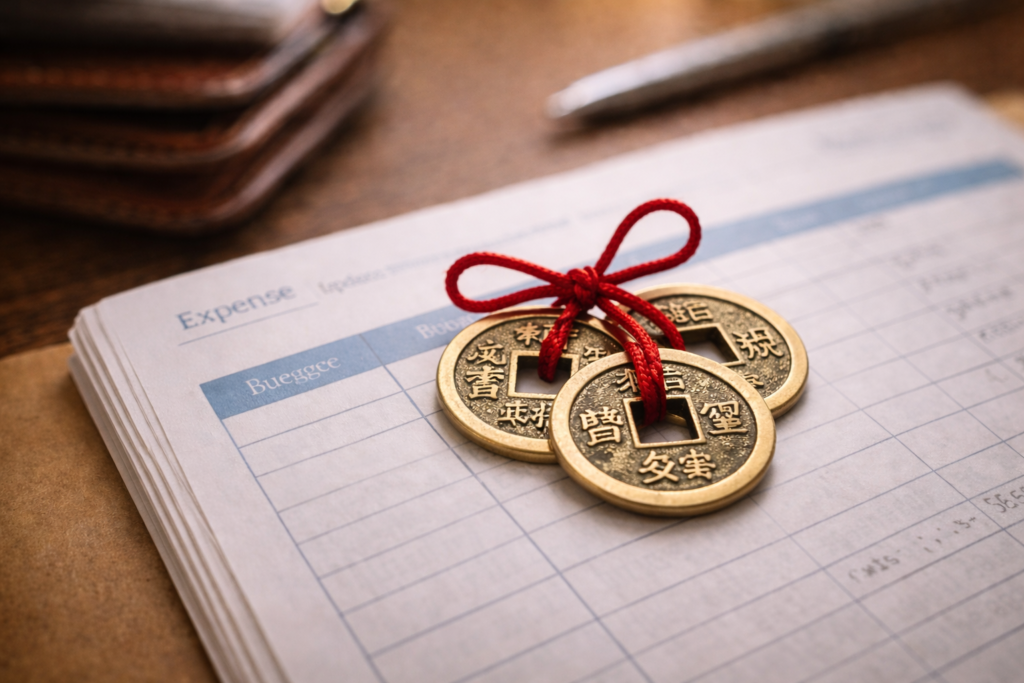
Feng Shui Chinese coins tied with a red thread placed on a desk, symbolizing money discipline, consistency, and calm financial focus

Chinese Coins Placement for Money Discipline and Consistency

Chinese Coins Placement for Money Discipline and Consistency Chinese coins placement for money discipline is rarely discussed correctly. Most explanations focus on attraction.Very few focus on behavior. Yet money problems are rarely caused by lack of opportunity.They are caused by inconsistency under pressure. Spending without awareness.Avoiding numbers.Reacting emotionally instead of deliberately. Environment shapes those habits quietly. And small, repeated visual cues influence how the brain approaches money decisions over time. Chinese coins, when placed intentionally, function as a discipline anchor — not a lucky charm. WHY MONEY DISCIPLINE FAILS UNDER PRESSURE   Financial inconsistency usually follows stress. When the nervous system feels overloaded, the brain shifts into short-term thinking.Impulse replaces planning. This is well documented in behavioral psychology. Visual reminders that signal structure and continuity reduce decision fatigue.They help stabilize attention. Chinese coins carry symbolic order: Circular shape = continuity Square center = structure That combination matters. Not spiritually.Psychologically. WHAT CHINESE COINS REPRESENT (WITHOUT SUPERSTITION)   Traditional Chinese coins combine two cognitive signals: Round outsideSignals flow and movement. Square centerSignals boundaries and control. The brain responds to repeated visual symbols through pattern recognition.Over time, these patterns influence behavior. This is how habits form. Coins placed correctly reinforce: Awareness before spending Consistency over impulse Long-term thinking over emotional reaction That is their real function. COMMON MISTAKES THAT REDUCE EFFECTIVENESS   These mistakes are subtle. They matter. Treating coins as decorative objects Placing them without intention Combining with clutter Expecting results without behavioral change Coins support discipline.They do not replace it. WHERE TO PLACE CHINESE COINS FOR MONEY DISCIPLINE   Placement determines effectiveness. Not energetically.Functionally. 1. Wallet or Expense Tracking Area This is the highest-impact placement. Coins placed inside a wallet, expense folder, or budgeting drawer act as a pause cue. They slow reactive spending.They reinforce intention. The brain registers the symbol before action. Consistency improves. 2. Desk Drawer or Work Surface (Out of Direct View)   Coins should not dominate attention. They work best when noticed briefly, not stared at. A desk drawer or side tray is ideal. This placement supports: Focused work Income-related decisions Reduced financial distraction 3. Near Financial Planning Tools   Place coins near: Budget planners Investment files Business documents This strengthens association between money and structure. Not emotion. Three Coin Chinese Wealth Coin Set Optional Support Tool A simple three-coin Chinese wealth coin set tied with a red thread works best for discipline-based placement.Choose minimal designs without excess ornamentation. 👉 Explore this Feng Shui support item WHERE CHINESE COINS SHOULD NOT BE PLACED   Some placements increase mental noise. Avoid these. ❌ Scattered Across the Home Loose placement dilutes meaning.The brain ignores clutter. Discipline requires containment. ❌ Bedrooms Sleep environments should reduce cognitive load. Money reminders here increase subconscious tension.That affects rest quality. ❌ High-Traffic Chaos Zones Entrances, kitchens, and cluttered shelves weaken signal clarity. Attention fragments. HOW MANY COINS TO USE (LESS IS MORE)   Three coins tied together is traditional. Psychologically, three signals: Awareness Choice Action More than that becomes decorative noise. One set per location is enough. HOW CHINESE COINS SUPPORT LONG-TERM CONSISTENCY   Consistency forms through repetition. Repeated cues strengthen neural pathways.This is neuroplasticity in action. Chinese coins act as: A behavioral checkpoint A reminder of structure A symbol of continuity Over time, this reduces emotional decision-making. That is how financial stability builds. Quietly. 🔗 INTERNAL REFERENCES   For a complete system view, read:→ Feng Shui for Wealth & Focus: How Your Space Shapes Money, Work, and Opportunity To support authority alongside flow, see:→ Why This Laughing Buddha Placement Attracts Money Within 30 Days FAQ SECTION (FOR ACCORDION + SCHEMA)   Are Chinese coins meant to attract money? No. They reinforce awareness and consistency around money decisions. Can I use Chinese coins without believing in Feng Shui? Yes. Their impact comes from behavioral cues, not belief. How long does it take to notice changes? Most people notice improved awareness within weeks, not instant results. Should Chinese coins be visible? No. Subtle placement works better for habit reinforcement. AFFILIATE DISCLOSURE (END OF ARTICLE) This article may contain affiliate links. If you choose to purchase through these links, we may earn a small commission at no additional cost to you. Products are selected to support intentional environment design and habit reinforcement. DISCLAIMER This content is for educational and informational purposes only. Feng Shui concepts are discussed through the lens of behavioral psychology and environmental influence. Results vary based on individual habits, consistency, and action.

Feng Shui · Wealth & Focus, Feng Shui & Abundance, Feng Shui & Environmental Psychology

Chinese Coins Placement for Money Discipline and Consistency Read Post »

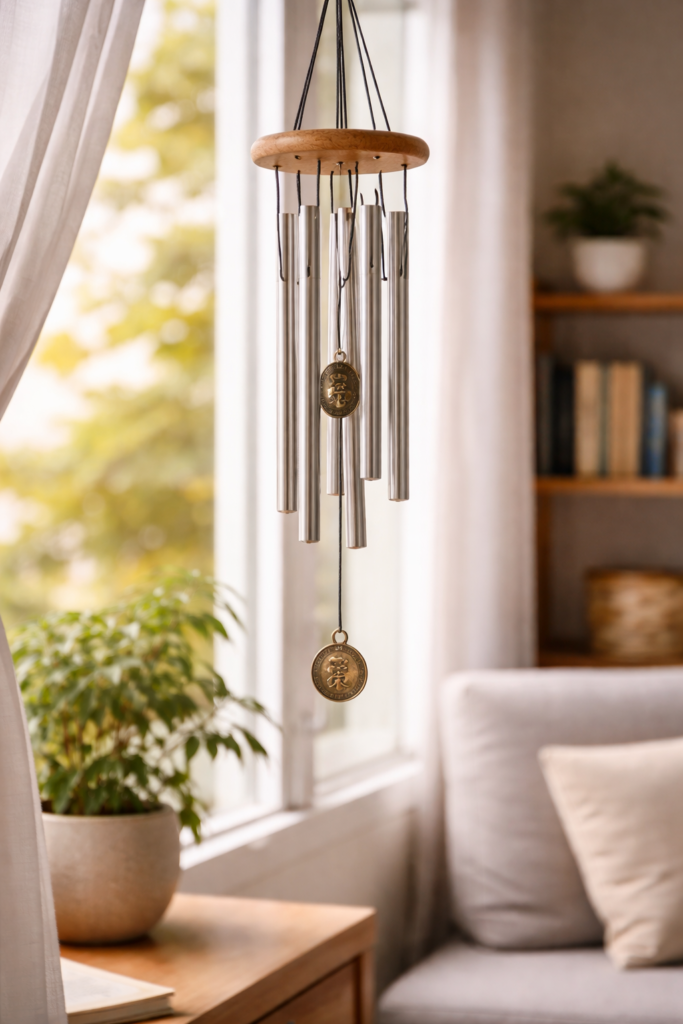
Metal wind chimes feng shui placement for money flow near a window, supporting movement, clarity, and financial circulation in a calm home environment

Metal Wind Chimes Feng Shui Placement for Money Flow

Metal Wind Chimes Feng Shui Placement for Money Flow Metal wind chimes feng shui placement for money flow is rarely explained correctly. Most advice focuses on sound alone. However, money flow is not about noise. It is about movement, timing, and release. The spaces where work and financial decisions happen either allow movement—or trap attention in stagnant loops. Metal wind chimes, when placed intentionally, function as environmental disruptors. They interrupt stagnation. And they reset attention. Why Stagnant Spaces Block Financial Momentum   Money flow depends on motion. Not physical motion. Mental motion. When a space feels stuck, the brain mirrors that condition. Over time, this shows up as: Delayed decisions Repeated financial stress Reduced follow-through Environmental psychology confirms this. Static environments increase cognitive friction. Movement cues reduce it. What Metal Wind Chimes Represent (Without Superstition)   Metal is associated with: Precision Structure Clarity Circulation In modern terms, metal elements support: Clear thinking Logical sequencing Reduced emotional noise Wind chimes introduce controlled movement. Not chaos. That distinction matters. Metal Wind Chimes Feng Shui  for Money Flow Metal Wind Chimes Feng Shui for Money Flow Some people choose simple metal wind chimes to support subtle movement in workspaces. When selecting one: Choose neutral metal Avoid painted colors Keep sound light 👉 Explore this Feng Shui support item Where to Place Metal Wind Chimes for Money Flow   Placement determines effectiveness. Incorrect placement creates irritation. Correct placement restores rhythm. Best Locations 1. Near entryways (not directly in the doorway)This supports transitions and opportunity awareness. 2. Home office windowsEspecially if work feels stuck or repetitive. 3. Wealth corner zones with low activityMovement prevents energy stagnation. Placements to Avoid   Bedrooms Near seating areas High-traffic walking paths Sound in rest zones disrupts regulation. And regulation supports financial clarity. Why the Number of Rods Matters   In Feng Shui, structure matters more than symbolism. Metal wind chimes with 6 or 8 rods work best. Why? Because even groupings create rhythm. Rhythm supports consistency. Consistency supports results. Avoid odd or excessive rod counts. More is not better. Office vs Home Placement Differences Office Placement   Metal wind chimes in offices support: Decision flow Project momentum Reduced mental clutter They should be subtle. Barely audible. If you notice them constantly, they are misplaced. Home Placement At home, wind chimes act as: Transitional cues Attention resets They work best near: Balconies Windows Entry points Never inside living rooms. Money flow requires calm—not distraction. Common Mistakes That Block the Effect   Most failures happen due to: Loud chimes Bright colors Overcrowded placement Emotional attachment to the object When the object becomes decorative instead of functional, the effect disappears. Function always comes first. How Metal Wind Chimes Support Financial Flow Psychologically   Movement cues trigger orientation responses in the brain. This resets: Attention loops Stress cycles Decision fatigue As a result, financial thinking becomes: More fluid Less reactive More consistent This is not mystical. It is neurological. Final Thought: Flow Is Created, Not Attracted   Money flow improves when friction decreases. Environment shapes that friction. Metal wind chimes, used intentionally, support flow by restoring movement, clarity, and rhythm—not by creating noise. 🔗 INTERNAL REFERENCES For a complete system view, read:→ Feng Shui for Wealth & Focus: How Your Space Shapes Money, Work, and Opportunity To support authority alongside flow, see:→ Feng Shui Dragon Placement for Career Success and Authority FREQUENTLY ASKED QUESTIONS   Do metal wind chimes really help with money flow? They support movement and reduce stagnation, which influences financial decision-making and consistency. Where should metal wind chimes not be placed? Bedrooms, seating areas, and high-traffic paths should be avoided. How many rods are best for Feng Shui wind chimes? Six or eight rods create balanced rhythm and reduce overstimulation. Should wind chimes be loud? No. Subtle sound is more effective than constant noise. ⚖️ AFFILIATE DISCLOSURE Some links on this page may be affiliate links. If you choose to purchase through them, I may earn a small commission at no additional cost to you. ⚠️ DISCLAIMER This article is for educational purposes only. Feng Shui tools support focus and environmental balance but do not guarantee financial outcomes.

Feng Shui · Wealth & Focus, Feng Shui & Abundance, Feng Shui & Environmental Psychology

Metal Wind Chimes Feng Shui Placement for Money Flow Read Post »

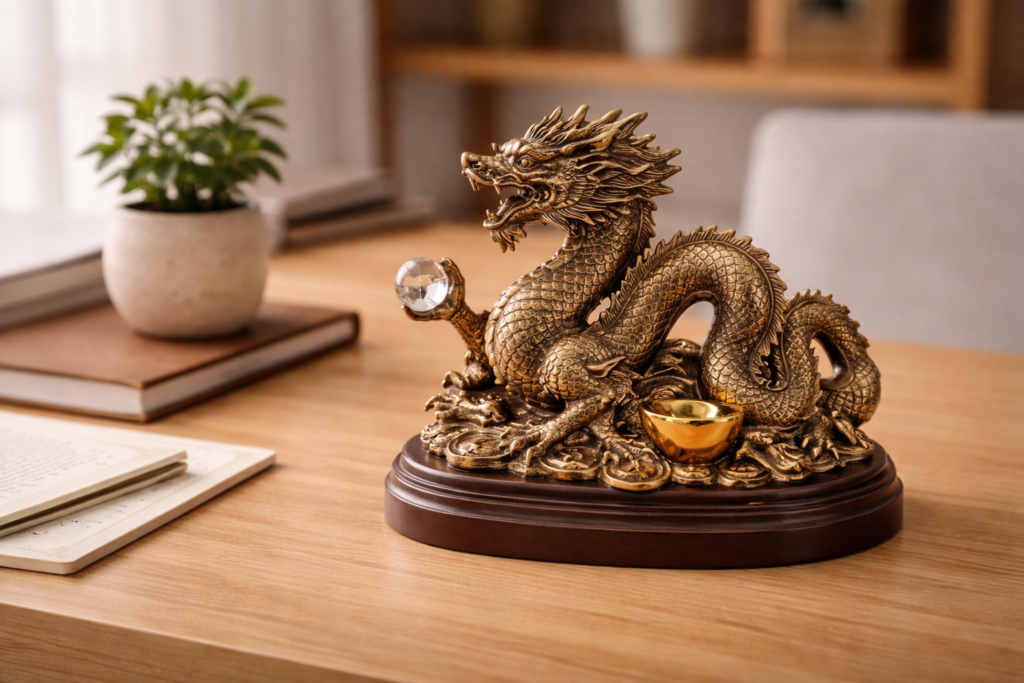
A bronze Feng Shui dragon statue placed on an office desk to support career success, authority, and confident decision-making.

Feng Shui Dragon Placement for Career Success and Authority

Feng Shui Dragon Placement for Career Success & Authority Feng Shui Dragon placement for career success Career growth is often explained through skill, effort, or timing. What rarely gets discussed is how authority is reinforced by environment—including feng shui dragon placement for career success. The spaces where leadership decisions are made shape posture, confidence, and perceived control long before results appear. Authority is not only asserted. It is reinforced. The Feng Shui Dragon, when used intentionally, is not a mythological symbol of power. It is a directional and dominance cue—one that influences how the mind occupies space. WHY THE DRAGON SYMBOL IS LINKED TO AUTHORITY The human brain responds strongly to symbols of dominance. Tall shapes. Forward-facing forms. Protective positioning. These cues signal safety, command, and readiness. In environmental psychology, this is known as territorial reinforcement. The dragon functions as a symbolic boundary. It marks a space as controlled rather than reactive. This matters for career success because leadership requires calm authority, not constant effort. WHAT THE DRAGON REPRESENTS (WITHOUT SUPERSTITION) In traditional Feng Shui, the dragon represents: Direction Momentum Protection Authority From a psychological lens, this translates into: Clear orientation Reduced hesitation Stronger presence Confidence under observation The dragon does not “create” authority. It supports the mental conditions where authority is expressed naturally. Feng Shui Dragon Some people choose to use a simple dragon figure as a workspace anchor. When selected, neutral finishes and minimal designs work best. Avoid exaggerated features. Avoid bright colors. The goal is quiet authority, not intimidation. 👉 View a simple Feng Shui dragon option her WHERE TO PLACE A FENG SHUI DRAGON FOR CAREER SUCCESS Placement determines whether the symbol supports focus or creates tension. IDEAL PLACEMENT LOCATIONS 1. Home office or personal workspaceEspecially in roles involving leadership, strategy, or negotiation. 2. On a side surface, not directly in front of youAuthority works best when reinforced, not confronted. 3. Slightly elevated positionShelves or cabinets at eye level or above reinforce dominance cues. PLACEMENT TO AVOID Bedrooms Shared living spaces Near the main door Directly behind seating These locations overstimulate or dilute the symbol’s effect. Authority becomes background noise. FACING DIRECTION: WHY IT MATTERS Facing direction influences perceived control. A dragon facing into the room reinforces command over the space. A dragon facing out of a window or door subconsciously signals energy leaving. This is not mystical. The brain interprets direction as intent. Intent shapes posture. Posture shapes confidence. OFFICE VS HOME PLACEMENT DIFFERENCES OFFICE PLACEMENT In offices, the dragon supports: Leadership identity Decisiveness Presence during communication Best placed near: Planning areas Strategy desks Document review spaces Avoid reception areas. Authority is personal, not performative. HOME PLACEMENT At home, the dragon should remain: Quiet Minimal Private It is not décor. It is a behavioral anchor. THE MOST COMMON DRAGON PLACEMENT MISTAKE Placing the dragon where it can be “seen by everyone.” This converts a support cue into a display object. The psychological link weakens. The symbol loses personal relevance. Authority cues must feel owned, not observed. HOW DRAGON PLACEMENT SUPPORTS CAREER MOMENTUM When placed correctly, the dragon reinforces: Stillness under pressure Boundary awareness Assertive decision-making Reduced self-doubt It does not replace preparation. It supports the state of mind where preparation performs. WHEN NOT TO USE A DRAGON SYMBOL The dragon is not for every phase. Avoid using one if: You feel overstimulated Your work requires rest, not drive Your environment is already visually busy Authority without calm becomes aggression. Balance matters. INTERNAL REFERENCE To understand how environmental symbols reinforce focus and financial consistency, read:→ Feng Shui for Wealth & Focus: How Your Space Shapes Money, Work, and Opportunity To balance drive with stability, see:→ Where to Place a Wealth Bowl at Home or Office for Best Results FREQUENTLY ASKED QUESTIONS Is a Feng Shui dragon good for career growth? Yes, when used as a subtle environmental cue supporting confidence and authority. Where should a dragon be placed in an office? In a personal workspace, slightly elevated, facing into the room. Can a dragon be placed at home? Yes, but only in a quiet, private work area—not shared spaces. Does dragon placement guarantee success? No. It supports mindset and behavior, not outcomes. AFFILIATE DISCLOSURE Some links in this article may be affiliate links.If you choose to purchase through these links, I may earn a small commission at no additional cost to you. DISCLAIMER This content is for educational and informational purposes only.Feng Shui tools are not guarantees of career or financial outcomes and should not replace skill development, experience, or professional decision-making.

Feng Shui · Wealth & Focus, Feng Shui & Abundance, Feng Shui & Environmental Psychology

Feng Shui Dragon Placement for Career Success and Authority Read Post »

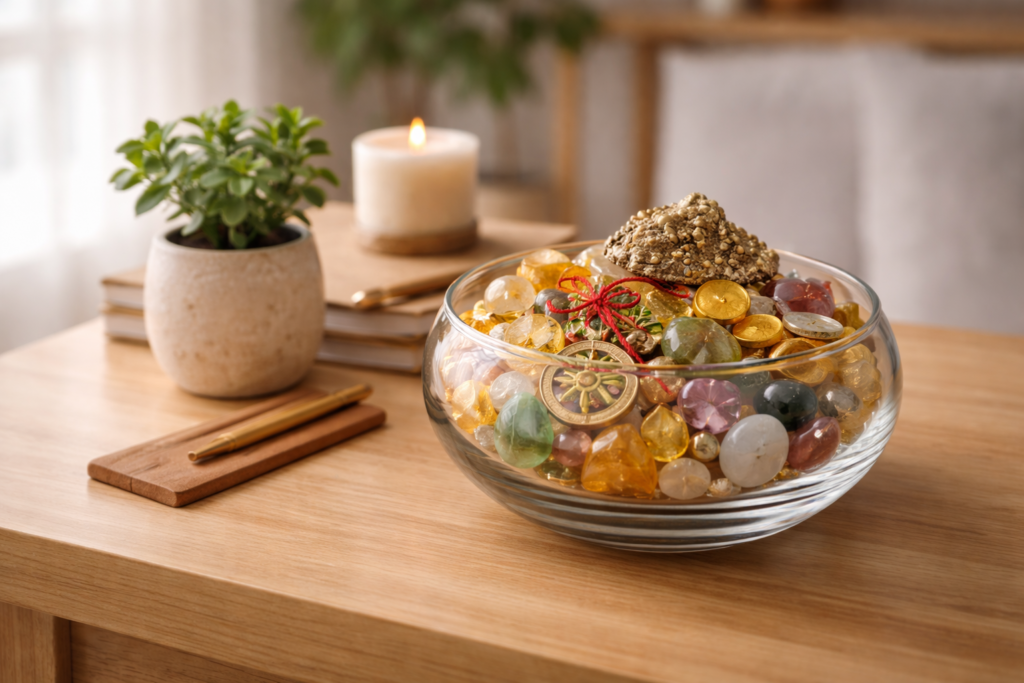
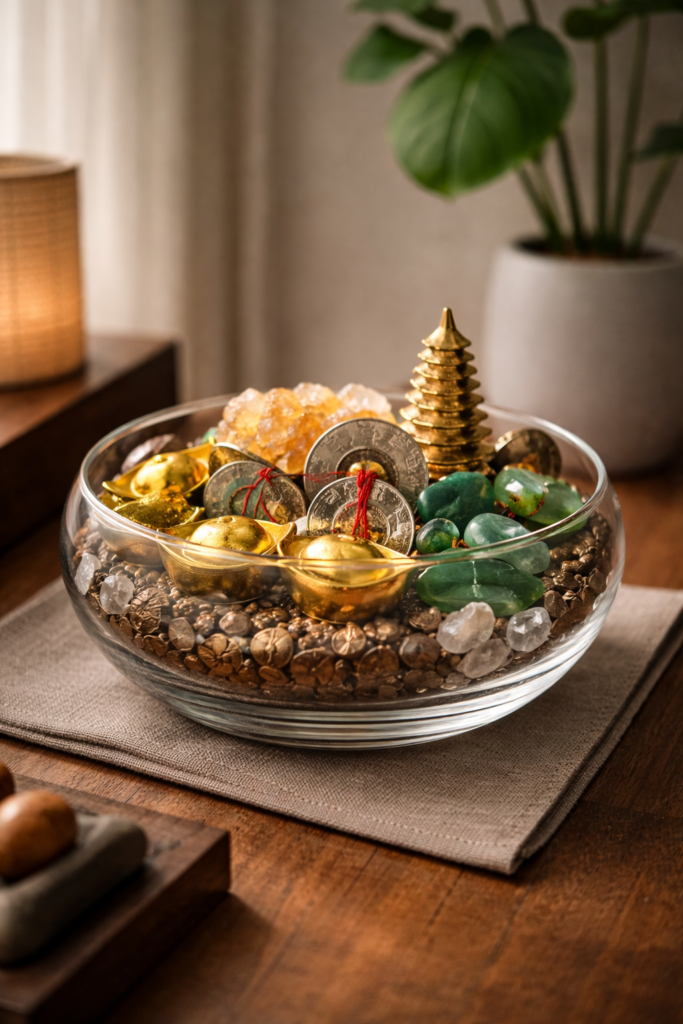
A Feng Shui wealth bowl placed on a wooden desk in a calm home office, showing proper wealth bowl placement to support focus, clarity, and business growth.

Where to Place a Wealth Bowl at Home or Office for Best Results

Where to Place a Wealth Bowl at Home or Office for Best Results Most conversations about financial growth focus on income, effort, or strategy. What often gets ignored is where to place a wealth bowl at home or office—and how that placement affects attention, emotional regulation, and consistency. The environment where money decisions are made shapes how the nervous system responds to pressure. Over time, that response determines whether focus is sustained or scattered. A wealth bowl, when used intentionally, is not a money-attracting object. It is a visual anchor—one that reinforces stability, direction, and follow-through. Why Placement Matters More Than the Object Itself The brain responds constantly to visual cues. Objects placed in meaningful locations become subconscious reference points. When a symbol is placed in a calm, low-distraction area, it reinforces clarity. When placed in chaotic or high-traffic zones, it competes with noise. This is not belief. It is attentional psychology. A wealth bowl works best when it supports focus, not fantasy. Feng Shui Wealth Bowl A Simple Visual Anchor for Focused Spaces   A wealth bowl is often used as a visual anchor—something the mind associates with stability, order, and intention. When placed in a calm, low-distraction area, it can support consistent focus by reducing visual noise and reinforcing deliberate work habits. This is not a promise of financial results.It is a subtle environmental cue that supports attention and follow-through over time. For those who choose to use one, simple bowls made from glass, ceramic, or natural stone tend to work best in both home and office settings. 👉 Explore this Feng Shui support itemhttps://geni.us/rv3Zy Where to Place a Wealth Bowl at Home The most effective placement is not random. It is intentional.   Ideal Home Locations 1. A quiet corner of the living areaThis supports reflection and long-term planning. 2. A personal workspace or study areaEspecially where financial decisions are reviewed. 3. A shelf or cabinet away from clutterVisual order reduces cognitive load. Locations to Avoid at Home   Near the main door Inside the kitchen On the floor In bedrooms High activity areas drain attention. Bedrooms overstimulate the nervous system. The wealth bowl becomes background noise instead of a cue. Where to Place a Wealth Bowl in an Office Office placement should support decision quality, not symbolism. Ideal Office Placement 1. On a side shelf near your deskNot directly in front of your eyes. 2. In a low-traffic corner of the workspaceStability matters more than visibility. 3. In a cabinet used for planning or finance documentsThis reinforces association with financial order. Office Locations to Avoid   Directly facing a doorway Near printers or electronics On shared desks In reception areas These zones increase distraction. Attention fragments. The cue loses effectiveness. The Most Common Placement Mistake   Placing a wealth bowl where it can be “seen by others.” This shifts its role. Instead of reinforcing internal focus, it becomes external display. Psychologically, this reduces personal attachment. The bowl works best when it supports your behavior, not perception. How a Wealth Bowl Supports Focus (Not Luck)   A well-placed wealth bowl does three things: Reinforces intentionality Reduces environmental noise Supports calm, consistent action It does not replace effort. It supports the mental conditions required for effort to sustain. This distinction matters. When Placement Needs to Change   If your space changes, reassess placement. Moving homes. Changing desks. Shifting roles. Environmental cues must evolve with behavior. Static placement leads to habituation. Habituation reduces impact. How a Wealth Bowl Supports Focus (Not Luck)   A well-placed wealth bowl does three things: Reinforces intentionality Reduces environmental noise Supports calm, consistent action It does not replace effort. It supports the mental conditions required for effort to sustain. This distinction matters. Internal Reference If you want to understand how items inside the bowl reinforce attention and consistency, read:→ The 7-Item Feng Shui Wealth Bowl Formula Used by Asian Merchants For the full environmental psychology framework, visit:→ Feng Shui for Wealth & Focus: How Your Space Shapes Money, Work, and Opportunity Frequently Asked Questions   Does a wealth bowl need to face a specific direction? No. Direction matters less than calm placement and visual clarity. Can I place a wealth bowl at work? Yes, if the space is personal, quiet, and decision-focused. Should the wealth bowl be visible? It should be accessible, not prominent. Can I have more than one wealth bowl? One is usually sufficient. Multiple bowls dilute focus. Affiliate Disclosure Some links in this article may be affiliate links.If you choose to purchase through these links, I may earn a small commission at no additional cost to you. Disclaimer This content is for educational and informational purposes only.Feng Shui tools are not guarantees of financial outcomes and should not replace skill development, effort, or financial planning.

Feng Shui · Wealth & Focus, Feng Shui & Abundance, Feng Shui & Environmental Psychology

Where to Place a Wealth Bowl at Home or Office for Best Results Read Post »

Feng Shui wealth bowl placed in a high-traffic area illustrating how poor placement can create attention drain and financial friction

Never Place a Wealth Bowl Here (Money Leakage Zone Explained)

Never Place a Wealth Bowl Here (Money Leakage Zone Explained) Money rarely disappears suddenly. It leaks. Through distraction.Through friction.Through environments that quietly drain attention and intention. The Wealth Bowl is meant to reduce that leakage. But when placed incorrectly, it does the opposite. Not dramatically.Not visibly. Quietly. What “Money Leakage” Actually Means (Psychological Definition)   Money leakage is not about loss. It is about attention drain. From a behavioral perspective, financial stability depends on: Sustained focus Emotional regulation Consistent follow-through When the environment introduces friction, these processes weaken. The Wealth Bowl, when placed in the wrong zone, becomes part of that friction instead of a stabilizing cue. . Why Placement Can Undermine the Wealth Bowl’s Purpose   The Wealth Bowl works as a focus anchor. It reinforces clarity around value, planning, and consistency. But anchors require stability. If placed where attention is fragmented, the brain does not register the bowl as supportive. It registers it as background noise. That is where leakage begins. The Primary Money Leakage Zone Most Homes Overlook   The most damaging placement zone is high-traffic chaos. This includes: Entryways cluttered with shoes, bags, and keys Hallways filled with movement and interruption Areas where attention is constantly pulled in multiple directions These zones activate the nervous system. They signal urgency.They signal transition.They signal interruption. A Wealth Bowl placed here is competing with motion. It cannot anchor focus in a space designed for movement. Why High-Movement Areas Drain Financial Attention   Movement increases cognitive load. The brain shifts into scanning mode. In scanning mode: Long-term planning weakens Reflection is interrupted Emotional steadiness drops This matters for money. Financial clarity requires stillness. Placing a Wealth Bowl in a movement-heavy area conditions the mind toward distraction rather than intention. Secondary Leakage Zone: Visual Overload Areas   Another common mistake is placing the Wealth Bowl near: Screens Electronics Notification-heavy zones Visual clutter clusters These environments train the brain toward rapid switching. Rapid switching erodes consistency. The bowl becomes visually present but psychologically muted. Instead of reinforcing focus, it becomes one more item competing for attention. Why Kitchens and Bedrooms Often Create Mixed Signals   Kitchens are active. They signal consumption, urgency, and task-switching. Bedrooms are restorative. They signal rest and disengagement. Placing a Wealth Bowl in either creates conflict. Conflict weakens cues. The mind struggles to reconcile: Action with rest Planning with recovery The result is subtle emotional noise. Why “Hidden Placement” Is Also a Form of Leakage   Some people hide their Wealth Bowl. In cabinets.In drawers.Behind decor. Out of sight feels safe. But hidden cues do not condition behavior. The subconscious learns through repetition and visibility. When the bowl is not seen, it cannot reinforce anything. The signal fades. How Environmental Friction Shows Up as Financial Resistance   Environmental friction rarely feels financial. It feels like: Avoiding planning Delaying decisions Feeling overwhelmed by simple money tasks These reactions are learned. They are reinforced by environments that lack clarity. The Wealth Bowl is meant to counteract this. But only if placed where clarity already exists. Where the Wealth Bowl Actually Supports Focus (Without Repeating Rules)   Instead of asking “Where should it go?” Ask: Where do I think clearly? Where do I plan without urgency? Where does intention already exist? Those are low-friction zones. The bowl amplifies what is already present. It cannot override chaos. How to Correct Leakage Without Rearranging Your Entire Home   You do not need dramatic changes. Small shifts work. Reducing clutter near the bowl.Moving it a few feet to a calmer zone.Stabilizing its surroundings. The nervous system responds quickly to reduced friction. Consistency improves when effort feels lighter. For the complete environment-first framework: → Read the full Feng Shui for Wealth & Focus guide To understand how a Wealth Bowl functions as a focus anchor: → The 7-Item Feng Shui Wealth Bowl Formula Used by Asian Merchants Final Thought   The Wealth Bowl does not protect money. It protects attention. And attention determines behavior. When placed in a low-friction environment, the bowl quietly reinforces clarity and consistency. When placed in chaos, it disappears into noise. That is the difference between support and leakage. Frequently Asked Questions   What does “money leakage” mean in Feng Shui? Money leakage refers to environmental friction that drains attention and clarity, weakening consistent financial behavior rather than causing direct financial loss. Can placing a wealth bowl incorrectly cause negative effects? It doesn’t cause harm, but it can increase distraction and reduce the bowl’s ability to reinforce focus and intention. Where should a wealth bowl not be placed? Avoid high-traffic areas, visually chaotic zones, and rest-only spaces where movement or recovery dominates attention. Is hiding a wealth bowl a good idea? No. Visibility is essential for subconscious reinforcement and behavioral conditioning. How quickly can correcting placement make a difference? Many people notice reduced resistance and clearer focus within days as environmental friction decreases.

Feng Shui & Abundance

Never Place a Wealth Bowl Here (Money Leakage Zone Explained) Read Post »

Feng Shui wealth bowl placed in a high-traffic area illustrating how poor placement can create attention drain and financial friction

How to Make a Feng Shui Wealth Bowl: The 7-Item Formula Used by Asian Merchants

How to Make a Feng Shui Wealth Bowl: The 7-Item Formula Used by Asian Merchants Money habits don’t collapse suddenly. They erode quietly. Through distraction.Through emotional overload.Through lack of visual reinforcement. For centuries, merchants understood something modern productivity culture often ignores. Environment trains attention.Attention trains behavior. The Wealth Bowl was never meant to “attract” money. It was designed to anchor focus, reinforce value awareness, and reduce mental friction around wealth decisions. That is why it still matters. This guide explains how to make a Feng Shui wealth bowl using a stable, 7-item structure that reinforces clarity and focus. What the Wealth Bowl Actually Represents (Modern Interpretation)   The Wealth Bowl is often explained symbolically. But its real power lies in consistency and repetition. From a behavioral psychology perspective, repeated exposure to meaningful visual cues strengthens neural associations. Over time, those associations influence decisions without conscious effort. The bowl works as a focus container. Not because of what it holds.But because of what it repeatedly reminds the brain to prioritize. Why Merchants Used Containers, Not Individual Symbols   Individual objects can be ignored. Containers create structure. A bowl groups multiple cues into one visual unit. This reduces scatter and increases salience. Merchants understood that: Scattered symbols dilute attention Grouped symbols reinforce intention Stability creates trust in the environment This is why the Wealth Bowl is one object made of several signals, not many objects competing for attention. The 7-Item Wealth Bowl Formula (Psychological Logic) The traditional formula uses seven items.Not because seven is lucky.But because it creates variety without overload. Each item serves a distinct psychological function. Together, they form a balanced visual system the brain can process effortlessly. The seven items are traditionally drawn from well-understood Feng Shui categories. Feng shui wealth bowl how it is made: They are named here for clarity, not as purchase instructions. Chinese Feng Shui CoinsRepresent stored value and circulation. Psychologically, they reinforce the idea that money is something managed and directed, not feared or avoided. Citrine or Pyrite (Wealth Stone)Acts as a visual cue for growth and continuity. Its role is to support momentum and opportunity awareness, not speculation. Rice or Grain (Symbol of Sustenance)A grounding element that signals sufficiency and stability. This reduces scarcity-driven thinking and impulsive financial behavior. Red Paper or Red Cloth AccentAdds visual warmth and alertness. Red increases salience without overstimulation, keeping the bowl perceptually active. A Small Metal Element (Ingot, Bell, or Coin Dish)Provides structure and weight. Metal reinforces order, boundaries, and containment in the visual field. A Reflective Element (Mirror Disc or Polished Surface)Encourages awareness and pause before action. Reflection supports self-regulation around money decisions. The Bowl Itself (Ceramic or Metal)The container is not neutral. It unifies all cues into one stable system. Without the bowl, the signals lose coherence. The effectiveness comes from balance, not from upgrading or constantly changing these items. Too few items feel empty.Too many create noise. Balance is the mechanism. Why Consistency Matters More Than Changing Ingredients   Many people constantly adjust their Wealth Bowl. Adding.Removing.Experimenting. This weakens its effect. The brain responds to stable cues, not novelty. When the bowl remains consistent: Neural associations strengthen Emotional signals stabilize Focus becomes automatic When it changes frequently, the signal resets. Consistency is the mechanism. Why This Bowl Affects Focus and Emotional Balance   This is where most explanations stop short. The Wealth Bowl works by reducing decision friction. Money-related tasks often trigger: Anxiety Avoidance Overthinking A calm, consistent visual anchor reduces these reactions by signaling:“This area of life is organized and supported.” That signal matters. Cluttered financial cues increase stress.Clear cues reduce it. The bowl acts as a buffer against emotional noise. Where the Wealth Bowl Should Exist (Without Overthinking)   The bowl should live where: Financial planning happens Work decisions are made Reflection occurs Common examples: Near a desk (not on it) In a calm living area In a space associated with intention, not urgency Avoid bedrooms. Rest spaces should remain neutral. Common Mistakes That Weaken the Wealth Bowl   Most failures are subtle. Common issues include: Overfilling the bowl Mixing unrelated objects Placing it near clutter Treating it as decoration When the bowl becomes visually busy, it loses clarity. Clarity is the goal. For readers who prefer a physical starting point, a ready-made Wealth Bowl can serve as a stable visual anchor. It removes decision fatigue and ensures consistency from the start. 👉 Explore a Feng Shui Wealth Bowl support item Feng Shui Wealth Bowl (Symbol of Accumulation and Stability) The Feng Shui Wealth Bowl is a symbolic reminder of accumulation, preparedness, and long-term financial thinking. Traditionally, it represents stored value rather than quick gain. From a psychological standpoint, visible symbols of abundance reinforce saving behavior, patience, and consistency — traits strongly associated with financial stability. The Wealth Bowl is often used incorrectly or overfilled without intention. What goes inside, where it is placed, and how often it is refreshed determine whether it reinforces prosperity — or becomes visual clutter. 👉 Explore this Feng Shui support item Affiliate Disclosure Some links on this website may be affiliate links.This means that if you choose to make a purchase through these links, we may earn a small commission at no additional cost to you. How This Connects to Other Wealth Symbols   The Wealth Bowl works best when aligned with other cues. It pairs especially well with: A properly placed Laughing Buddha A calm, uncluttered workspace Clear sightlines and lighting Together, these cues reinforce ease, stability, and focus. For the full environment framework: → Read the complete Feng Shui for Wealth & Focus guideTo understand how visual cues like the Laughing Buddha support emotional regulation: → Why This Laughing Buddha Placement Attracts Money Within 30 Days→ Most Homes Place Laughing Buddha Wrong (And Quietly Block Wealth) Frequently Asked Questions   Does a Feng Shui wealth bowl actually attract money? A wealth bowl does not create money directly. It supports focus, reduces emotional friction around finances, and reinforces consistent decision-making over time. What are

Feng Shui & Abundance

How to Make a Feng Shui Wealth Bowl: The 7-Item Formula Used by Asian Merchants Read Post »

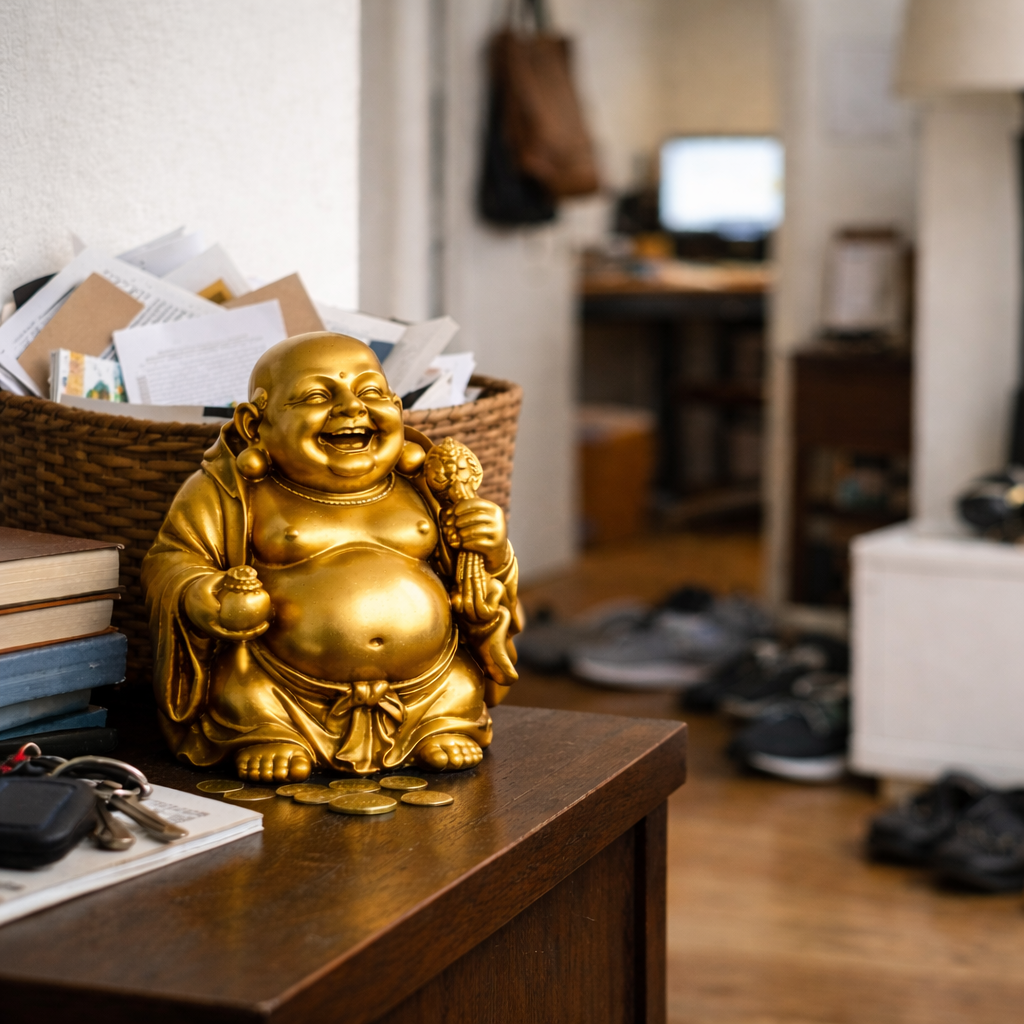
Laughing Buddha placed incorrectly in a cluttered home environment showing how poor feng shui placement can reduce focus and financial clarity

Most Homes Place Laughing Buddha Wrong (And Block Wealth)

Most Homes Place Laughing Buddha Wrong (And Quietly Block Wealth) The Feng Shui Laughing Buddha is not ignored. It is often overused. Placed casually.Surrounded by clutter.Treated as decoration instead of a cue. That’s where the problem begins. When Feng Shui symbols are placed without intention, they don’t become neutral.They become noise. And noise quietly disrupts focus, emotional regulation, and follow-through—especially around money and work. This article explains why most homes unintentionally weaken the Laughing Buddha’s effect, and how subtle environmental mistakes shape behavior more than people realize. No superstition.No fear tactics. Just psychology, attention, and environment. Why “Wrong Placement” Is a Psychological Issue (Not a Feng Shui One)   Most people assume Feng Shui works through belief. It doesn’t. It works through repetition, attention, and emotional association. The Laughing Buddha is meant to act as a visual anchor—a consistent reminder of ease, optimism, and emotional abundance. When that anchor is weakened, the brain stops responding. Over time, this creates friction instead of support. The issue is not where the statue sits. The issue is how the mind experiences it daily. Mistake #1: Surrounding the Laughing Buddha With Visual Clutter   Clutter competes for attention. The brain does not prioritize symbols—it prioritizes contrast. When the Laughing Buddha is placed among: • Piles of paper• Unsorted objects• Decorative overload• Random trinkets Its signal is diluted. Instead of reinforcing calm optimism, it becomes part of the background. From a behavioral psychology perspective, clutter increases: • Cognitive load• Stress reactivity• Decision fatigue That stress quietly bleeds into financial decisions. A symbol meant to soften anxiety ends up sitting inside it. Why This Matters for Wealth Psychology   Financial behavior is stress-sensitive. Under cognitive strain, the brain defaults to: • Avoidance• Short-term thinking• Over-control or impulsivity When a wealth symbol is placed in a cluttered environment, it cannot counteract those patterns. It becomes visually present—but psychologically inactive. Mistake #2: Treating the Feng Shui Laughing Buddha as “Just Decor” Decor is passive. Feng Shui symbols are interactive cues. When the Laughing Buddha is treated like an aesthetic object—chosen only for size or color—the brain never assigns meaning to it. Meaning is what activates behavior. Without meaning: • The eyes pass over it• The nervous system ignores it• The association never forms This is why many people report “nothing changed.” Nothing was reinforced. Environmental Cues Shape Identity The brain learns identity through environment. Objects placed intentionally reinforce: “I am supported.”“I am safe.”“I am capable.” Objects placed casually reinforce nothing. Over time, the difference compounds. Mistake #3: Facing Direction That Creates Psychological Tension   Facing direction matters—not mystically, but emotionally. When the Laughing Buddha faces: • A wall• A cramped corner• A chaotic space The subconscious association shifts. Instead of openness and receiving, the mind registers: • Restriction• Confinement• Visual resistance This subtle tension affects how opportunity is perceived. People feel “busy but stuck.”Effort increases.Results lag. Not because of fate—but because the environment trains the nervous system to brace instead of receive. Mistake #4: Placing the Symbol Where It’s Rarely Seen   A symbol cannot influence behavior if it is rarely noticed. Many homes place the Laughing Buddha: • On a high shelf• In a side corner• In a decorative niche Out of sight is out of mind. Behavioral conditioning requires repetition. If the symbol does not enter your visual field daily, it cannot reinforce emotional patterns tied to money or work. The brain responds to what it repeatedly sees—not what exists somewhere in the room. Mistake #5: Mixing Conflicting Emotional Signals   This mistake is subtle. And common. The Laughing Buddha represents ease and optimism. When placed near: • Bills• Stress reminders• Broken items• Electronics overload The emotional message becomes mixed. The brain cannot hold contradictory signals cleanly. Instead of calm confidence, the result is mild internal tension. Not dramatic. Just enough to affect consistency. Why These Mistakes Quietly Block Wealth (Behaviorally)   Wealth is not attracted. It is allowed through clarity and follow-through. Environmental friction reduces: • Focus• Emotional safety• Willingness to take aligned action When symbols that should reduce friction instead add noise, progress feels harder than it needs to be. This is not spiritual failure. It is environmental misalignment. How to Use the Laughing Buddha as a Supportive Cue (Without Repeating Placement Rules)   The goal is not perfection. The goal is psychological clarity. Ask three questions: Is the symbol visually calm? Is it noticed daily without effort? Does the surrounding environment reinforce ease or tension? If the answer is unclear, adjustment is needed. Small changes matter. The nervous system responds to subtle shifts more than dramatic rearrangements. If you haven’t read the foundational guide yet, start here: → Read the complete Feng Shui for Wealth & Focus guide For a deeper breakdown of correct Laughing Buddha placement principles: → Why This Laughing Buddha Placement Attracts Money Within 30 Days Optional Support ItemFor readers who prefer a tangible visual cue, a Laughing Buddha statue can serve as a consistent environmental reminder of calm focus and emotional abundance. Then: 👉 Explore a Feng Shui Laughing Buddha option suitable for home or workspace Affiliate Disclosure: Some links on this page are affiliate links. If you purchase through them, I may earn a small commission at no extra cost to you. As an Amazon Associate, I earn from qualifying purchases. Feng Shui Laughing Buddha (Hotei with Gold) The Feng Shui Laughing Buddha represents contentment, optimism, and emotional abundance. In Feng Shui, it is associated with easing financial anxiety and reinforcing a positive relationship with success. From a behavioral perspective, symbols of joy reduce stress-driven decision making, helping the mind approach work and opportunity with calm confidence. 👉 Explore this Feng Shui support item Final Insight   The Laughing Buddha does not “attract” wealth. It conditions the mind toward ease, optimism, and openness. When placed poorly, it conditions nothing. When placed intentionally, it quietly supports better decisions, calmer focus, and consistent action. That’s how environments shape outcomes. And that’s why this symbol deserves more respect than decoration.

Feng Shui & Abundance

Most Homes Place Laughing Buddha Wrong (And Block Wealth) Read Post »

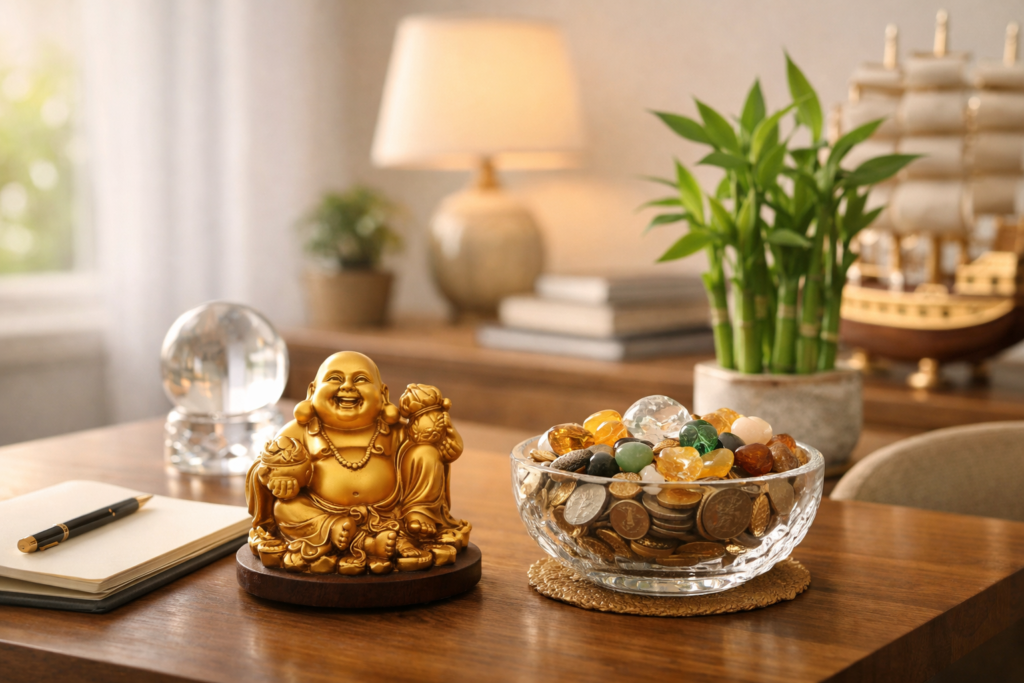
Feng Shui home office setup for wealth, focus, and productivity with balanced energy and intentional design

Why This Laughing Buddha Placement Attracts Money Within 30 Days

Why This Laughing Buddha Placement Attracts Money Within 30 Days Money habits rarely fail because of lack of effort. They fail because the environment quietly trains avoidance, stress, and distraction. Most people never notice this training happening. They only notice the results. The Laughing Buddha is often introduced as a symbol of wealth.But that explanation misses what actually matters. What makes this placement effective is not belief.It is how the brain responds to visual cues, emotional signals, and spatial consistency over time. That is where change begins. What the Laughing Buddha Actually Represents (Psychological Framing)   The Laughing Buddha represents contentment, emotional ease, and optimism. Not happiness as a feeling.But safety as a state. From a behavioral psychology perspective, symbols associated with calm and abundance reduce stress-driven thinking. When stress decreases, decision-making improves. This matters for money. Financial choices are especially sensitive to emotional pressure.An anxious mind avoids.A regulated mind engages. The Laughing Buddha acts as a visual anchor that reinforces emotional steadiness when placed correctly. When placed poorly, it does the opposite. Why Placement Matters More Than the Object Itself   Objects do not create outcomes. They create signals. The brain constantly interprets signals from the environment: Is this space safe? Is it overwhelming? Is attention required right now? Placement determines which signal dominates. If the Laughing Buddha is hidden, cluttered, or visually drowned out, the signal weakens.If it is placed with clarity and intention, the signal strengthens. This is not symbolism. It is stimulus-response conditioning. The One Placement Rule Most People Get Wrong   Most homes place the Laughing Buddha randomly. On a crowded shelf.In a corner.Surrounded by unrelated objects. This creates visual noise. Visual noise increases cognitive load.Cognitive load reduces follow-through. The correct placement prioritizes visibility without dominance. The Buddha should be: At eye level when seated or standing nearby Clearly visible without being the focal point of the room Free from clutter within arm’s length This allows the symbol to act as a reminder, not a distraction. Facing Direction: Why It Influences Money Behavior   Facing direction is often misunderstood as ritual. In reality, it influences perceived control. When the Laughing Buddha faces into the room: The mind interprets openness Attention feels expansive Opportunity awareness increases When it faces a wall, window, or exit: The signal weakens The mind associates closure or loss Subtle avoidance patterns form These patterns are quiet.But repeated daily, they shape behavior. Consistency compounds. Why This Placement Affects Focus and Emotional Balance   This is the most important part. Visual anchors work through repetition. Every time the brain encounters a familiar, emotionally positive cue in a stable location, it reinforces a neural association. Over time, that association becomes automatic. The Laughing Buddha, when placed correctly: Reduces micro-stress during work Softens anxiety around money-related tasks Encourages approach instead of avoidance Clutter near the symbol interrupts this process. Clutter creates competing signals.Competing signals weaken conditioning. This is why placement alone is not enough.The surrounding environment matters equally. The Best Areas to Place the Laughing Buddha (Without Overthinking)   You do not need complex maps. Focus on where financial decisions are made or delayed. The most effective areas tend to be: Near a workspace or desk (not on it) In a living area where planning or reflection occurs In a space associated with calm, not urgency Avoid bedrooms. Bedrooms are for recovery.Wealth-related cues introduce activation where rest should dominate. Common Mistakes That Quietly Block Results   Many placements fail because of small, overlooked details. Common mistakes include: Placing the Buddha too high or too low Surrounding it with unrelated decorative items Positioning it near clutter or storage Treating it as decoration instead of a signal None of these are dramatic. That is why they are dangerous. Small frictions repeated daily shape habits more than big intentions. Why Results Often Appear Gradually (Not Instantly)   The “30 days” framing works because it aligns with neuroplasticity timelines. Neural associations strengthen through repetition and emotional consistency.This takes time. Within a few weeks, many people notice: Less resistance around money tasks Improved clarity when making decisions Reduced emotional charge around financial planning These are not miracles. They are signs of reduced internal friction. How to Support This Placement With Simple Behavior   Environment works best when paired with minimal action. Once placed: Keep the surrounding area clean Avoid moving the Buddha frequently Spend a few seconds acknowledging it during work breaks This reinforces the signal. No rituals.No affirmations required. Consistency does the work. Why This Works Better Than Motivation Alone   Motivation fluctuates. Environment does not. When the environment supports calm focus, behavior becomes easier to sustain. This is why environment-first strategies often outperform mindset-first approaches. The Laughing Buddha placement works when it becomes part of a larger system of reduced friction. If You Want the Full System   This article focuses on one symbol. The complete framework explains how environment design, workspace layout, and visual order interact to support focus, consistency, and financial behavior. If you want the full context, read the main guide: → Feng Shui for Wealth & Focus: How Your Space Shapes Money, Work, and Opportunity Final Thought   The Laughing Buddha does not attract money. It supports the mental state that allows better financial behavior to emerge. That distinction matters. Change begins when effort feels lighter. And that begins with the environment. Frequently Asked Questions   Does Laughing Buddha placement really affect wealth? Laughing Buddha placement does not create money directly. It supports emotional calm, reduces cognitive stress, and reinforces focus—conditions that influence financial decisions over time.   Where should the Laughing Buddha face for best results? From a psychological perspective, facing the Laughing Buddha into the room supports openness and perceived control. Facing exits or walls weakens its visual impact.   Can Laughing Buddha be placed in a bedroom? Bedrooms are designed for rest and recovery. Wealth-related cues can introduce unnecessary mental activation, making bedrooms a poor placement choice.   How long does it take to notice results from placement changes? Environmental

Feng Shui & Abundance

Why This Laughing Buddha Placement Attracts Money Within 30 Days Read Post »

Feng Shui home office setup for wealth, focus, and productivity with balanced energy and intentional design

Feng Shui for Wealth & Focus | Space, Money & Work

Feng Shui for Wealth & Focus: How Your Space Shapes Money, Work, and Opportunity Feng Shui for wealth and focus works by shaping attention, emotional regulation, and decision-making through intentional space design. By aligning layout, lighting, symbolic anchors, and visual order, your environment supports productivity, financial discipline, and long-term professional stability. How environment psychology, Feng Shui symbols, and intentional design support prosperity and productivity Your Space Is Quietly Training Your Brain   Most people believe success comes from motivation, discipline, or mindset alone. But neuroscience shows something different. Your environment constantly sends signals to your brain—often more powerfully than your thoughts. These signals shape how safe, focused, confident, and consistent you feel throughout the day. This is where Feng Shui is often misunderstood. Real Feng Shui is not superstition.It is environmental psychology. It is about how visual cues, order, light, symbols, and layout influence: Attention Emotional regulation Decision-making Habit formation Identity reinforcement This guide explains Feng Shui in a grounded, modern way—and shows how to use simple objects and layout choices to support wealth, focus, and long-term success. No mysticism.No promises.Just how the brain responds to space. What Is Feng Shui?   Feng Shui is a spatial design system that organizes your environment to improve focus, clarity, and emotional balance. In modern terms, it aligns closely with environmental psychology — how layout, light, objects, and placement influence stress levels, attention, and decision-making. Practically, Feng Shui helps structure space to support stability, productivity, and long-term consistency. How Feng Shui Actually Works (Psychology First) Why Environment Shapes Behavior More Than Motivation   Your brain evolved to respond to surroundings first. Before you think, your nervous system scans for: Safety Order Threat Opportunity When your environment feels chaotic or heavy, the brain shifts into protection mode. When it feels ordered and intentional, the brain has more capacity for focus, creativity, and growth. This is why: A cluttered desk reduces focus Poor lighting increases fatigue Visual disorder increases stress Intentional spaces increase consistency Motivation fades.Environment stays. Feng Shui Explained Without Mysticism   At its core, Feng Shui works through three psychological mechanisms:   1. Visual Attention Training What you see repeatedly shapes what your brain prioritizes.   2. Emotional Association Objects carry meaning. Meaning creates emotional responses.   3. Habit Reinforcement Your space nudges behavior without effort.   When used correctly, Feng Shui does not “attract money.”It supports the behaviors and mindset that make growth sustainable.   This guide breaks down Feng Shui using psychology, behavior, and practical placement — without superstition or exaggeration How to Apply Feng Shui for Wealth and Focus (7 Practical Steps)   If you are starting fresh, begin here: Clear visible clutter from primary work surfaces Position your desk in command position Choose one wealth anchor (not multiple) Improve lighting quality Define workspace boundaries Add one growth-oriented element (plant or symbol) Create a weekly reset ritual Small changes compound faster than dramatic overhauls. Quick Navigation• Big Three Wealth Anchors• Workspace Feng Shui• Protection & Stability• Water Elements• Advanced Feng Shui Symbols 🎁 Free Resource: 7-Day Wealth Corner Reset Apply the wealth corner principles step-by-step using our printable audit guide. Download the 7-Day Wealth Corner Reset Checklist Wealth Corner: Attention & Expectation Training In Feng Shui, the “wealth corner” is not about superstition. It is about directing attention. Attention shapes expectation.Expectation shapes behavior. When a space consistently reminds your brain of growth, stability, and value, it reinforces identity quietly. The Big Three Wealth Anchors (Foundation Symbols) Feng Shui Three-Legged Money Frog  Feng Shui Three-Legged Money Frog (Jin Chan – Symbol of Wealth Attraction)   The Three-Legged Money Frog is traditionally used as a visual anchor for incoming opportunity. When placed intentionally, it trains attention toward receiving rather than chasing wealth. From a psychological perspective, it works as an environmental cue—reminding the mind to notice opportunity and act with confidence. 👉 Explore this Feng Shui support item Feng Shui Laughing Buddha (Hotei – Symbol of Joy and Abundance) The Laughing Buddha represents contentment, optimism, and emotional abundance. In Feng Shui, it is associated with easing financial anxiety and reinforcing a positive relationship with success. From a behavioral perspective, symbols of joy reduce stress-driven decision making, helping the mind approach work and opportunity with calm confidence. The Laughing Buddha is one of the most misused Feng Shui symbols. Placement, facing direction, and surrounding objects determine whether it supports focus and prosperity — or quietly works against it. → Read the full Laughing Buddha placement guide for wealth 👉 Explore this Feng Shui support item Feng Shui Wealth Bowl (Symbol of Accumulation and Stability) The Feng Shui Wealth Bowl is a symbolic reminder of accumulation, preparedness, and long-term financial thinking. Traditionally, it represents stored value rather than quick gain. From a psychological standpoint, visible symbols of abundance reinforce saving behavior, patience, and consistency — traits strongly associated with financial stability. The Wealth Bowl is often used incorrectly or overfilled without intention. What goes inside, where it is placed, and how often it is refreshed determine whether it reinforces prosperity — or becomes visual clutter. → Read the full Feng Shui Wealth Bowl setup and placement guide 👉 Explore this Feng Shui support item Feng Shui Dragon (Symbol of Power and Success) In Feng Shui, the Dragon symbolizes authority, momentum, and upward movement. It is associated with leadership energy, confidence, and the ability to take decisive action. Behaviorally, powerful symbols influence posture, focus, and assertiveness — subtle cues that shape how people approach work, negotiation, and opportunity. The Feng Shui Dragon is one of the most mispositioned symbols. Incorrect placement or facing direction can weaken its effect or create visual tension rather than support confidence and progress. → Read the complete Feng Shui Dragon placement guide for success 👉 Explore this Feng Shui support item Feng Shui Chinese Coins (Money Discipline & Consistency) Feng Shui Chinese Coins Supports money discipline and consistency through subtle visual cues.Best placed in wallets or work drawers where financial decisions happen. Simple placement : Inside a wallet or

Feng Shui & Abundance

Feng Shui for Wealth & Focus | Space, Money & Work Read Post »

Scroll to Top
Mind Boggling Studio logo with brain design representing mindset and thinking
Privacy Overview

This website uses cookies so that we can provide you with the best user experience possible. Cookie information is stored in your browser and performs functions such as recognising you when you return to our website and helping our team to understand which sections of the website you find most interesting and useful.