Home Office Optimization

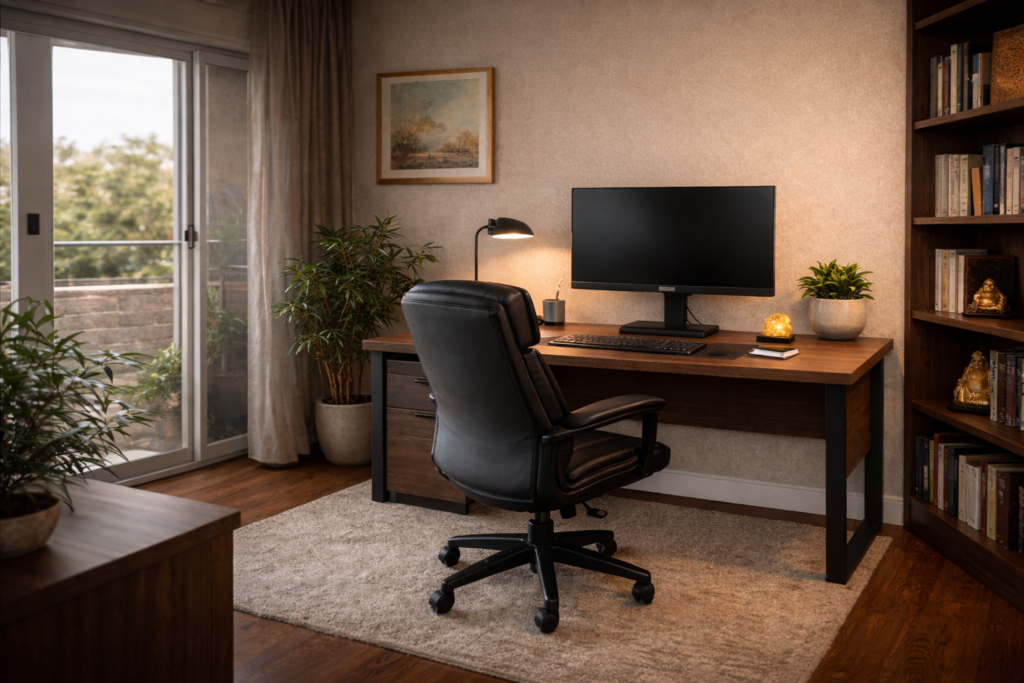
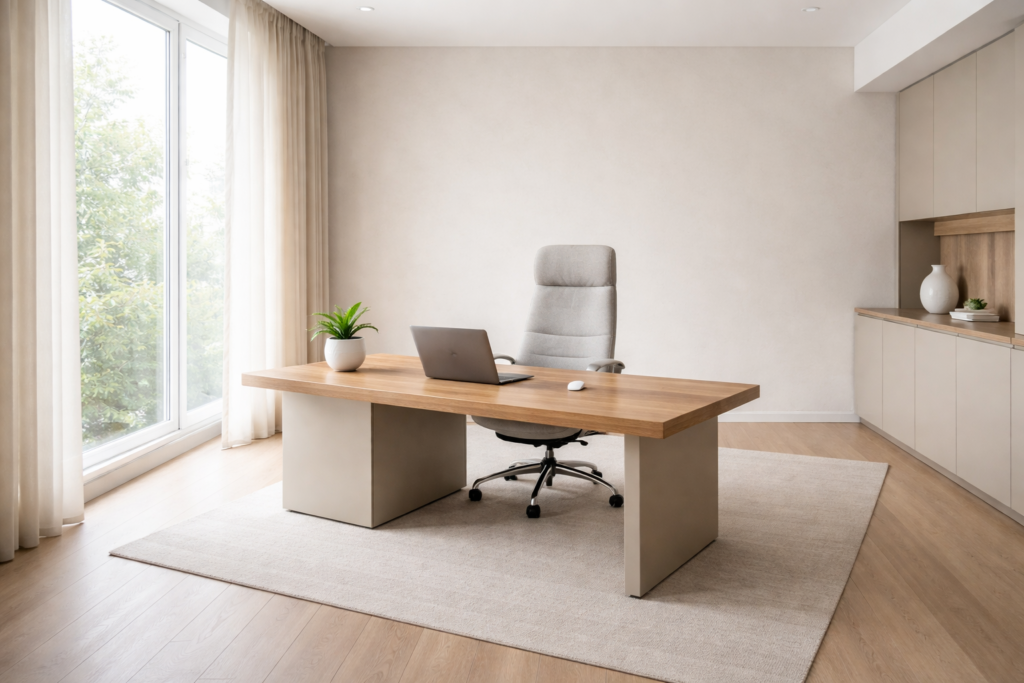
Feng Shui for career stability in India showing north-facing desk with solid wall backing in small apartment home office

The 1-Inch Shift: Small Desk Changes That Create Big Confidence and Income Results

The 1-Inch Shift: Small Desk Changes That Create Big Confidence and Income Results Small desk changes for confidence can improve posture, executive presence, and focus. Even a one-inch shift in desk angle or chair placement influences stability, tone, and authority during remote work. Most professionals think they need a full office redesign. They do not. Often, a one-inch adjustment changes how the body feels in the space. And how the body feels affects how you lead. This article focuses on small desk changes for confidence. Not renovation. Not decoration. Micro-adjustments. Because confidence is not always about motivation. Sometimes it is about angle. Why Micro-Adjustments Matter More Than Renovations   Large changes feel dramatic. However, the nervous system responds faster to subtle shifts. When your desk angle changes slightly, your perception of control changes. When your chair moves closer to a wall, stability increases. Small inputs. Measurable outputs. Environmental psychology shows that humans adapt quickly to spatial cues. Therefore, minor adjustments often produce immediate behavioral shifts. You do not need a new office. You need precision. The 1-Inch Angle Shift   If your desk sits parallel to the wall, try rotating it slightly toward the entrance. Not fully. Just enough to widen your field of view. This small desk change for confidence increases spatial awareness. When you can see more of the room, tension reduces. Reduced tension improves posture. Improved posture strengthens presence. Presence affects opportunity. The 3-Inch Backing Adjustment   Move your chair closer to a solid wall. Even three inches matter. When the back feels supported, the shoulders relax. Relaxed shoulders improve breathing. Breathing affects tone. Tone affects leadership perception. This adjustment costs nothing. Yet it alters authority signals. Raise the Monitor by One Inch   Eye level matters. If your screen sits too low, you look down during calls. Looking down reduces perceived confidence. Raise the monitor slightly so your gaze aligns naturally with the camera. Aligned gaze increases credibility. This is camera psychology. Not Feng Shui mythology. Clear 20% of Surface Area   Do not remove everything. Remove 20%. That small reduction creates visible negative space. Negative space signals order. Order signals control. Control increases confidence. This is not about minimalism trends. It is about cognitive signaling. Add One Vertical Element   Confidence is reinforced by vertical lines. Add a tall lamp. Or a narrow bookshelf. Or a vertical framed print. Vertical structure stabilizes the visual field. Stability reinforces grounded posture. Grounded posture reinforces authority. Adjust Lighting Direction   Lighting behind you creates silhouette instability. Shift your light source slightly forward or to the side. Balanced lighting improves facial clarity. Facial clarity increases trust. Trust increases professional opportunities. This is practical positioning. The 5-Minute Micro Audit   Before buying anything, test this: • Rotate desk slightly• Move chair closer to wall• Raise monitor• Remove 20% surface clutter• Adjust light angle Observe how your body feels. If posture improves, keep it. If not, adjust again. Micro-testing creates personalized optimization. India-Specific Application   In 1 BHK or 2 BHK apartments, space is tight. That is why micro-adjustments matter more. You may not move walls. But you can shift angles. You may not buy new furniture. But you can reposition. Small apartments amplify instability. Precision restores it. The Compound Effect of Small Desk Changes   A one-inch shift seems minor. However, repeated daily posture reinforcement compounds. Confidence becomes embodied. Embodied confidence changes how you speak. Speech changes perception. Perception changes opportunity flow. This is environmental leverage. Not decoration. Continue the Executive Workspace Series   Your workspace shapes your posture, presence, and professional performance. If you want to build a complete high-authority environment, continue with the full Executive Workspace Series:   1. The Invisible Script Learn how environmental psychology of the home office influences daily decisions, focus patterns, and behavioral momentum. This foundation explains how space quietly shapes habits and executive thinking.→ Read: How Your Home Environment Shapes Habits and Decisions   2. Desk Setup for Confidence (The Wealth Wall) Discover how physical backing, vertical stability, and command position placement strengthen authority, posture, and leadership presence during remote work.→ Read: Desk Setup for Confidence: The Wealth Wall Strategy   3. Feng Shui for Wealth & Focus (Hub Guide) Explore the complete framework connecting environmental psychology, workspace structure, and financial opportunity. This guide integrates focus, stability, and strategic spatial design into one cohesive system.→ Read: Feng Shui for Wealth & Focus: How Your Space Shapes Money, Work, and Opportunity   Small structural shifts create measurable professional impact. Build your environment deliberately.Then let your performance follow.   Conclusion: Precision Over Renovation   You do not need dramatic change. You need intentional calibration. Small desk changes for confidence influence posture, tone, and authority. And those influence career outcomes. Adjust your space. Then observe your presence. FAQ: Small Desk Changes for Confidence   Can small desk adjustments really change confidence? Yes. Minor changes influence posture and visual stability. Posture directly affects breathing and tone, which shape perceived authority.   How much should I rotate my desk? Even a slight diagonal shift toward the entrance improves spatial awareness. Avoid dramatic repositioning unless necessary.   What is the fastest change I can test? Move your chair closer to a wall and raise your monitor to eye level. These produce immediate posture improvements.   Do I need to buy new furniture? No. Start with repositioning existing elements. Purchase only if structural support is missing. Disclaimer: The content on Mind Boggling Studio is for informational and educational purposes only. Feng Shui results are highly personal and are not guaranteed to produce specific financial or life outcomes. Any wellness recommendations, such as weighted eye masks or mindset tools, are not a substitute for professional medical or psychological advice. Always consult with a qualified professional before beginning new health or lifestyle routines.

Feng Shui & Environmental Psychology, Home Office Optimization

The 1-Inch Shift: Small Desk Changes That Create Big Confidence and Income Results Read Post »

Feng Shui for career stability in India showing north-facing desk with solid wall backing in small apartment home office

Global Ambition, Local Peace: Feng Shui for Career Stability in Indian Offices & WFH Setups

Global Ambition, Local Peace: Feng Shui for Career Stability in Indian Offices & WFH Setups Feng Shui for career stability in India combines Vastu direction principles with environmental psychology. Proper desk placement, solid backing, and visual balance reduce stress signals and support long-term professional focus in Indian home offices and hybrid workspaces. Why Indian Workspaces Need Cultural Adaptation   Feng Shui for career stability in India cannot ignore local context. Many professionals work from 1 BHK or 2 BHK flats. At the same time, they serve global companies and clients. This creates a tension. Global ambition.Local spatial constraints. Therefore, workspace design must integrate both psychological structure and directional traditions such as Vastu. This is not about belief. It is about stability. Why Career Stability Is a Spatial Issue   Career growth depends on consistent performance. Consistent performance depends on focus. Focus depends on nervous system regulation. In compact Indian homes, visual density increases quickly. Because rooms serve multiple functions, boundaries blur. As a result, the brain remains semi-alert. Semi-alert states reduce deep thinking. Deep thinking supports strategic growth. Therefore, spatial order becomes a professional asset. Vastu and Feng Shui: What Actually Overlaps   Many assume Vastu and Feng Shui are identical. They are not. However, both emphasize: • Directional alignment• Stable backing• Balanced visual flow Vastu focuses strongly on cardinal directions. Feng Shui emphasizes command position and energy flow. When combined practically, they create a structured framework for Indian professionals. Best Desk Direction for Career Stability in India   Direction influences perception. According to Vastu tradition, facing north or east is considered supportive for professional growth. These directions are associated with clarity and opportunity. From a psychological lens, facing a direction with open visual depth reduces compression. However, direction alone is not enough. Backing matters more. The Command Position Within Indian Layouts   Even in Indian flats, apply command position. See the entrance. Avoid sitting directly in line with it. Have a solid wall behind you. Because when your back feels exposed, subconscious vigilance increases. While you may not notice it, your posture tightens. Tight posture reduces vocal stability during calls. Vocal stability influences authority perception. North-Facing Desk Benefits: A Practical View   North-facing desk benefits are often discussed symbolically. However, the practical advantage is lighting and orientation. North light tends to be softer and consistent. Consistent light reduces visual fatigue. Reduced fatigue supports sustained focus. Therefore, direction should support comfort first. Symbolism comes second. Small Apartment Application: 1 BHK & 2 BHK Adaptation   Indian apartments present real constraints. You may not control room direction. You may share space with family. You may work from a bedroom corner. Therefore, precision matters. If a north-facing desk is impossible, prioritize: • Solid backing• Clear front view• Minimal overhead clutter• Vertical stability behind chair Because stability is more important than perfection. The Survival Wall Principle   In compact homes, many desks float in open rooms. This creates subtle instability. Instead, move against a wall whenever possible. If walls are limited, use: • Tall bookshelf• Folding partition• High-back ergonomic chair Visual solidity reduces subconscious scanning. Scanning reduces focus. Visual Density and Career Momentum   Indian homes often contain: • Multiple storage units• Decorative elements• Open shelves Visual density increases cognitive tension. Reduce 20% of visible surface clutter. This is not minimalism. It is visual relief. Visual relief increases calm. Calm supports consistent output. Hybrid Professionals: Global Meetings, Local Rooms   Indian professionals often attend global calls. Your background becomes part of your brand. Ensure: • Stable wall behind• Neutral tone• Balanced lighting• No chaotic movement behind you Because global teams interpret background stability as leadership presence. Leadership presence supports career growth. The Wealth Corner in Indian Context   Traditionally, the far-left desk corner represents wealth. Instead of over-decorating, place one structured anchor. For example: • Small citrine stone• Minimal Laughing Buddha• Framed professional certificate This acts as a cognitive cue. When stress rises, the eye lands on achievement symbolism. Symbolism interrupts scarcity thinking. Scarcity thinking weakens negotiation. Feng Shui Citrine Stone Compact Citrine Desk Stone   A small citrine stone placed intentionally in the far-left desk area can serve as a visual anchor for professional focus. Keep the surrounding space clean for maximum psychological clarity. 👉 Explore this Feng Shui support item Balancing Tradition with Performance   Blindly following direction rules creates rigidity. Ignoring tradition creates internal conflict. Balance both. Use direction when practical. Prioritize stability when necessary. Because career stability comes from sustained clarity, not symbolic perfection. Conclusion: Structured Space, Sustainable Growth   Feng Shui for career stability in India is not about ritual. It is about structure. Solid backing.Clear direction.Reduced visual density.Stable lighting. When space feels grounded, performance stabilizes. Stability compounds. And career growth follows consistency. Continue the Executive Workspace Serie Strengthen your full workspace strategy: • Read: The Invisible Script – How Home Environments Shape Habits & Decisions• Read: Desk Setup for Confidence – The Wealth Wall Strategy• Read: The 1-Inch Shift – Small Desk Changes That Create Big Results • Read: Feng Shui for Wealth & Focus: How Your Space Shapes Money, Work, and Opportunity • Read: Feng Shui Dragon Placement for Career Success FAQ   What is the best desk direction for career stability in India? Facing north or east is traditionally considered supportive. However, stable backing and visual clarity matter more than strict directional perfection.   Can Vastu and Feng Shui be combined? Yes. Vastu provides directional guidance, while Feng Shui emphasizes command position and spatial balance. Together, they create a structured approach.   What if my flat does not allow ideal direction? Prioritize solid backing, stable lighting, and reduced clutter. Practical stability outweighs ideal direction.   Does desk placement really affect career growth? Indirectly, yes. Structured space reduces stress signals and improves consistent performance, which supports long-term professional advancement. Disclosure: As an Amazon Associate, I earn from qualifying purchases. This post contains affiliate links for products I recommend for your wellbeing. If you click and buy through these links, I may receive a small commission

Feng Shui for Indian Homes, Home Office Optimization

Global Ambition, Local Peace: Feng Shui for Career Stability in Indian Offices & WFH Setups Read Post »

Feng Shui for career stability in India showing north-facing desk with solid wall backing in small apartment home office

The 1-Inch Shift: Small Desk Changes That Create Big Confidence and Income Results

The 1-Inch Shift: Small Desk Changes That Create Big Confidence and Income Results Small desk changes for confidence can improve posture, executive presence, and focus. Even a one-inch shift in desk angle or chair placement influences stability, tone, and authority during remote work. Most professionals think they need a full office redesign. They do not. Often, a one-inch adjustment changes how the body feels in the space. And how the body feels affects how you lead. This article focuses on small desk changes for confidence. Not renovation. Not decoration. Micro-adjustments. Because confidence is not always about motivation. Sometimes it is about angle. Why Micro-Adjustments Matter More Than Renovations   Large changes feel dramatic. However, the nervous system responds faster to subtle shifts. When your desk angle changes slightly, your perception of control changes. When your chair moves closer to a wall, stability increases. Small inputs. Measurable outputs. Environmental psychology shows that humans adapt quickly to spatial cues. Therefore, minor adjustments often produce immediate behavioral shifts. You do not need a new office. You need precision. The 1-Inch Angle Shift   If your desk sits parallel to the wall, try rotating it slightly toward the entrance. Not fully. Just enough to widen your field of view. This small desk change for confidence increases spatial awareness. When you can see more of the room, tension reduces. Reduced tension improves posture. Improved posture strengthens presence. Presence affects opportunity. The 3-Inch Backing Adjustment   Move your chair closer to a solid wall. Even three inches matter. When the back feels supported, the shoulders relax. Relaxed shoulders improve breathing. Breathing affects tone. Tone affects leadership perception. This adjustment costs nothing. Yet it alters authority signals. Raise the Monitor by One Inch   Eye level matters. If your screen sits too low, you look down during calls. Looking down reduces perceived confidence. Raise the monitor slightly so your gaze aligns naturally with the camera. Aligned gaze increases credibility. This is camera psychology. Not Feng Shui mythology. Clear 20% of Surface Area   Do not remove everything. Remove 20%. That small reduction creates visible negative space. Negative space signals order. Order signals control. Control increases confidence. This is not about minimalism trends. It is about cognitive signaling. Add One Vertical Element   Confidence is reinforced by vertical lines. Add a tall lamp. Or a narrow bookshelf. Or a vertical framed print. Vertical structure stabilizes the visual field. Stability reinforces grounded posture. Grounded posture reinforces authority. Adjust Lighting Direction   Lighting behind you creates silhouette instability. Shift your light source slightly forward or to the side. Balanced lighting improves facial clarity. Facial clarity increases trust. Trust increases professional opportunities. This is practical positioning. The 5-Minute Micro Audit   Before buying anything, test this: • Rotate desk slightly• Move chair closer to wall• Raise monitor• Remove 20% surface clutter• Adjust light angle Observe how your body feels. If posture improves, keep it. If not, adjust again. Micro-testing creates personalized optimization. India-Specific Application   In 1 BHK or 2 BHK apartments, space is tight. That is why micro-adjustments matter more. You may not move walls. But you can shift angles. You may not buy new furniture. But you can reposition. Small apartments amplify instability. Precision restores it. The Compound Effect of Small Desk Changes   A one-inch shift seems minor. However, repeated daily posture reinforcement compounds. Confidence becomes embodied. Embodied confidence changes how you speak. Speech changes perception. Perception changes opportunity flow. This is environmental leverage. Not decoration. Continue the Executive Workspace Series   Your workspace shapes your posture, presence, and professional performance. If you want to build a complete high-authority environment, continue with the full Executive Workspace Series:   1. The Invisible Script Learn how environmental psychology of the home office influences daily decisions, focus patterns, and behavioral momentum. This foundation explains how space quietly shapes habits and executive thinking.→ Read: How Your Home Environment Shapes Habits and Decisions   2. Desk Setup for Confidence (The Wealth Wall) Discover how physical backing, vertical stability, and command position placement strengthen authority, posture, and leadership presence during remote work.→ Read: Desk Setup for Confidence: The Wealth Wall Strategy   3. Feng Shui for Wealth & Focus (Hub Guide) Explore the complete framework connecting environmental psychology, workspace structure, and financial opportunity. This guide integrates focus, stability, and strategic spatial design into one cohesive system.→ Read: Feng Shui for Wealth & Focus: How Your Space Shapes Money, Work, and Opportunity   Small structural shifts create measurable professional impact. Build your environment deliberately.Then let your performance follow.   Conclusion: Precision Over Renovation   You do not need dramatic change. You need intentional calibration. Small desk changes for confidence influence posture, tone, and authority. And those influence career outcomes. Adjust your space. Then observe your presence. FAQ: Small Desk Changes for Confidence   Can small desk adjustments really change confidence? Yes. Minor changes influence posture and visual stability. Posture directly affects breathing and tone, which shape perceived authority.   How much should I rotate my desk? Even a slight diagonal shift toward the entrance improves spatial awareness. Avoid dramatic repositioning unless necessary.   What is the fastest change I can test? Move your chair closer to a wall and raise your monitor to eye level. These produce immediate posture improvements.   Do I need to buy new furniture? No. Start with repositioning existing elements. Purchase only if structural support is missing. Disclaimer: The content on Mind Boggling Studio is for informational and educational purposes only. Feng Shui results are highly personal and are not guaranteed to produce specific financial or life outcomes. Any wellness recommendations, such as weighted eye masks or mindset tools, are not a substitute for professional medical or psychological advice. Always consult with a qualified professional before beginning new health or lifestyle routines.

Feng Shui & Environmental Psychology, Home Office Optimization

The 1-Inch Shift: Small Desk Changes That Create Big Confidence and Income Results Read Post »

Visual clutter in home office increasing cognitive load compared to organized desk reducing decision fatigue remote work

The Invisible Script: How Environmental Psychology of Your Home Office Shapes Success

The Invisible Script: How Your Home Environment Shapes Your Habits and Decisions Environmental psychology of home office design explains why cluttered spaces increase decision fatigue in remote work. Your workspace creates spatial habits that either reduce cognitive load or drain executive focus. By applying neuroscience of spatial design, you convert your desk into a productivity system. The Hidden Cost of a Messy Desk You sit down to work. However, before you open a document, you adjust papers, move cables, and check your phone. This is not lack of discipline. It is environmental friction. In the environmental psychology of home office research field, physical space acts as behavioral architecture. Your desk sends constant visual cues. Because the brain processes every visible object, clutter increases cognitive load. As a result, energy leaks before meaningful work begins. Remote professionals experience this daily. Therefore, solving decision fatigue in remote work begins with spatial clarity, not motivation. Your workspace is either structured support. Or silent resistance. 🎁 [FREE DOWNLOAD] The 5-Minute Executive Office Audit Don’t just read—act. Download our neuroscience-backed checklist to identify the 5 “Invisible Scripts” in your office that are killing your productivity. Click Here to Download theThe 5-Minute Executive Office Audit PDF Checklist. DOWNLOAD NOW! How Environment Controls Habits: The Science of Choice Architecture Your environment automates behavior. Each object on your desk acts as a visual trigger. Because the brain seeks efficiency, it forms automated responses to repeated cues. For example, a visible phone triggers checking behavior. An open browser tab triggers distraction. Similarly, scattered documents trigger unfinished-task anxiety. These are spatial habits. According to behavioral economics, choice architecture influences decision pathways. When too many visual signals compete, the brain must filter constantly. That filtering consumes working memory. Working memory fuels executive thinking. Therefore, clutter reduces strategic capacity. High performers simplify inputs. Not because it looks minimal. But because it protects cognitive resources. The Cost of Visual Clutter on Executive Function Visual clutter competes for neural attention. The primary visual cortex scans everything in your field of view. Even when you ignore objects, your brain registers them. Because unfinished items represent unresolved tasks, they create subtle tension. Subtle tension increases stress hormones. While the effect is small, it accumulates across hours. As a result, the prefrontal cortex tires faster. The prefrontal cortex manages planning and financial judgment. Therefore, clutter indirectly impacts income quality. This is not superstition. It is neuro-architecture. The Neuroscience of Spatial Design: Wiring Your Brain for Wealth Feng Shui uses symbolic language. Neuroscience uses biological language. However, both describe environmental regulation. When layout feels unpredictable, the amygdala activates. The amygdala monitors threat. While your office is safe, your brain still scans for movement behind you or blocked sightlines. This scanning reduces executive clarity. However, when the desk faces the entrance and the back feels supported, the brain relaxes. Because the environment appears stable, survival vigilance decreases. As a result, strategic thinking improves. This is why spatial design affects income decisions. Income depends on judgment. Judgment depends on regulated attention. Attention depends on environmental calm. From “Tangled Qi” to Tangible ROI: The Psychology of Cable Management Loose cables fragment visual flow. Fragmentation increases perceptual stress. Because the brain prefers continuity, exposed wires create small disruptions in spatial coherence. Over time, these disruptions increase irritability and reduce focus stamina. Cable management solves this quietly. When wires are hidden, surfaces appear smooth. As a result, attention stabilizes. Less scanning. Less micro-stress. More endurance for deep work. This is the ROI of environment. Activate Your Success Anchors: The Psychology of Wealth Symbols To complete your office transformation, you must prime your subconscious mind for abundance. In environmental psychology, we use “Spatial Anchors” to trigger success-oriented mindsets: The Laughing Buddha (The Stress Transformer): Place this facing your entrance. It serves as a visual “Pattern Interrupter,” reminding your brain that wealth flows through joy, not struggle. [Check Price on Amazon] The Wealth Ship (The Opportunity Magnet): Position this “sailing” into your room. It creates a psychological “Inflow” bias, priming you to recognize new global opportunities. [Check Price on Amazon] Chinese Wealth Coins (The Legacy Anchor): Keep these near your computer or in your desk drawer to anchor your daily work to long-term financial goals. [Check Price on Amazon] Note: This article shares educational insights on environmental design and productivity. It does not replace professional advice. Product links may earn us a small commission. Essential Tools for a High-Performance Office To achieve a “Pass” on your productivity audit, these tools are non-negotiable for maintaining an executive-level environment: Minimalist Desk Organizers: Essential for eliminating visual clutter and stopping decision fatigue instantly. [Check out the top-rated Minimalist Organizers on Amazon] Pro Cable Management Kits: The fastest way to hide “Tangled Qi” and lower subconscious stress levels in your workspace. [View the best-selling Cable Management solutions here] High-Back Ergonomic Chairs: Provides the “Mountain Support” your nervous system requires for long-term confidence and focus. [Find the best Ergonomic Executive Chairs for your home office] Solving Decision Fatigue in Remote Work with Strategic Zoning Remote work blends roles. Without boundaries, the brain struggles to switch contexts. Therefore, decision fatigue in remote work increases. Instead, create defined zones. Deep Work Zone: Clear surface. Single monitor. No peripheral items.Admin Zone: Side desk or secondary corner.Creative Zone: Notebook and plant. Softer light. Because memory is context-dependent, location primes behavior. When you sit in the Deep Work Zone, your brain associates it with focused execution. Transitions become automatic. As a result, willpower lasts longer. The Command Position: Why Executives Sit Where They Do The Command Position aligns with subconscious safety. See the door. Avoid sitting directly in line with it. Have solid support behind you. When you can visually monitor entry points, the startle response reduces. Therefore, the amygdala relaxes. When your back feels supported, posture stabilizes. As a result, breathing improves. Improved breathing stabilizes vocal tone. Stable tone increases executive presence. This is how seating affects leadership confidence. Mastering Spatial Habits: A 7-Day Environmental Reset Change space. Behavior follows. This reset applies

Environmental Psychology, Feng Shui & Environmental Psychology, Home Office Optimization

The Invisible Script: How Environmental Psychology of Your Home Office Shapes Success Read Post »

Scroll to Top
Mind Boggling Studio logo with brain design representing mindset and thinking
Privacy Overview

This website uses cookies so that we can provide you with the best user experience possible. Cookie information is stored in your browser and performs functions such as recognising you when you return to our website and helping our team to understand which sections of the website you find most interesting and useful.