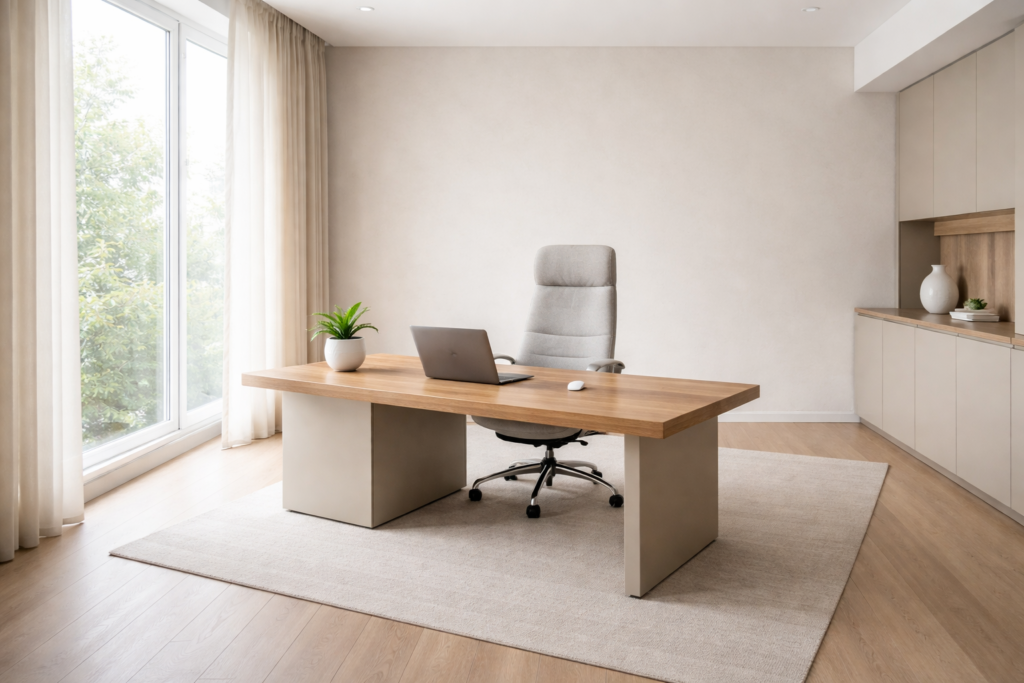
Visual clutter in home office increasing cognitive load compared to organized desk reducing decision fatigue remote work

The Invisible Script: How Environmental Psychology of Your Home Office Shapes Success

The Invisible Script: How Your Home Environment Shapes Your Habits and Decisions Environmental psychology of home office design explains why cluttered spaces increase decision fatigue in remote work. Your workspace creates spatial habits that either reduce cognitive load or drain executive focus. By applying neuroscience of spatial design, you convert your desk into a productivity system. The Hidden Cost of a Messy Desk You sit down to work. However, before you open a document, you adjust papers, move cables, and check your phone. This is not lack of discipline. It is environmental friction. In the environmental psychology of home office research field, physical space acts as behavioral architecture. Your desk sends constant visual cues. Because the brain processes every visible object, clutter increases cognitive load. As a result, energy leaks before meaningful work begins. Remote professionals experience this daily. Therefore, solving decision fatigue in remote work begins with spatial clarity, not motivation. Your workspace is either structured support. Or silent resistance. šŸŽ [FREE DOWNLOAD] The 5-Minute Executive Office Audit Don’t just read—act. Download our neuroscience-backed checklist to identify the 5 “Invisible Scripts” in your office that are killing your productivity. Click Here to Download theThe 5-Minute Executive Office Audit PDF Checklist. DOWNLOAD NOW! How Environment Controls Habits: The Science of Choice Architecture Your environment automates behavior. Each object on your desk acts as a visual trigger. Because the brain seeks efficiency, it forms automated responses to repeated cues. For example, a visible phone triggers checking behavior. An open browser tab triggers distraction. Similarly, scattered documents trigger unfinished-task anxiety. These are spatial habits. According to behavioral economics, choice architecture influences decision pathways. When too many visual signals compete, the brain must filter constantly. That filtering consumes working memory. Working memory fuels executive thinking. Therefore, clutter reduces strategic capacity. High performers simplify inputs. Not because it looks minimal. But because it protects cognitive resources. The Cost of Visual Clutter on Executive Function Visual clutter competes for neural attention. The primary visual cortex scans everything in your field of view. Even when you ignore objects, your brain registers them. Because unfinished items represent unresolved tasks, they create subtle tension. Subtle tension increases stress hormones. While the effect is small, it accumulates across hours. As a result, the prefrontal cortex tires faster. The prefrontal cortex manages planning and financial judgment. Therefore, clutter indirectly impacts income quality. This is not superstition. It is neuro-architecture. The Neuroscience of Spatial Design: Wiring Your Brain for Wealth Feng Shui uses symbolic language. Neuroscience uses biological language. However, both describe environmental regulation. When layout feels unpredictable, the amygdala activates. The amygdala monitors threat. While your office is safe, your brain still scans for movement behind you or blocked sightlines. This scanning reduces executive clarity. However, when the desk faces the entrance and the back feels supported, the brain relaxes. Because the environment appears stable, survival vigilance decreases. As a result, strategic thinking improves. This is why spatial design affects income decisions. Income depends on judgment. Judgment depends on regulated attention. Attention depends on environmental calm. From ā€œTangled Qiā€ to Tangible ROI: The Psychology of Cable Management Loose cables fragment visual flow. Fragmentation increases perceptual stress. Because the brain prefers continuity, exposed wires create small disruptions in spatial coherence. Over time, these disruptions increase irritability and reduce focus stamina. Cable management solves this quietly. When wires are hidden, surfaces appear smooth. As a result, attention stabilizes. Less scanning. Less micro-stress. More endurance for deep work. This is the ROI of environment. Activate Your Success Anchors: The Psychology of Wealth Symbols To complete your office transformation, you must prime your subconscious mind for abundance. In environmental psychology, we use “Spatial Anchors” to trigger success-oriented mindsets: The Laughing Buddha (The Stress Transformer): Place this facing your entrance. It serves as a visual “Pattern Interrupter,” reminding your brain that wealth flows through joy, not struggle. [Check Price on Amazon] The Wealth Ship (The Opportunity Magnet): Position this “sailing” into your room. It creates a psychological “Inflow” bias, priming you to recognize new global opportunities. [Check Price on Amazon] Chinese Wealth Coins (The Legacy Anchor): Keep these near your computer or in your desk drawer to anchor your daily work to long-term financial goals. [Check Price on Amazon] Note: This article shares educational insights on environmental design and productivity. It does not replace professional advice. Product links may earn us a small commission. Essential Tools for a High-Performance Office To achieve a “Pass” on your productivity audit, these tools are non-negotiable for maintaining an executive-level environment: Minimalist Desk Organizers: Essential for eliminating visual clutter and stopping decision fatigue instantly. [Check out the top-rated Minimalist Organizers on Amazon] Pro Cable Management Kits: The fastest way to hide “Tangled Qi” and lower subconscious stress levels in your workspace. [View the best-selling Cable Management solutions here] High-Back Ergonomic Chairs: Provides the “Mountain Support” your nervous system requires for long-term confidence and focus. [Find the best Ergonomic Executive Chairs for your home office] Solving Decision Fatigue in Remote Work with Strategic Zoning Remote work blends roles. Without boundaries, the brain struggles to switch contexts. Therefore, decision fatigue in remote work increases. Instead, create defined zones. Deep Work Zone: Clear surface. Single monitor. No peripheral items.Admin Zone: Side desk or secondary corner.Creative Zone: Notebook and plant. Softer light. Because memory is context-dependent, location primes behavior. When you sit in the Deep Work Zone, your brain associates it with focused execution. Transitions become automatic. As a result, willpower lasts longer. The Command Position: Why Executives Sit Where They Do The Command Position aligns with subconscious safety. See the door. Avoid sitting directly in line with it. Have solid support behind you. When you can visually monitor entry points, the startle response reduces. Therefore, the amygdala relaxes. When your back feels supported, posture stabilizes. As a result, breathing improves. Improved breathing stabilizes vocal tone. Stable tone increases executive presence. This is how seating affects leadership confidence. Mastering Spatial Habits: A 7-Day Environmental Reset Change space. Behavior follows. This reset applies

Environmental Psychology, Feng Shui & Environmental Psychology, Home Office Optimization

The Invisible Script: How Environmental Psychology of Your Home Office Shapes Success Read Post Ā»