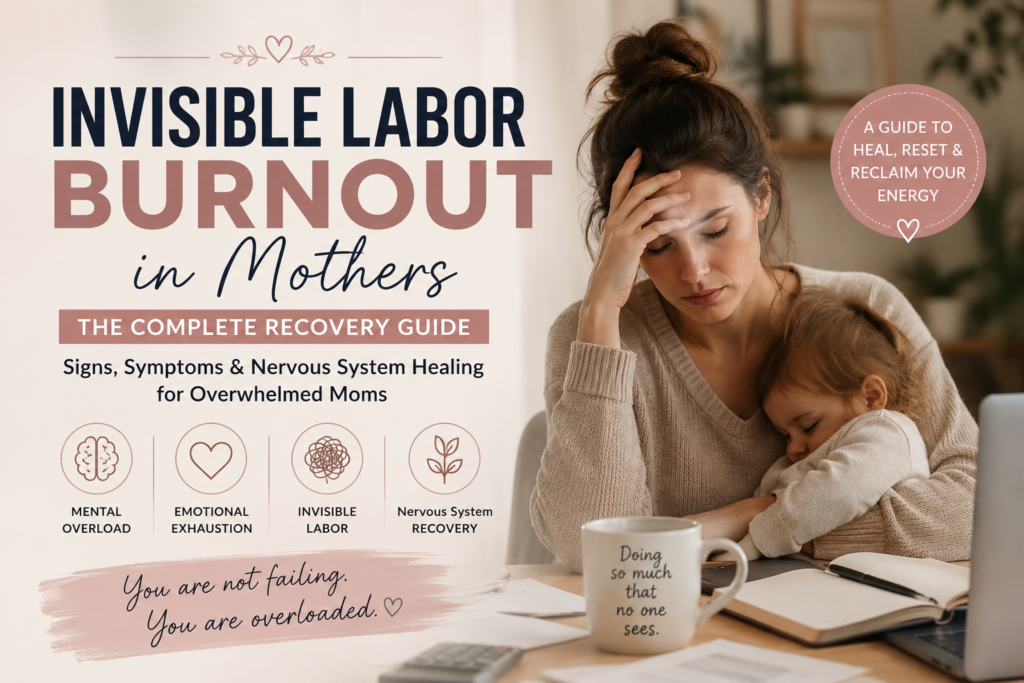
Why Overwhelmed Moms Feel Tired Even After Sleeping

Exhausted mom symptoms often have very little to do with how many hours you spend in bed.
You went to bed.
You got several hours of sleep.
Yet somehow, you wake up feeling just as exhausted as you did the day before.
If this sounds familiar, you are not alone.
Many mothers experience persistent fatigue that does not improve with more rest.
In fact, one of the most common exhausted mom symptoms is feeling physically tired, mentally drained, and emotionally depleted even after a full night’s sleep.
At first, exhaustion can seem like a sleep problem.
However, sleep is not always the real issue.
For many overwhelmed mothers, the deeper cause is ongoing mental load, emotional labor, and nervous system overload.
Long before your feet hit the floor each morning, your brain may already be tracking appointments, planning meals, remembering schedules, solving problems, and anticipating everyone’s needs.
Because of this, your mind rarely has an opportunity to fully switch off.
Even during periods of rest, part of your attention may remain focused on what needs to happen next.
Over time, this constant responsibility can contribute to mental fatigue, emotional exhaustion, and many of the exhausted mom symptoms that leave mothers feeling worn out no matter how much they sleep.
Fortunately, understanding the source of your exhaustion is the first step toward changing it.
In this guide, you’ll learn why so many overwhelmed moms feel tired even after sleeping, how mental load affects energy levels, what role the nervous system plays in recovery, and practical strategies that support lasting healing rather than temporary relief.
What Are Exhausted Mom Symptoms?
Many mothers feel tired.
That is expected.
Parenting requires energy, attention, and emotional effort every single day.
However, there is a significant difference between normal tiredness and the persistent exhaustion that often appears with exhausted mom symptoms.
In many cases, sleep is not the only issue.
Instead, mental load, emotional labor, and ongoing stress may be driving the problem.
As a result, many mothers wake up feeling drained even after spending enough time in bed.
Over time, this exhaustion can affect focus, mood, motivation, and overall well-being.
Therefore, understanding the signs is an important first step toward recovery.
Common Exhausted Mom Symptoms
Although every mother’s experience is different, several symptoms appear again and again.
Common exhausted mom symptoms include:
waking up tired despite sleeping
mental fatigue
brain fog
forgetfulness
difficulty concentrating
emotional exhaustion
feeling overwhelmed by simple tasks
low motivation
decision fatigue
irritability
feeling disconnected from yourself
In addition, many overwhelmed moms describe feeling as though they are constantly running on empty.
Even after they complete their daily tasks, true recovery often feels out of reach.
Why Sleep Doesn’t Always Fix Exhaustion
At first glance, exhaustion seems like a sleep problem.
However, the reality is often more complex.
For many mothers, the brain keeps working long after the body stops moving.
You remember appointments. You review schedules. You solve problems before they happen. You think about everyone’s needs.
Meanwhile, your mind continues planning, organizing, and preparing for what comes next.
As a result, your brain rarely gets a chance to fully switch off.
Consequently, the nervous system may remain activated even during periods of rest.
Therefore, a full night’s sleep does not always provide the recovery that exhausted mothers need.
The Difference Between Being Tired and Being Depleted
Being tired and being depleted are not the same thing.
Typically, tiredness improves after rest.
Depletion does not.
Instead, depletion develops when mental, emotional, and physical resources are used faster than they can be restored.
For example, constant responsibility, chronic stress, and mental load can gradually wear down the nervous system.
Eventually, even simple daily tasks may begin to feel difficult.
This is why many mothers experiencing exhausted mom symptoms continue feeling exhausted despite sleeping.
The issue is not always a lack of sleep.
More often, the issue is a lack of true recovery.
Until the deeper cause is addressed, exhaustion may continue no matter how many hours you spend in bed.
What Are Exhausted Mom Symptoms?
Many mothers feel tired.
That is expected.
Parenting requires energy, attention, and emotional effort every single day.
However, there is a significant difference between normal tiredness and the persistent exhaustion that often appears with exhausted mom symptoms.
You remember appointments. You review schedules. You solve problems before they happen. You think about everyone’s needs.
In many cases, sleep is not the only issue.
Instead, mental load, emotional labor, and ongoing stress may be driving the problem.
As a result, many mothers wake up feeling drained even after spending enough time in bed.
Over time, this exhaustion can affect focus, mood, motivation, and overall well-being.
Therefore, understanding the signs is an important first step toward recovery.
Common Exhausted Mom Symptoms
Although every mother’s experience is different, several symptoms appear again and again.
Common exhausted mom symptoms include:
waking up tired despite sleeping
mental fatigue
brain fog
forgetfulness
difficulty concentrating
emotional exhaustion
feeling overwhelmed by simple tasks
low motivation
decision fatigue
irritability
feeling disconnected from yourself
In addition, many overwhelmed moms describe feeling as though they are constantly running on empty.
Even after they complete their daily tasks, true recovery often feels out of reach.
Why Sleep Doesn’t Always Fix Exhaustion
At first glance, exhaustion seems like a sleep problem.
However, the reality is often more complex.
For many mothers, the brain keeps working long after the body stops moving.
Meanwhile, your mind continues planning, organizing, and preparing for what comes next.
As a result, your brain rarely gets a chance to fully switch off.
Consequently, the nervous system may remain activated even during periods of rest.
Therefore, a full night’s sleep does not always provide the recovery that exhausted mothers need.
The Difference Between Being Tired and Being Depleted
Being tired and being depleted are not the same thing.
Typically, tiredness improves after rest.
Depletion does not.
Instead, depletion develops when mental, emotional, and physical resources are used faster than they can be restored.
For example, constant responsibility, chronic stress, and mental load can gradually wear down the nervous system.
Eventually, even simple daily tasks may begin to feel difficult.
This is why many mothers experiencing exhausted mom symptoms continue feeling exhausted despite sleeping.
The issue is not always a lack of sleep.
More often, the issue is a lack of true recovery.
Until the deeper cause is addressed, exhaustion may continue no matter how many hours you spend in bed.
Why Overwhelmed Moms Feel Tired Even After Sleeping
Many mothers assume that exhaustion is caused by a lack of sleep.
While sleep deprivation can certainly contribute to fatigue, it is not always the main reason overwhelmed moms feel tired.
In fact, many mothers spend enough time in bed and still wake up feeling drained.
This can be confusing.
After all, sleep is supposed to restore energy.
However, when mental fatigue, chronic stress, and ongoing responsibility are involved, sleep alone may not provide the recovery the mind and body need.
For many mothers, exhaustion is not simply a physical issue.
Instead, it is often the result of carrying a heavy mental load for an extended period of time.
The brain remains active.
Responsibilities continue.
The nervous system stays engaged.
As a result, true recovery becomes increasingly difficult.
Understanding why this happens can help explain many common exhausted mom symptoms and provide a clearer path toward recovery.
Mental Fatigue Keeps the Brain Working
Physical work is not the only type of work that consumes energy.
Mental work can be equally exhausting.
Throughout the day, many mothers make decisions, solve problems, remember schedules, manage household responsibilities, and anticipate future needs.
Each task requires cognitive effort.
While a single responsibility may seem small, hundreds of responsibilities can quickly add up.
Over time, this constant mental activity creates mental fatigue.
Consequently, the brain has fewer resources available for focus, patience, motivation, and emotional regulation.
Even when the body rests, the effects of mental fatigue can remain.
Why Your Mind Never Fully Switches Off
Many mothers describe feeling as though their brains are always running.
Even during quiet moments, thoughts often return to upcoming appointments, school schedules, household tasks, family needs, and unfinished responsibilities.
As a result, the mind rarely experiences complete downtime.
Instead of fully relaxing, the brain continues scanning for what needs attention next.
This ongoing state of awareness can make recovery feel difficult, even after a full night’s sleep.
Therefore, many overwhelmed moms wake up feeling as though they never truly rested.
The Hidden Energy Cost of Constant Responsibility
Responsibility requires energy.
The more responsibilities a person carries, the more energy is consumed.
For many mothers, the challenge is not a single task.
The challenge is carrying responsibility for countless tasks at the same time.
Managing family schedules.
Remembering important dates.
Planning meals.
Coordinating appointments.
Supporting children emotionally.
Keeping daily life running smoothly.
Individually, these tasks may seem manageable.
Collectively, they create a significant hidden workload.
Over time, this constant responsibility can contribute to emotional exhaustion, mental fatigue, and many of the exhausted mom symptoms that leave mothers feeling tired even after sleeping.
This is why recovery often requires more than rest alone.
It also requires reducing the mental burden that the brain has been carrying for far too long.
How Mental Load Creates Exhausted Mom Symptoms
Many mothers assume exhaustion comes from doing too much.
However, the problem is often bigger than the visible tasks on a to-do list.
For many women, the true source of exhaustion is the constant mental effort required to keep family life running smoothly.
This invisible workload is often referred to as the mental load.
It includes remembering, planning, organizing, anticipating, and managing countless responsibilities every day.
Unlike physical tasks, mental load rarely has a clear beginning or end.
Instead, it follows many mothers throughout the day and often into the night.
As a result, the brain receives very few opportunities to fully recover.
Over time, this ongoing mental effort can contribute to exhausted mom symptoms, mental fatigue, emotional exhaustion, and chronic stress.
Understanding how mental load affects energy levels can help explain why so many overwhelmed moms feel tired even after sleeping.
The Mental Load Most Mothers Carry
Mental load is the invisible work of managing everything that keeps a household functioning.
For many mothers, this includes:
remembering appointments
tracking school events
planning meals
managing schedules
organizing household tasks
anticipating family needs
coordinating responsibilities
While each task may seem small on its own, the combined effect can be significant.
In many families, mothers become the default planners, organizers, and problem-solvers.
Consequently, the brain remains occupied long before a task begins and long after it ends.
This ongoing mental effort is one of the most overlooked contributors to exhausted mom symptoms.
Why Remembering Everything Is Exhausting
Remembering information requires mental energy.
Remembering information for an entire family requires even more.
Many mothers carry a running checklist in their minds throughout the day.
Who needs to be picked up?
What appointment is coming up?
What needs to be purchased?
What task cannot be forgotten?
Meanwhile, new responsibilities continue to appear.
As a result, the brain rarely gets a break from tracking information.
Over time, this constant mental monitoring can contribute to mental fatigue, forgetfulness, and emotional exhaustion.
Ironically, the more information the brain tries to hold, the harder it often becomes to process new information efficiently.
When Planning Becomes a Full-Time Job
Planning is another hidden source of mental fatigue.
Many mothers are not simply managing today’s responsibilities.
They are also planning tomorrow, next week, and next month.
Meals are planned.
Schedules are coordinated.
Appointments are organized.
Potential problems are anticipated.
Family needs are considered in advance.
Consequently, the mind spends a significant amount of time living in the future.
While planning can help daily life run smoothly, constant planning also consumes valuable mental resources.
Over time, this hidden workload can leave mothers feeling mentally drained, emotionally depleted, and physically exhausted.
This is why mental load is more than an inconvenience.
For many women, it is a major contributor to the exhausted mom symptoms that persist even after a full night’s sleep.
Invisible Labor and Exhausted Mom Symptoms
Many mothers assume exhaustion comes from the tasks they can see.
The laundry.
The dishes.
The school runs.
The endless items on the family to-do list.
However, much of the exhaustion many mothers experience comes from work that is far less visible.
This hidden workload is known as invisible labor.
Unlike physical tasks, invisible labor often happens entirely in the mind.
It involves remembering, planning, organizing, anticipating, and managing countless responsibilities every day.
As a result, many mothers carry a significant mental burden long before a task actually needs to be completed.
Over time, this constant responsibility can contribute to exhausted mom symptoms, emotional exhaustion, and chronic stress.
The challenge is that invisible labor often goes unnoticed by others.
Consequently, many overwhelmed mothers feel exhausted while struggling to explain why.
If this hidden workload sounds familiar, you may also want to read our guide on Invisible Labor Burnout in Mothers: Signs, Symptoms & Recovery Guide, which explores how mental load, emotional labor, and invisible responsibilities can contribute to long-term burnout.
Understanding the connection between invisible labor and exhaustion can help make sense of why so many mothers feel tired even after sleeping.
The Work Nobody Sees
Invisible labor includes all the behind-the-scenes work required to keep family life functioning smoothly.
For many mothers, this means:
- remembering appointments
- tracking school events
- planning meals
- coordinating schedules
- anticipating family needs
- managing household logistics
Unlike physical tasks, this work rarely receives recognition.
Yet it requires constant attention.
Meanwhile, new responsibilities continue to appear throughout the day.
As a result, the brain remains occupied even when no visible task is being performed.
Emotional Labor Drains Energy Too
In addition to practical responsibilities, many mothers also carry a significant amount of emotional labor.
This includes managing emotions, resolving conflicts, supporting family members, and maintaining stability within the household.
Many mothers become the emotional anchor for everyone around them.
They notice when someone is struggling.
They provide encouragement.
They help solve problems.
They absorb stress that does not belong to them.
Consequently, emotional labor can consume just as much energy as physical work.
Over time, this invisible responsibility can contribute to emotional exhaustion, mental fatigue, and many common exhausted mom symptoms.
Why Invisible Labor Leads to Burnout
Burnout rarely happens overnight.
Instead, it often develops after months or years of carrying responsibilities without enough recovery.
Invisible labor keeps the mind engaged.
Emotional labor consumes energy.
Mental load demands constant attention.
Together, these pressures create a level of stress that can gradually overwhelm the nervous system.
As a result, many mothers begin experiencing brain fog, decision fatigue, irritability, emotional exhaustion, and persistent fatigue.
This is why invisible labor is more than a household issue.
For many overwhelmed mothers, it is one of the biggest drivers of burnout and a major contributor to the exhausted mom symptoms that continue long after a good night’s sleep.
Nervous System Overload: The Hidden Cause of Exhausted Mom Symptoms
Many mothers assume exhaustion is caused by a lack of sleep.
While sleep can certainly affect energy levels, it is often only part of the picture.
For many overwhelmed moms, the deeper issue is nervous system overload.
The nervous system is responsible for helping the body respond to challenges, manage stress, and recover afterward.
However, when stress becomes constant, the nervous system may struggle to return to a calm and balanced state.
As a result, the body can remain stuck in a cycle of heightened alertness and ongoing fatigue.
This helps explain why many women continue experiencing exhausted mom symptoms even when they are getting enough sleep.
Understanding this connection is important because recovery requires more than rest alone.
It also requires reducing the pressure that keeps the nervous system working overtime.
How Chronic Stress Affects Energy
Stress is not always caused by major life events.
In many cases, it develops through the accumulation of small responsibilities over time.
Managing schedules.
Remembering appointments.
Handling household tasks.
Meeting family needs.
Solving daily problems.
Individually, these responsibilities may seem manageable.
Collectively, they can place significant demands on the mind and body.
As stress continues day after day, the nervous system uses more energy to stay prepared for potential challenges.
Consequently, fewer resources remain available for recovery.
Over time, this can contribute to mental fatigue, emotional exhaustion, and persistent tiredness.
Why the Nervous System Stays Alert
The nervous system is designed to protect us.
When it detects pressure, uncertainty, or ongoing demands, it increases awareness and prepares the body to respond.
This response can be helpful in short periods.
However, many mothers experience responsibility without clear stopping points.
There is always another task to complete.
Another schedule to manage.
Another need to anticipate.
As a result, the nervous system may remain on high alert for long periods of time.
Instead of fully relaxing, the brain continues scanning for what needs attention next.
Consequently, true recovery becomes more difficult.
Why Rest Doesn’t Always Feel Restful
Many overwhelmed moms describe a frustrating experience.
Their body is resting.
However, their mind is still working.
Even during quiet moments, thoughts often return to unfinished tasks, upcoming responsibilities, and family concerns.
As a result, rest may not feel as restorative as expected.
The nervous system remains partially engaged.
The brain continues processing information.
Recovery stays incomplete.
This is one reason many mothers wake up feeling tired despite spending enough time in bed.
The body may have rested.
The nervous system may not have.
The Connection Between Nervous System Overload and Fatigue
When nervous system overload continues for weeks, months, or even years, fatigue often becomes more noticeable.
Mental energy declines.
Patience becomes harder to maintain.
Small decisions require more effort.
Simple tasks feel overwhelming.
Motivation decreases.
Eventually, many mothers begin experiencing some of the most common exhausted mom symptoms, including brain fog, emotional exhaustion, irritability, and persistent fatigue.
This is why nervous system overload is often a hidden driver of exhaustion.
The issue is not always a lack of sleep.
More often, the issue is a lack of recovery from ongoing mental, emotional, and physical demands.
Understanding this connection is an important step toward healing because lasting recovery begins when the nervous system is finally given an opportunity to slow down, regulate, and recover.
7 Exhausted Mom Symptoms You Shouldn’t Ignore
Feeling tired is a normal part of motherhood.
However, persistent exhaustion that never seems to improve may be a sign that something deeper is happening.
Many mothers dismiss their symptoms because they assume feeling overwhelmed is simply part of parenting.
Over time, this can make it difficult to recognize when stress, mental load, and nervous system overload are beginning to take a serious toll.
If the following signs sound familiar, your mind and body may be asking for recovery rather than more effort.
Sign #1: You Wake Up Tired Every Morning
One of the most common exhausted mom symptoms is waking up tired despite getting enough sleep.
Many mothers expect to feel refreshed after a full night in bed.
Instead, they wake up feeling as though they never rested at all.
This often happens when mental load and chronic stress continue affecting the nervous system even during sleep.
As a result, the body may rest while the mind struggles to fully recover.
Over time, waking up exhausted can become so normal that many mothers stop questioning it.
However, persistent morning fatigue is often a sign that deeper recovery is needed.
Sign #2: Small Tasks Feel Overwhelming
Tasks that once felt simple may suddenly feel difficult.
Responding to emails.
Planning dinner.
Making a phone call.
Folding laundry.
When mental fatigue accumulates, even small responsibilities can feel surprisingly overwhelming.
This does not mean you are lazy or incapable.
Instead, it often means your brain is operating with limited mental resources.
As a result, everyday decisions require more effort than they once did.
Many mothers experiencing exhausted mom symptoms notice that tasks they previously handled with ease now feel mentally exhausting.
Sign #3: You Forget Simple Things
Forgetfulness is another common sign of ongoing exhaustion.
You walk into a room and forget why.
You miss an appointment.
You struggle to remember information you normally would not forget.
This can feel frustrating.
However, it is often a natural response to mental overload.
When the brain is busy tracking schedules, responsibilities, and family needs, fewer resources remain available for memory and concentration.
Consequently, brain fog and forgetfulness often become more noticeable.
Sign #4: You Feel Guilty When Resting
Many mothers find it difficult to relax.
Even when there is time to rest, guilt often appears.
Thoughts such as:
“What should I be doing right now?”
“What am I forgetting?”
“Shouldn’t I be more productive?”
may quickly replace any sense of relaxation.
As a result, rest can feel uncomfortable instead of restorative.
This pattern is particularly common among overwhelmed moms who spend most of their time caring for others.
Over time, the inability to rest without guilt can contribute to emotional exhaustion and burnout.
Sign #5: Noise and Interruptions Feel Too Much
When the nervous system becomes overloaded, tolerance for stimulation often decreases.
Normal household sounds may suddenly feel overwhelming.
Children talking.
Television noise.
Questions.
Interruptions.
Background chatter.
While these experiences may not have bothered you before, they can become increasingly difficult to handle during periods of exhaustion.
As a result, many mothers become more irritable, frustrated, or emotionally reactive.
This is often a sign that the nervous system is carrying more stress than it can comfortably manage.
Sign #6: You Feel Emotionally Drained
Physical exhaustion is only part of the picture.
Many mothers also experience emotional exhaustion.
You may feel disconnected from activities you once enjoyed.
Patience may become harder to maintain.
Even small emotional demands can feel draining.
In addition, you may find yourself giving emotional support to everyone around you while having very little energy left for yourself.
Over time, this emotional depletion can make daily life feel increasingly difficult.
Sign #7: You No Longer Feel Like Yourself
Perhaps the most concerning sign is feeling disconnected from who you used to be.
Many mothers describe feeling as though they have lost parts of themselves beneath the weight of constant responsibility.
The hobbies that once brought joy may disappear.
Personal goals may feel distant.
Energy, motivation, and enthusiasm may decline.
As a result, life can begin to feel like an endless cycle of responsibilities rather than something to be experienced and enjoyed.
If this sounds familiar, it is important to remember that you are not failing.
You are likely carrying more than your mind and body were designed to carry alone.
Recognizing these exhausted mom symptoms is often the first step toward meaningful recovery and a healthier relationship with rest, responsibility, and self-care.
Mental Fatigue and Exhausted Mom Symptoms in Overwhelmed Moms
Many mothers assume exhaustion is always physical.
After all, parenting involves constant movement, caregiving, and household responsibilities.
However, physical fatigue is only one type of exhaustion.
For many overwhelmed moms, mental fatigue can be even more draining.
Unlike physical fatigue, which often improves after rest, mental exhaustion can linger for days, weeks, or even months when the underlying causes remain unchanged.
As a result, many mothers continue feeling tired despite sleeping, resting, or taking occasional breaks.
Understanding the difference can help explain why recovery often requires more than simply getting more sleep.
Why Thinking Can Be More Exhausting Than Doing
Every thought requires energy.
Every decision consumes mental resources.
Every responsibility demands attention.
For many mothers, the brain is constantly processing information.
Schedules need to be remembered.
Appointments need to be tracked.
Meals need to be planned.
Problems need to be solved.
Meanwhile, new responsibilities continue to appear throughout the day.
Consequently, the brain rarely receives an opportunity to fully rest.
Over time, this ongoing mental effort can become just as exhausting as physical work.
The Cognitive Cost of Motherhood
Motherhood involves far more than visible tasks.
Behind every completed task is often a series of decisions, reminders, plans, and responsibilities.
This hidden cognitive workload is one reason many mothers experience ongoing mental fatigue.
In many households, mothers become the default planners, organizers, and coordinators.
As a result, they carry a significant amount of information in their minds at all times.
While each responsibility may seem small on its own, the combined effect can place a heavy burden on mental energy.
How Mental Exhaustion Affects Daily Life
Mental exhaustion can affect nearly every area of daily life.
Focus may become more difficult.
Patience may decrease.
Decision-making may feel overwhelming.
Motivation may decline.
In addition, simple tasks may require far more effort than they once did.
Consequently, many overwhelmed moms begin experiencing frustration, brain fog, emotional exhaustion, and persistent fatigue.
This is why addressing mental fatigue is an important part of recovery.
The goal is not simply to rest the body.
The goal is also to reduce the mental burden that keeps the brain working long after the day should be over.
How to Recover From Exhausted Mom Symptoms
Recovering from exhausted mom symptoms does not require a complete life overhaul.
In fact, many overwhelmed mothers become even more exhausted when recovery feels like another item on an already overflowing to-do list.
Instead, sustainable recovery often begins with small changes that reduce pressure on the mind and support the nervous system.
The goal is not perfection.
The goal is creating enough space for your brain and body to recover from the constant demands they have been carrying.
Over time, even small adjustments can help reduce mental fatigue, emotional exhaustion, and the chronic stress that contributes to ongoing burnout.
Reduce Mental Tracking
How Reducing Mental Tracking Can Ease Exhausted Mom Symptoms
One of the biggest contributors to exhaustion is the need to remember everything.
Appointments.
School events.
Household responsibilities.
Family schedules.
Grocery lists.
Important deadlines.
When the brain constantly tracks information, it has fewer resources available for recovery.
Therefore, reducing mental tracking can be one of the most effective ways to ease exhausted mom symptoms.
Whenever possible, move information out of your head and into external systems.
Use calendars.
Write lists.
Create reminders.
Keep family schedules in one location.
As a result, your brain no longer needs to carry every responsibility at once.
Lower Unnecessary Standards
Many mothers unknowingly create additional pressure by holding themselves to impossible standards.
The house should always be clean.
Everyone should always be happy.
Nothing should ever be forgotten.
Everything should be done perfectly.
However, these expectations often increase stress without improving well-being.
Over time, perfectionism can contribute to mental fatigue and emotional exhaustion.
Instead, ask yourself an important question:
“What truly matters right now?”
Often, good enough is more than enough.
By lowering unnecessary standards, you create space for recovery without sacrificing what matters most.
Protect Emotional Energy
Protecting Emotional Energy Helps Reduce Exhausted Mom Symptoms
Physical energy is important.
However, emotional energy matters too.
Many mothers spend their days supporting other people.
They listen.
They encourage.
They solve problems.
They manage emotions.
As a result, very little emotional energy remains for themselves.
This is why protecting emotional energy is an important part of recovery.
Set healthy boundaries where possible.
Reduce unnecessary commitments.
Allow yourself to say no when needed.
Most importantly, recognize that your emotional well-being deserves attention too.
Over time, protecting emotional energy can help reduce feelings of overwhelm and emotional exhaustion.
Create Small Recovery Moments
Small Daily Habits That Support Recovery From Exhausted Mom Symptoms
Recovery does not always require large blocks of free time.
For many mothers, that simply is not realistic.
Instead, focus on creating small recovery moments throughout the day.
A quiet cup of coffee.
Five minutes outside.
A short walk.
A few deep breaths before moving to the next task.
A brief pause between responsibilities.
While these moments may seem small, they send an important signal to the nervous system.
They communicate that not every moment requires action.
Consequently, the body has more opportunities to shift out of survival mode and into recovery.
Support Nervous System Healing
How Nervous System Healing Improves Exhausted Mom Symptoms
Many recovery strategies focus only on productivity.
However, exhausted mom symptoms are often connected to nervous system overload.
This means healing requires more than getting things done.
It requires helping the nervous system feel safe enough to relax.
Simple practices such as slowing down, reducing overstimulation, spending time in nature, improving sleep habits, and creating moments of calm can support nervous system healing.
The process does not happen overnight.
However, small actions performed consistently can make a meaningful difference.
As the nervous system begins to recover, many mothers notice improvements in energy, focus, patience, emotional resilience, and overall well-being.
Recovery is not about becoming a perfect mother.
It is about creating a sustainable way of living that allows you to care for others without constantly sacrificing yourself in the process.
Frequently Asked Questions About Exhausted Mom Symptoms
Many mothers experience ongoing fatigue and wonder whether what they are feeling is normal.
Below are answers to some of the most common questions about exhausted mom symptoms, mental fatigue, and recovery.
What Are Exhausted Mom Symptoms?
Exhausted mom symptoms are signs of ongoing physical, mental, and emotional exhaustion that persist even after rest.
Common symptoms include waking up tired, brain fog, forgetfulness, emotional exhaustion, irritability, difficulty concentrating, low motivation, and feeling overwhelmed by everyday responsibilities.
While occasional fatigue is normal, persistent exhaustion may indicate mental overload, chronic stress, burnout, or nervous system dysregulation.
Why Am I Tired Even After Sleeping?
Many mothers assume more sleep will solve their exhaustion.
However, sleep is not always the only factor involved.
Mental load, emotional labor, chronic stress, and nervous system overload can continue draining energy even when you are spending enough time in bed.
As a result, many overwhelmed moms wake up feeling tired despite getting what appears to be adequate sleep.
Can Mental Fatigue Cause Physical Exhaustion?
Yes.
Mental fatigue and physical exhaustion are closely connected.
When the brain spends long periods planning, organizing, remembering, problem-solving, and managing responsibilities, it uses significant amounts of energy.
Over time, this ongoing mental effort can leave the body feeling physically exhausted as well.
This is one reason many mothers experience fatigue even when they have not been doing physically demanding work.
What Is Nervous System Overload?
Nervous system overload occurs when the body remains under prolonged stress without enough opportunities for recovery.
As a result, the nervous system may stay in a heightened state of alertness.
Many mothers experiencing nervous system overload report symptoms such as fatigue, overwhelm, irritability, brain fog, difficulty relaxing, and emotional exhaustion.
How Long Does Recovery Take?
Recovery looks different for everyone.
Some mothers notice improvements within a few weeks of reducing mental load and creating more recovery opportunities.
For others, healing may take longer, especially if exhaustion has been building for months or years.
The most important factor is consistency.
Small, sustainable changes often produce better long-term results than dramatic short-term efforts.
When Should I Seek Professional Help?
If exhaustion is significantly affecting your daily life, relationships, emotional well-being, or ability to function, it may be helpful to speak with a qualified healthcare professional.
Professional support can be especially important if symptoms are severe, persistent, worsening over time, or accompanied by anxiety, depression, sleep problems, or other health concerns.
Seeking help is not a sign of weakness.
It is an important step toward recovery and long-term well-being.
You Are Not Lazy. You Are Exhausted.
If you have recognized yourself in this article, take a moment to remember something important:
You are not lazy.
You are not failing.
You are not weak.
You are overloaded.
For many mothers, exhaustion is not caused by a lack of effort.
In fact, the opposite is often true.
You have been carrying responsibilities, mental load, emotional labor, and invisible expectations for so long that exhaustion has started to feel normal.
Meanwhile, you may have blamed yourself for struggling.
You may have wondered why you cannot keep up.
You may have questioned why rest never seems to feel like enough.
However, the problem is not a lack of motivation.
The problem is that your mind and body have been carrying more than they were designed to carry without support or recovery.
The good news is that recovery is possible.
Small changes can make a meaningful difference.
Reducing mental load.
Protecting emotional energy.
Supporting nervous system healing.
Creating space for rest without guilt.
These steps may seem simple, but over time they can help rebuild energy, resilience, and emotional well-being.
Most importantly, remember that burnout recovery for moms is not about becoming more productive.
It is about creating a sustainable way of living that allows you to care for yourself while caring for others.
You deserve support.
You deserve recovery.
And you deserve to feel like yourself again.
Ready for the Next Step?
If invisible labor, mental overload, and emotional exhaustion have left you feeling constantly drained, the Invisible Labor Recovery System™ was created to help overwhelmed mothers reduce mental burden, calm nervous system overload, and begin recovering without adding more pressure to their lives.
Get the Invisible Labor Recovery System™ and start building a recovery plan that feels realistic, sustainable, and supportive.
Need Relief Right Now?
If your mind feels overwhelmed and you need a simple tool you can use today, check out:
Stop Feeling Overwhelmed—Fast (The 5-Minute Cognitive Reset System)
A practical step-by-step reset designed to help calm racing thoughts, reduce overwhelm, and create mental clarity in just a few minutes.
Because recovery does not have to start next month.
It can start today.