Where to Keep Laughing Buddha at Home for Business Growth
Most conversations about business growth focus on strategy, effort, or discipline.
What often gets ignored is the quiet influence of environment—including where to keep a Laughing Buddha at home for business growth and mental focus.
The spaces we work and think in shape how the nervous system responds to pressure, how decisions are made, and how consistently action is sustained.
Business growth rarely fails because of effort.
It fails when attention fractures under pressure.
The spaces where decisions are made either calm the mind—or quietly overload it.
The Laughing Buddha, when used intentionally, is not about attracting money.
It is about easing the internal tension that disrupts focus, confidence, and follow-through.
What the Laughing Buddha Actually Represents
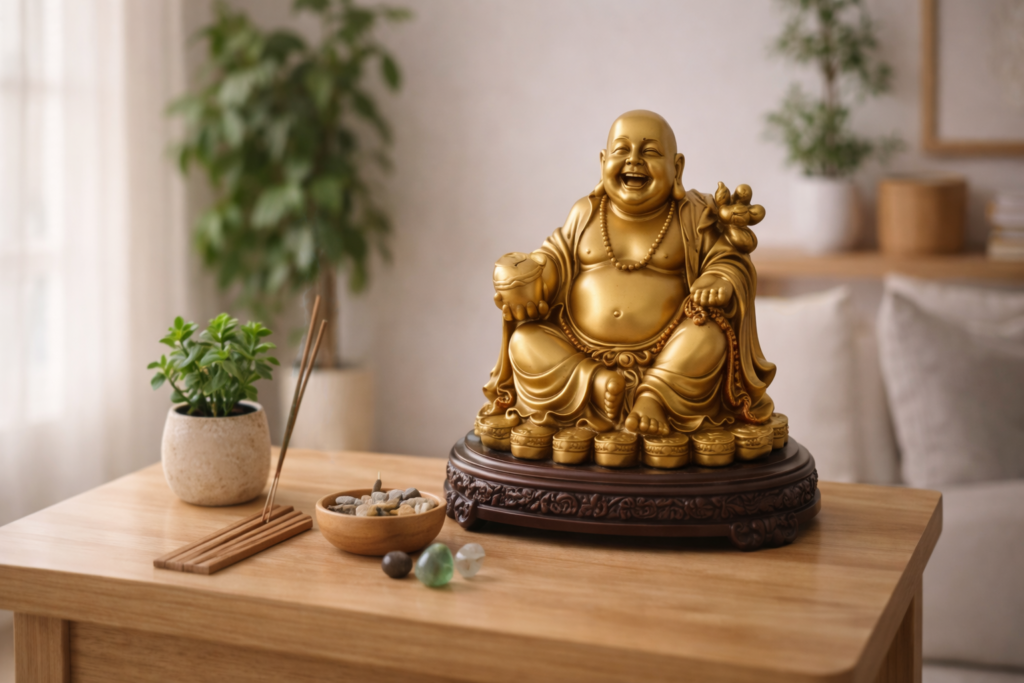
The Laughing Buddha symbolizes emotional ease.
Not wealth itself.
From a psychological perspective, symbols of contentment reduce stress-driven decision making.
They soften the nervous system’s response to uncertainty.
This matters for business.
When anxiety drops, clarity improves.
When clarity improves, follow-through increases.
That is the role this symbol plays when placed correctly.
Why Placement Matters More Than the Object
Objects do not work in isolation.
The brain responds to context, not decoration.
If a symbol associated with ease is placed in a visually chaotic or emotionally charged area, it loses meaning.
Worse, it can increase cognitive noise.
Correct placement supports:
Calm focus
Emotional regulation
Long-term consistency
Incorrect placement creates distraction.
Rooms That Support Business Growth Placement
Home Office
This is the strongest placement.
The Laughing Buddha here helps regulate stress during:
Financial planning
Problem solving
Long work sessions
It supports persistence, not motivation spikes.
The Best Place for Laughing Buddha in a Business-Focused Home
Near the Work or Planning Area
The most effective placement is near, but not on, your primary work zone.
Examples:
A shelf behind your desk
A side table near your workspace
A cabinet you see when starting work
This placement subtly reinforces emotional steadiness before action begins.
It does not dominate attention.
It anchors mood.
Why the Entrance Is Often Misunderstood
Many people place the Laughing Buddha directly at the front door.
This is not always ideal.
Entrances are transition zones.
They carry movement, noise, and urgency.
For business growth, the symbol works better in decision zones, not traffic zones.
If placed near the entrance:
Keep it slightly off-axis
Avoid clutter around it
Ensure it is not facing chaos or storage areas
The goal is calm visibility, not exposure.
A Simple Supportive Symbol for Focused Workspaces
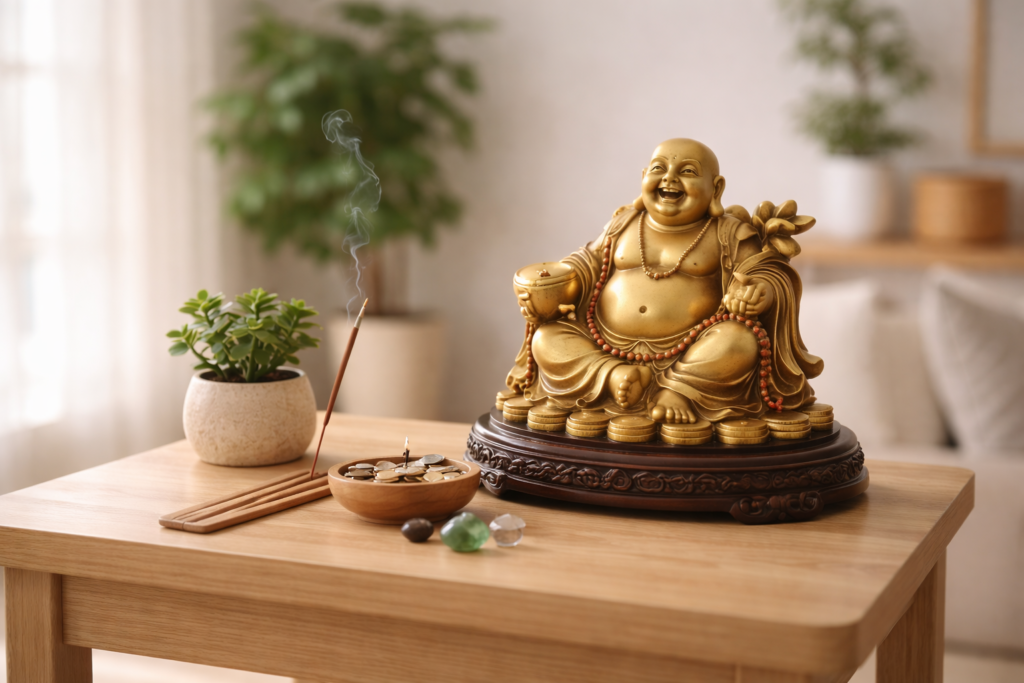
The Laughing Buddha is often used as a visual reminder of emotional ease and steadiness during work.
When placed intentionally in a calm, uncluttered area, it can support focus by reducing stress-driven decision-making—especially during long or demanding work sessions.
This is not a productivity tool or a promise of results.
It is a subtle environmental cue that supports a calmer mental state while working.
For those who choose to use one, neutral materials and simple designs tend to work best in business-focused spaces.
Disclosure: This link may earn a small commission at no additional cost to you.
Study or Reading Area
If your business involves learning or strategy, this placement works well.
It reinforces patience and long-term thinking.
Rooms to Avoid
Bedrooms
Bedrooms are recovery spaces.
Mixing work-related symbolism here can blur emotional boundaries.
This may lead to:
Mental restlessness
Difficulty switching off
Reduced recovery quality
Business growth requires rest.
Kitchens and Bathrooms
These are functional spaces with strong sensory activity.
They dilute symbolic meaning.
Avoid placing the Laughing Buddha here.
Facing Direction: Keep It Simple
The symbol should face into the room, not toward exits.
Facing inward reinforces:
Ownership
Stability
Presence
Facing outward creates subtle psychological “push” energy, which is not ideal for calm focus.
Size and Material Considerations
Bigger is not better.
Choose a size that:
Does not dominate the room
Feels intentional, not decorative
Materials that work well:
Wood
Stone
Matte ceramic
Avoid overly glossy or flashy finishes in workspaces.
They increase visual stimulation.
Common Mistakes That Undermine Its Effect
Placing it:
In cluttered shelves
Surrounded by bills or stress reminders
Directly under bright, harsh lighting
These conditions increase mental noise.
The symbol becomes background clutter instead of an anchor.
How This Supports Business Growth Over Time
Business success is rarely about bursts of effort.
It is about:
Consistency
Emotional steadiness
Clear decision cycles
The Laughing Buddha supports the emotional conditions that make consistency easier.
It does not replace skill, discipline, or action.
It supports the state of mind that sustains them.
Connecting This to the Bigger System
The Laughing Buddha works best as part of a system.
It complements:
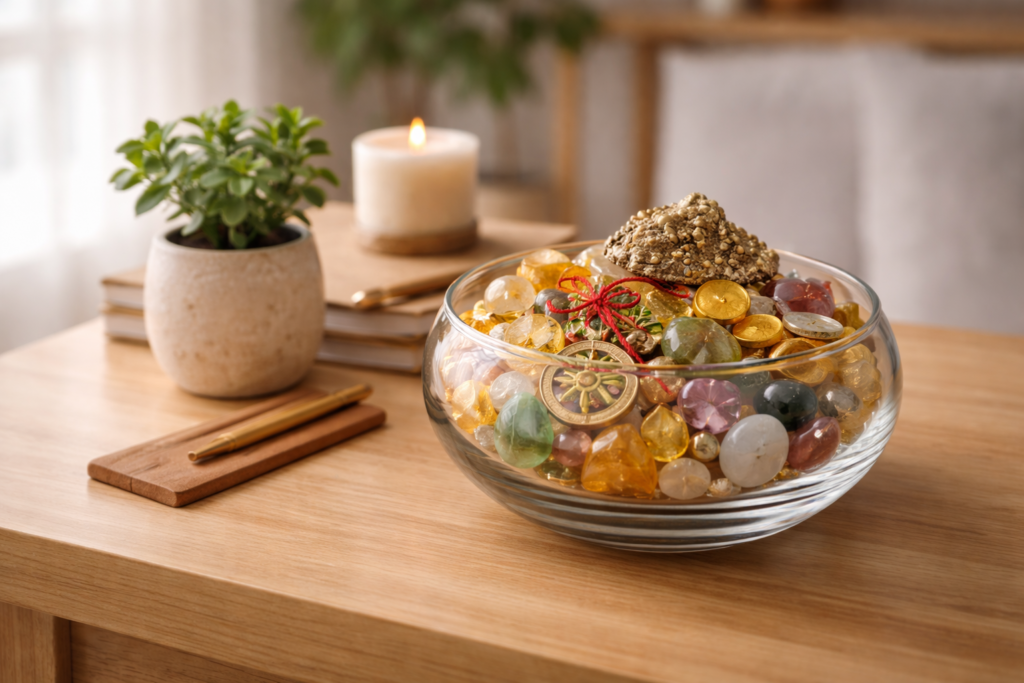
Wealth bowls (reinforcement)
Clean workspaces (clarity)
Calm environments (regulation)
Used alone, it helps.
Used intentionally, it compounds.
👉 For the complete system view, read the Feng Shui for Wealth & Focus guide.
Final Perspective
Business growth is not forced.
It is stabilized.
The right environment does not push you forward.
It removes what quietly holds you back.
Frequently Asked Questions
Q1. Where should I place a Laughing Buddha at home for business growth?
Place it in a calm, visible area where you work or plan finances. Avoid cluttered or high-traffic zones that increase mental noise.
Q2. Can Laughing Buddha help with business success?
It does not create success. It works as a visual cue that supports emotional regulation, focus, and confident decision-making.
Q3. Is Laughing Buddha placement based on belief or psychology?
Modern use focuses on environmental psychology—how visual symbols influence stress, attention, and behavior over time.
Q4. Can I place Laughing Buddha in a home office?
Yes. Home offices are one of the most effective locations when the space is clean, calm, and distraction-free.
Q5. Does direction matter for Laughing Buddha placement?
Direction matters less than emotional impact. The symbol should feel welcoming and not visually overwhelming.
Affiliate Disclosure:
Some links in this article may be affiliate links. This means we may earn a small commission if you choose to make a purchase, at no additional cost to you. We only reference products that align with the topic and are presented for informational purposes.
Disclaimer:
This article is for educational and informational purposes only. Feng Shui symbols and placement suggestions are discussed from a psychological and environmental perspective. They are not guarantees of financial or business outcomes and should not replace professional, financial, or business advice.