Why This Laughing Buddha Placement Attracts Money Within 30 Days
Money habits rarely fail because of lack of effort.
They fail because the environment quietly trains avoidance, stress, and distraction.
Most people never notice this training happening.
They only notice the results.
The Laughing Buddha is often introduced as a symbol of wealth.
But that explanation misses what actually matters.
What makes this placement effective is not belief.
It is how the brain responds to visual cues, emotional signals, and spatial consistency over time.
That is where change begins.
What the Laughing Buddha Actually Represents (Psychological Framing)
The Laughing Buddha represents contentment, emotional ease, and optimism.
Not happiness as a feeling.
But safety as a state.
From a behavioral psychology perspective, symbols associated with calm and abundance reduce stress-driven thinking. When stress decreases, decision-making improves.
This matters for money.
Financial choices are especially sensitive to emotional pressure.
An anxious mind avoids.
A regulated mind engages.
The Laughing Buddha acts as a visual anchor that reinforces emotional steadiness when placed correctly.
When placed poorly, it does the opposite.
Why Placement Matters More Than the Object Itself
Objects do not create outcomes.
They create signals.
The brain constantly interprets signals from the environment:
Is this space safe?
Is it overwhelming?
Is attention required right now?
Placement determines which signal dominates.
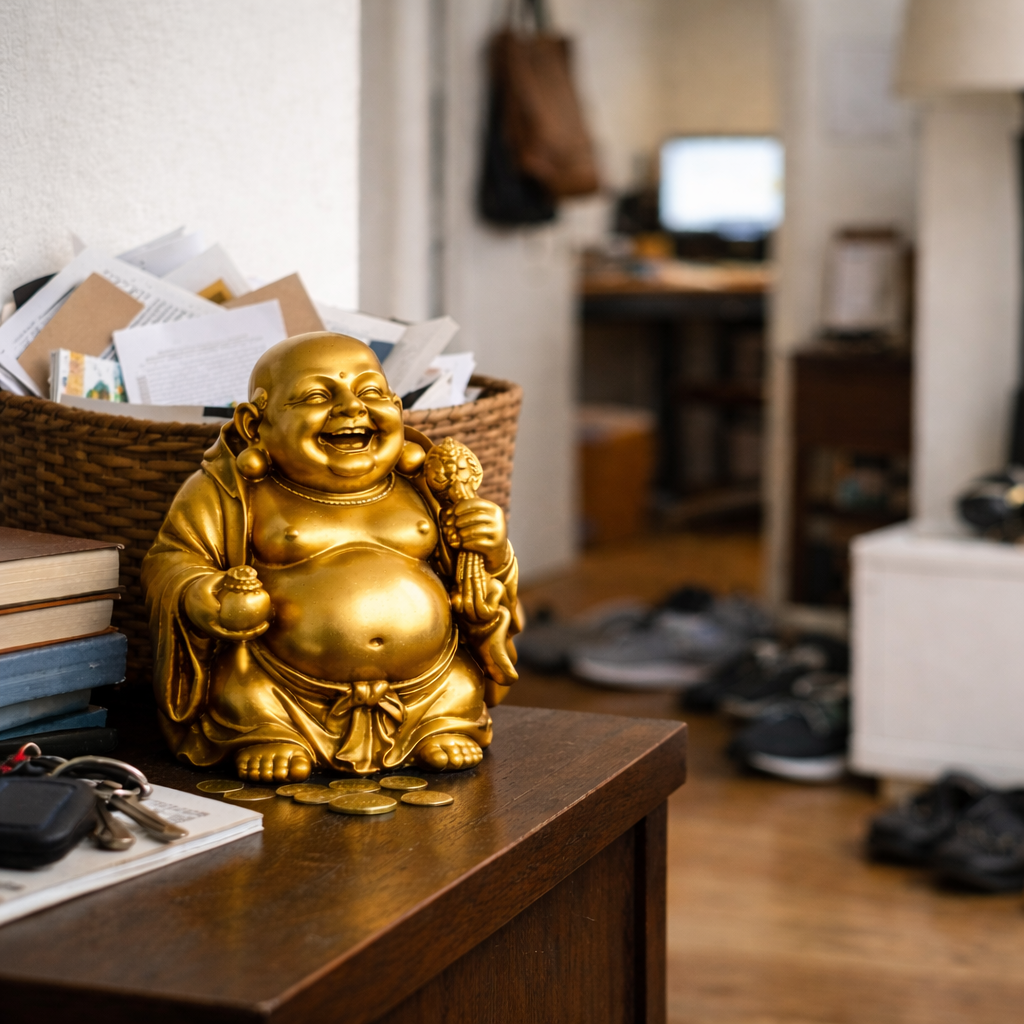
If the Laughing Buddha is hidden, cluttered, or visually drowned out, the signal weakens.
If it is placed with clarity and intention, the signal strengthens.
This is not symbolism.
It is stimulus-response conditioning.
The One Placement Rule Most People Get Wrong
Most homes place the Laughing Buddha randomly.
On a crowded shelf.
In a corner.
Surrounded by unrelated objects.
This creates visual noise.
Visual noise increases cognitive load.
Cognitive load reduces follow-through.
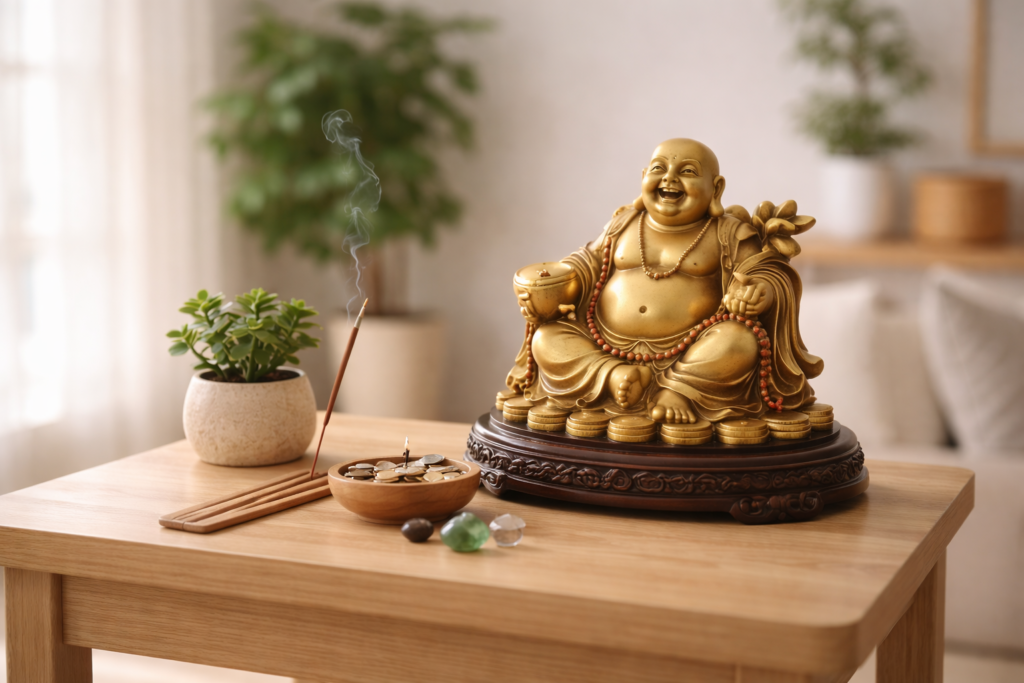
The correct placement prioritizes visibility without dominance.
The Buddha should be:
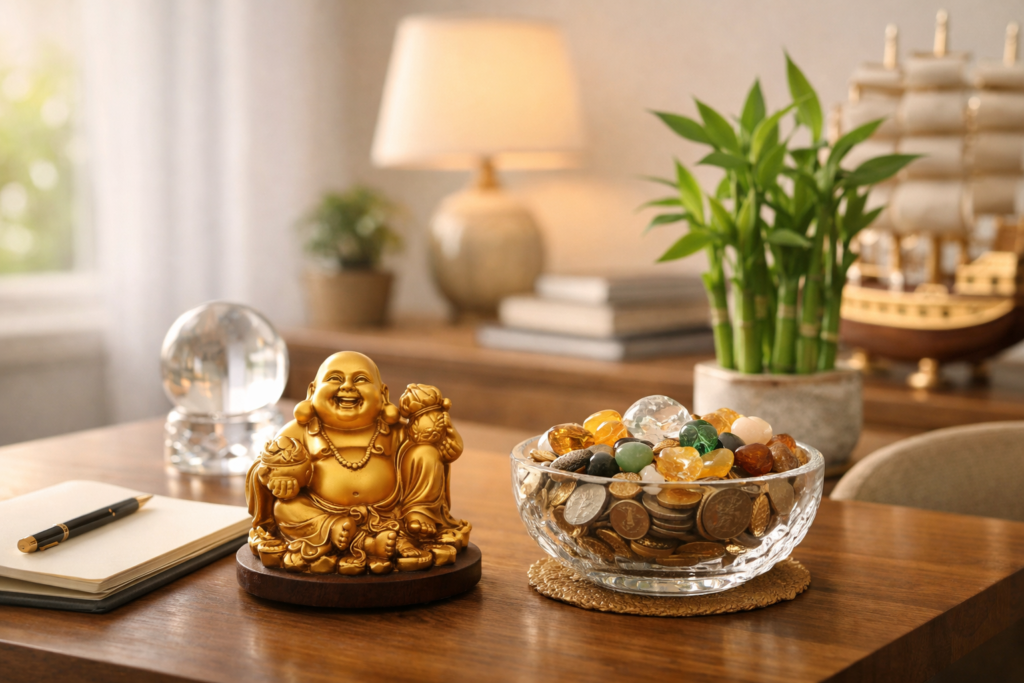
At eye level when seated or standing nearby
Clearly visible without being the focal point of the room
Free from clutter within arm’s length
This allows the symbol to act as a reminder, not a distraction.
Facing Direction: Why It Influences Money Behavior
Facing direction is often misunderstood as ritual.
In reality, it influences perceived control.
When the Laughing Buddha faces into the room:
The mind interprets openness
Attention feels expansive
Opportunity awareness increases
When it faces a wall, window, or exit:
The signal weakens
The mind associates closure or loss
Subtle avoidance patterns form
These patterns are quiet.
But repeated daily, they shape behavior.
Consistency compounds.
Why This Placement Affects Focus and Emotional Balance
This is the most important part.
Visual anchors work through repetition.
Every time the brain encounters a familiar, emotionally positive cue in a stable location, it reinforces a neural association.
Over time, that association becomes automatic.
The Laughing Buddha, when placed correctly:
Reduces micro-stress during work
Softens anxiety around money-related tasks
Encourages approach instead of avoidance
Clutter near the symbol interrupts this process.
Clutter creates competing signals.
Competing signals weaken conditioning.
This is why placement alone is not enough.
The surrounding environment matters equally.
The Best Areas to Place the Laughing Buddha (Without Overthinking)
You do not need complex maps.
Focus on where financial decisions are made or delayed.
The most effective areas tend to be:
Near a workspace or desk (not on it)
In a living area where planning or reflection occurs
In a space associated with calm, not urgency
Avoid bedrooms.
Bedrooms are for recovery.
Wealth-related cues introduce activation where rest should dominate.
Common Mistakes That Quietly Block Results
Many placements fail because of small, overlooked details.
Common mistakes include:
Placing the Buddha too high or too low
Surrounding it with unrelated decorative items
Positioning it near clutter or storage
Treating it as decoration instead of a signal
None of these are dramatic.
That is why they are dangerous.
Small frictions repeated daily shape habits more than big intentions.
Why Results Often Appear Gradually (Not Instantly)
The “30 days” framing works because it aligns with neuroplasticity timelines.
Neural associations strengthen through repetition and emotional consistency.
This takes time.
Within a few weeks, many people notice:
Less resistance around money tasks
Improved clarity when making decisions
Reduced emotional charge around financial planning
These are not miracles.
They are signs of reduced internal friction.
How to Support This Placement With Simple Behavior
Environment works best when paired with minimal action.
Once placed:
Keep the surrounding area clean
Avoid moving the Buddha frequently
Spend a few seconds acknowledging it during work breaks
This reinforces the signal.
No rituals.
No affirmations required.
Consistency does the work.
Why This Works Better Than Motivation Alone
Motivation fluctuates.
Environment does not.
When the environment supports calm focus, behavior becomes easier to sustain.
This is why environment-first strategies often outperform mindset-first approaches.
The Laughing Buddha placement works when it becomes part of a larger system of reduced friction.
If You Want the Full System
This article focuses on one symbol.
The complete framework explains how environment design, workspace layout, and visual order interact to support focus, consistency, and financial behavior.
If you want the full context, read the main guide:
→ Feng Shui for Wealth & Focus: How Your Space Shapes Money, Work, and Opportunity
Final Thought
The Laughing Buddha does not attract money.
It supports the mental state that allows better financial behavior to emerge.
That distinction matters.
Change begins when effort feels lighter.
And that begins with the environment.
Frequently Asked Questions
Does Laughing Buddha placement really affect wealth?
Laughing Buddha placement does not create money directly. It supports emotional calm, reduces cognitive stress, and reinforces focus—conditions that influence financial decisions over time.
Where should the Laughing Buddha face for best results?
From a psychological perspective, facing the Laughing Buddha into the room supports openness and perceived control. Facing exits or walls weakens its visual impact.
Can Laughing Buddha be placed in a bedroom?
Bedrooms are designed for rest and recovery. Wealth-related cues can introduce unnecessary mental activation, making bedrooms a poor placement choice.
How long does it take to notice results from placement changes?
Environmental cues work through repetition. Many people notice reduced resistance and improved clarity within a few weeks as new patterns stabilize.
Is belief required for Feng Shui symbols to work?
No. Environmental cues influence behavior through attention, emotional association, and repetition—not belief or faith.
Disclaimer
The content on this website is provided for educational and informational purposes only.
Articles, guides, and recommendations related to mindset, environment design, Feng Shui, or behavioral psychology are not intended as financial, legal, medical, or professional advice.
No specific outcomes—financial or otherwise—are guaranteed.
Individual experiences may vary based on personal circumstances, choices, and actions.
Concepts discussed on this site focus on environmental influence, attention, habit formation, and psychological framing.
They should be viewed as supportive tools rather than substitutes for effort, skill development, or professional guidance.
By using this website, you agree to take full responsibility for your decisions and actions.