Subconscious Psychology

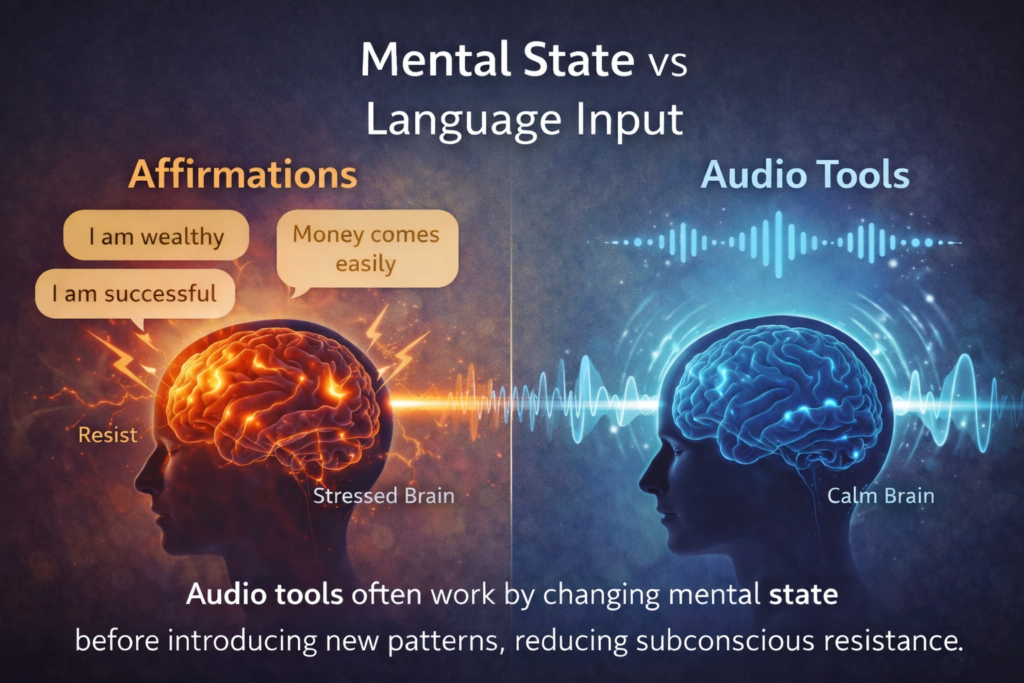
Diagram comparing affirmations and audio tools, showing how audio influences mental state while affirmations rely on conscious language processing

Why Audio Tools Work Faster Than Affirmations Alone

Why Audio Tools Work Faster Than Affirmations Alone Affirmations fail most often for one quiet reason. They rely on effort.The subconscious relies on state. Repeating positive language can feel productive.Acceptance, however, does not depend on words alone. It depends on emotional readiness.It depends on nervous system safety.It depends on how much resistance is present. When the mind feels tense or defensive, repetition triggers evaluation. Not absorption. That evaluation slows change. Audio-based tools work differently. Instead of asking the mind to believe something new, they influence mental state first. As resistance lowers, repetition becomes easier. Language no longer feels forced.Patterns update with less friction. This difference explains why affirmations often feel exhausting on their own. It also explains why combining them with audio tools tends to produce faster, more sustainable shifts. The Conscious “Critical Filter”   The conscious mind acts as a filter. It evaluates.It questions.It compares new information against existing beliefs. This process protects identity and stability. When affirmations pass through this filter, they are assessed immediately. If a statement conflicts with lived experience, the mind flags it as unrealistic or unsafe. That reaction often feels like: Doubt Resistance Mental fatigue This is not negativity. It is protection. The critical filter evolved to prevent sudden belief changes that could disrupt functioning. As a result, language-based repetition alone often struggles to pass through without friction. Effort increases awareness of the conflict. Awareness strengthens resistance. This is why people can repeat affirmations daily and still feel stuck. The message reaches the conscious mind—but never settles into the systems that govern habit and behavior. State Matters More Than Words   The subconscious responds to state, not argument. Calm states reduce analysis.Heightened states increase evaluation. This distinction matters. When the nervous system feels safe and regulated, the mind becomes more receptive. Suggestions encounter less internal debate and more passive absorption. Language works best after the state shifts. This explains why affirmations feel easier: Before sleep After meditation During relaxed focus It is not the words that change. The mental environment does. How Audio Tools Alter Mental State   Audio tools work by influencing mental state first. Sound patterns affect attention, rhythm, and internal pacing. Over time, these elements guide the brain toward calmer or more focused states. In those states: Analytical filtering decreases Emotional reactivity softens Repetition becomes less effortful This does not bypass thinking. It quiets unnecessary resistance. Once resistance lowers, repetition works as intended. That sequence—state first, suggestion second—is the key difference between audio-based methods and language-only approaches. Passive vs Active Reprogramming   Affirmations require active participation. Audio tools allow passive exposure. This difference matters for consistency. Active methods depend on: Motivation Discipline Attention Passive methods depend on: Repetition Environment Routine When effort drops, consistency improves. Consistency—not intensity—drives long-term pattern change. When Affirmations Still Play an Important Role   Affirmations are not ineffective. They are incomplete when used alone. Once mental state aligns, language reinforces direction. Affirmations help clarify identity and intention. Used together: Audio supports receptivity Language supports meaning This combination reduces friction and increases follow-through. Balance matters. If you prefer a gentle, practical example, this short session focuses on calming the nervous system before repetition. It’s designed to support relaxation and emotional balance, not to force belief. https://youtu.be/aUC4UgH6GK0 Conclusion: Tools Support State, Not Willpower   Change does not require more effort. It requires better conditions. Audio tools support mental state.Affirmations support identity.Repetition integrates both. When pressure decreases, absorption increases. If you want to understand why this works and how the brain shifts money patterns without force: Brainwave Entrainment & Subconscious Change(A clear, science-grounded breakdown of how awareness rewires financial behavior.) When you are ready to see the practical tools this awareness supports— → Visit Best Brainwave & Subliminal Programs for Wealth Manifestation (A calm overview of programs and resources designed to reinforce subconscious change.) Understanding comes first.Action becomes easier after. Disclaimer The information provided in this article is for educational and informational purposes only. It is not intended to diagnose, treat, cure, or prevent any medical or mental health condition. Audio-based tools, affirmations, and relaxation techniques may support awareness, reflection, and emotional regulation, but individual experiences can vary. These methods are not a substitute for professional medical, psychological, or therapeutic care.   If you are experiencing persistent distress, anxiety, or health-related concerns, please seek guidance from a qualified healthcare professional.

Subconscious Psychology

Why Audio Tools Work Faster Than Affirmations Alone Read Post »

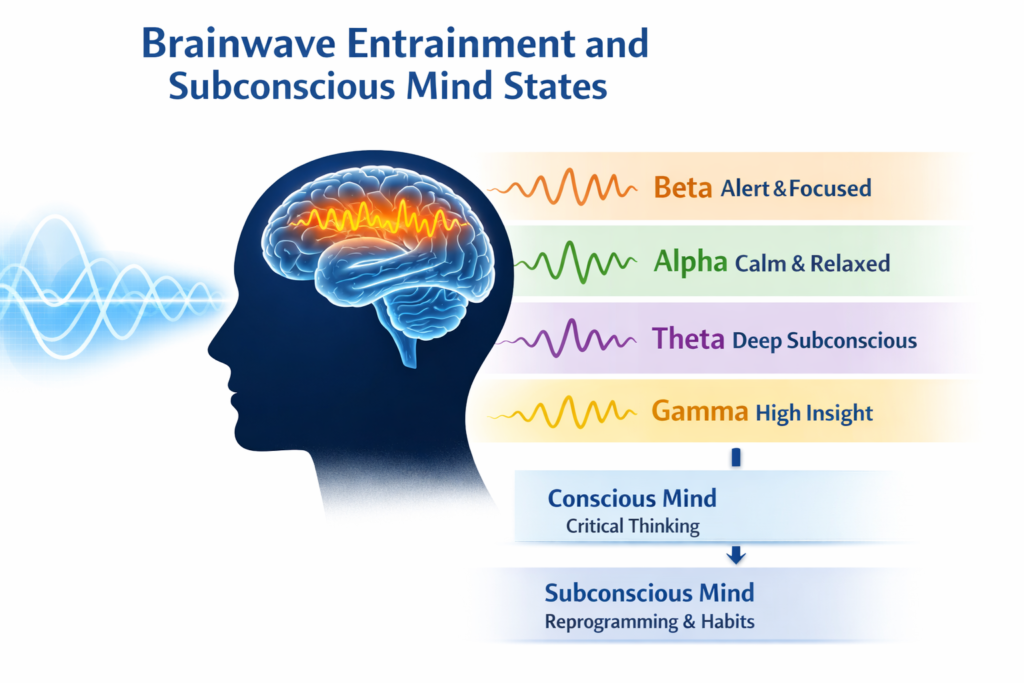
brainwave entrainment and subconscious mind states explained

Brainwave Entrainment Explained: How Sound Reprograms the Mind

Brainwave Entrainment Explained: How Sound Reprograms the Subconscious Mind Most attempts at personal change focus on effort, discipline, or motivation. Yet lasting change rarely comes from trying harder. It comes from changing the state in which the mind operates. The brain is not a purely logical system.It is rhythmic, patterned, and largely automatic. This is why many people understand what they should do with money, habits, or focus—but struggle to follow through consistently. Willpower works at the conscious level.Patterns live deeper. Sound-based methods, such as brainwave entrainment, work differently. They do not rely on persuasion or belief. Instead, they influence the mental state that determines how thoughts, emotions, and behaviors are processed. State always shapes behavior. When the mind enters certain states, learning becomes easier, resistance softens, and repetition leaves a deeper imprint. This is why sound has been used across cultures—for focus, ritual, and regulation—long before modern psychology existed. In this article, we’ll break down what brainwave entrainment actually is, how it interacts with the subconscious mind, and why it’s often used as a support tool for habit and mindset change. Calmly.Practically.Without exaggerated claims. WHAT IS BRAINWAVE ENTRAINMENT? (SIMPLE EXPLANATION) Brainwave entrainment is a method used to guide the brain into a specific mental state using rhythmic sound. The human brain naturally produces electrical activity.These patterns are called brainwaves. They change depending on what you are doing—thinking, relaxing, imagining, or sleeping. Brainwave entrainment works by introducing a steady external rhythm, usually through sound. Over time, the brain tends to synchronize with that rhythm. This process is known as entrainment. You experience this naturally in everyday life. When music helps you focus.When a steady beat calms you.When repetitive sounds make it easier to relax. Brainwave entrainment does not “force” the brain to do anything.It provides a pattern. The brain chooses whether to follow it. Different sound-based methods can be used, but the principle is the same: rhythm influences state, and state influences perception, learning, and behavior. Instead of trying to change thoughts directly, brainwave entrainment works at the level beneath thought. It helps shift the background condition in which thoughts arise. This is why it is often described as a state-based approach rather than a belief-based one. Understanding this distinction is important. Because when the mental state changes, attention, openness, and responsiveness tend to change with it—without conscious effort. THE SUBCONSCIOUS MIND AND WHY WILLPOWER FAILS Most daily behavior is not guided by conscious decision-making. It is guided by patterns. The subconscious mind manages habits, emotional responses, and automatic reactions. It operates continuously, even when attention is elsewhere. This is why people can understand what they should do, yet repeatedly act in ways that contradict their intentions. Willpower operates at the conscious level.Patterns operate beneath it. When the two conflict, patterns usually win. This is not a character flaw.It is how the brain conserves energy. The subconscious favors what is familiar, not what is optimal. It repeats what feels safe, predictable, and known. The subconscious runs the defaults. Attempts to change behavior using force or motivation often fail because they do not address these underlying defaults. They try to override patterns instead of reshaping them. This is also why repeating affirmations can feel effortful or ineffective for some people. When the mental state is tense or resistant, new suggestions struggle to integrate. Change becomes easier when the background state of the mind shifts first. When resistance lowers, repetition lands differently. This is the context in which state-based methods, including sound-driven approaches, are often explored. They work alongside conscious effort rather than competing with it. Understanding this relationship between conscious intention and subconscious patterning is key to understanding why brainwave entrainment is used at all. HOW SOUND INFLUENCES MENTAL STATES Sound influences the mind not through meaning, but through rhythm. Before a thought is evaluated, the brain responds to patterns. Repetition, tempo, and consistency all affect how attention and arousal are regulated. This is why certain sounds can feel calming, focusing, or immersive without requiring interpretation. The influence happens at the level of state. When the nervous system senses a steady, predictable rhythm, it often shifts out of vigilance and into regulation. Breathing slows. Attention narrows or softens. Mental noise reduces. These shifts are subtle, but meaningful. They change how information is processed. Instead of attempting to convince the mind to accept new ideas, sound alters the context in which ideas are received. This is an important distinction. Language works through understanding.Sound works through exposure. Because sound does not argue with the mind, it encounters less resistance. The analytical filter remains quieter. This is why sound-based methods are often paired with learning, relaxation, or reflection. They help create conditions where the mind is more receptive. Not because sound contains instructions, but because it shapes the environment in which cognition occurs. In this way, sound functions as a background influence rather than a directive force. It supports state change first. Behavior and perception tend to follow. KEY BRAINWAVE STATES EXPLAINED (WITHOUT JARGON) The brain does not operate in a single mode. Its activity shifts throughout the day depending on attention, emotion, and level of alertness. These shifts are commonly described as brainwave states. Each state is associated with a different mental condition. Understanding them does not require technical knowledge.Only context.   Beta — Active Thinking and Problem-Solving Beta is the state most people spend their waking day in. It supports: Logical thinking Decision-making Task completion When prolonged, it can also lead to: Mental fatigue Overanalysis Stress-driven focus Alpha — Relaxed Focus and Learning Alpha sits between alertness and calm. It is often present during: Light relaxation Creative thinking Absorbing new information In this state, the mind remains awake but less guarded.Learning tends to feel easier.   Theta — Imagination and Subconscious Access Theta is associated with: Daydreaming Deep imagination The moments before sleep This state is often linked with memory, emotional processing, and habit reinforcement. Resistance tends to be lower here.   Gamma — Integration and Clarity Gamma is associated with:

subconscious mind, Subconscious Psychology

Brainwave Entrainment Explained: How Sound Reprograms the Mind Read Post »

Scroll to Top
Mind Boggling Studio logo with brain design representing mindset and thinking
Privacy Overview

This website uses cookies so that we can provide you with the best user experience possible. Cookie information is stored in your browser and performs functions such as recognising you when you return to our website and helping our team to understand which sections of the website you find most interesting and useful.