Mindset & Subconscious Rewiring

comparison of subliminals and affirmations showing how each interacts with conscious resistance and the subconscious mind

Subliminals vs Affirmations: Why One Bypasses Resistance

Subliminals vs Affirmations: Why One Bypasses Resistance Changing internal patterns is rarely about effort alone. Most people encounter resistance long before results appear.Not because the method is wrong.But because the mind protects what feels familiar. Subliminals and affirmations are often grouped together.They are not the same. Both aim to support subconscious change.Yet they interact with the mind in very different ways. Understanding that difference matters.Especially when consistency feels difficult. What Are Subliminals? Subliminals are forms of input presented below conscious awareness. They may appear as audio layered beneath music, tones, or ambient sound.The message is not consciously analyzed. This is intentional. The subconscious processes patterns continuously.It does not require logical agreement to register repetition. Subliminals are commonly used in passive states. While resting During background listening Before sleep Because attention is not required, effort remains low. This lowers friction. Instead of actively repeating a message, the listener allows repetition to occur naturally.The nervous system remains relaxed. Over time, familiarity replaces resistance. Consistency matters more than intensity here.Short, repeated exposure tends to be more sustainable than long sessions. Subliminals are not about forcing belief.They are about reducing interference. What Are Affirmations? Affirmations rely on language. They are consciously repeated statements intended to reinforce a desired belief or identity. This process requires engagement. Attention Focus Emotional alignment When these conditions are present, affirmations can feel supportive. But language also activates self-monitoring. The conscious mind evaluates meaning.It checks for accuracy. If a statement conflicts with existing assumptions, tension can appear. This does not mean affirmations are ineffective.It means timing and state matter. Affirmations ask the mind to participate.That participation can become effortful when the nervous system is stressed. Fatigue often follows. Repetition alone is not always enough.State determines reception. Why Affirmations Often Trigger Resistance Resistance is not a flaw. It is a protective function. The brain prioritizes stability over change.Even when current patterns are limiting. When affirmations challenge identity, the mind responds defensively. This can show up as: Discomfort Doubt Mental pushback Emotional memory plays a role. If past experiences contradict the statement, the mind flags it as unsafe.Logic does not override this automatically. Effort increases.Progress feels slow. This is why discipline alone often fails. Resistance signals misalignment between message and state.Not a lack of willpower. How Subliminals Bypass the Critical Filter The critical filter evaluates information consciously. When attention is lowered, this filter relaxes. Subliminals take advantage of this window. Instead of confronting belief directly, they work indirectly.Repetition occurs without debate. This process is closely related to the concept of brainwave entrainment, where rhythmic input influences mental state before new patterns are introduced.When the nervous system is calm, the mind becomes more receptive. Familiarity increases safety. No argument is required. Subliminals do not convince.They normalize. This is why they are often used at night or during relaxed states.Effort drops away. When Affirmations Still Work Best Affirmations are not obsolete. They work best under specific conditions. When the nervous system feels regulated When language feels believable When statements are gradual Bridge phrasing helps. Instead of forcing certainty, affirmations can allow openness. Timing matters. Affirmations introduced after relaxation tend to feel lighter.They integrate more easily. Used alongside audio tools, they often feel less draining.Supportive rather than demanding. Choosing the Right Method for You There is no universal answer. The best method is the one you can maintain. Consider these factors: Active vs passiveDo you prefer engagement or background input? Day vs nightAre you more consistent when relaxed? Effort toleranceDoes repetition feel energizing or exhausting? ConsistencyWhich method fits naturally into your routine? Many people combine these approaches within structured subconscious audio programs designed to reduce resistance while supporting repetition. Sustainability determines speed.Not intensity. Conclusion Resistance is not a sign to stop. It is a sign to adjust approach. Affirmations rely on conscious participation.Subliminals reduce the need for it. Neither method is inherently better.But one may feel easier to live with. When effort decreases, consistency improves.And consistency is what creates change over time. Disclaimer This content is for educational and informational purposes only.Subliminal audio and affirmations are not medical or psychological treatments.Individual experiences may vary, and no outcomes are guaranteed. Affiliate Disclosure Some links on this page may be affiliate links.If you choose to purchase through these links, the site may earn a commission at no additional cost to you.

Mindset & Subconscious Rewiring

Subliminals vs Affirmations: Why One Bypasses Resistance Read Post »

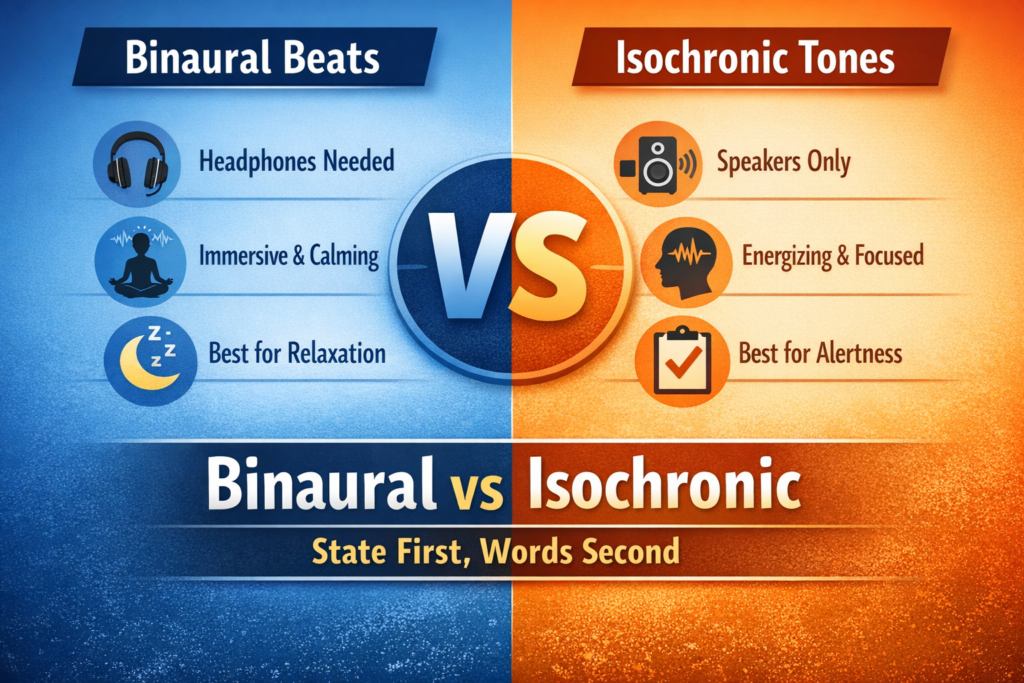
comparison of binaural beats and isochronic tones for brainwave entrainment

Binaural Beats vs Isochronic Tones for Wealth Focus

Binaural Beats vs Isochronic Tones: Which Works Faster for Wealth? Binaural beats and isochronic tones are often grouped together.But they work in very different ways. Both are used to influence focus, mental state, and repetition.Yet the brain responds to each one differently. Speed is not about intensity.It’s about how easily the method fits into your routine. Understanding this difference makes choosing simpler—and more sustainable. What Are Binaural Beats? Binaural beats work through immersion. Two slightly different frequencies play through each ear.The brain processes the difference. That difference creates a perceived rhythmic pattern. This pattern influences mental state. Because each ear receives a separate signal, headphones are required. Many people describe binaural beats as: Calming Absorbing Subtle They tend to support longer listening sessions. Especially during: Relaxation Meditation Sleep preparation What Are Isochronic Tones? Isochronic tones work through direct stimulation. A single tone pulses on and off at a regular rhythm.The brain synchronizes with that pulse. No headphones are required. The sound is more pronounced.The effect is often faster. Many users describe isochronic tones as: Energizing Focus-enhancing More noticeable They are commonly used during: Daytime focus Short sessions Task-oriented work This response is explained by the principles of brainwave entrainment, where rhythmic input influences mental state over time. Curious about the mechanism behind this shift? The following article may help you:  Brainwave Entrainment & Money Awareness Key Differences at a Glance Binaural Beats Require headphones More immersive Gentler stimulation Often used for relaxation Isochronic Tones Work through speakers More stimulating Clear rhythmic pulses Often used for focus Neither method is “better” by default. They simply engage the brain differently. Both methods are commonly used within structured brainwave programs designed to support consistency through repetition. Looking for grounded tools that support this process? Check out the the following blog: → Money Page: Subconscious Support Resources Which Works Better for Wealth Conditioning?   Wealth conditioning depends on repetition and receptivity. Not intensity. Not belief. Not effort. If the nervous system feels calm and open, repetition integrates more easily. If the mind feels overstimulated, resistance increases. This is why results vary. Some people absorb patterns faster through calm immersion.Others respond better to alert focus. The question is not which method works faster. The question is which state your mind enters more easily. When Binaural Beats Make More Sense   Binaural beats often fit better when: You prefer subtle input You use audio before sleep You stay engaged for longer sessions They support: Reduced mental chatter Lower resistance Passive repetition For many, this environment feels safer. Safety increases absorption. When Isochronic Tones Are a Better Fit   Isochronic tones often work better when: You struggle to stay focused You prefer short sessions You listen during the day They support: Alert attention Task engagement Consistency without long sessions For some nervous systems, this clarity matters. The Hybrid Approach (Authority Recommendation)   The most effective approach is often contextual. Not exclusive. Many people use: Isochronic tones during the day Binaural beats at night This supports: Focus when needed Absorption when relaxed State first.Repetition second. This sequence matters more than the tool itself. Conclusion: Choose Based on Response, Not Hype   Binaural beats and isochronic tones both influence mental state. They simply take different paths. Wealth conditioning improves when repetition meets receptivity. The right choice is the one your nervous system accepts most easily. That acceptance—not effort—is what creates momentum. Disclaimer:This content is for educational and informational purposes only.Subliminal audio and affirmations are not medical or psychological treatments.Individual experiences may vary, and no outcomes are guaranteed.

Mindset & Subconscious Rewiring

Binaural Beats vs Isochronic Tones for Wealth Focus Read Post »

Why Affirmations Don’t Work (And Why Your Brain Blocks Them)

Why Your Brain Resists Positive Affirmations (And What It Means) Why Affirmations Don’t Work—and How to Stop Your Brain From Rejecting Them Many people don’t struggle with affirmations because they lack discipline. They struggle because something inside them tightens every time they repeat the words. They say the affirmation. And immediately feel resistance. Not loud resistance. Quiet resistance. The kind that shows up as tension in the chest, a subtle doubt, or the feeling of “this isn’t landing.” They repeat affirmations daily.They stay consistent.They even believe in the idea. Yet something feels off. Instead of ease, there is strain.Instead of confidence, there is effort.Sometimes, affirmations feel draining rather than empowering. This experience is rarely talked about. When affirmations “don’t work,” people often assume they are doing something wrong. Not positive enough. Not focused enough. Not disciplined enough. But resistance is not a failure. It is a signal. The brain is designed to protect familiar identity patterns, even when those patterns are limiting. When a message conflicts with deeply held assumptions, the mind does not always accept it quietly. It pushes back. Understanding why this happens changes the entire conversation around affirmations—from effort to awareness. If you prefer a visual explanation, this short video explains why affirmations often trigger resistance instead of change. THE BRAIN’S JOB IS PROTECTION, NOT POSITIVITY The human brain did not evolve to make people optimistic. It evolved to keep them safe. Safety, to the brain, means predictability. Familiar patterns. Known outcomes. Even when those patterns are uncomfortable, they are still recognized. Positive affirmations can unintentionally challenge this sense of safety. When a statement contradicts an existing self-image, the brain evaluates it as a potential threat. Not because it is negative—but because it is unfamiliar. This response happens automatically. The subconscious does not analyze whether an affirmation is helpful or inspiring. It checks whether the message aligns with existing beliefs and emotional memory. If there is a mismatch, resistance appears. This resistance can show up as: Discomfort Doubt Mental fatigue Subtle irritation These reactions are often misinterpreted as a lack of belief or effort. In reality, they are protective signals. The brain is not rejecting growth.It is protecting continuity. Recognizing this reframes the entire experience. Resistance is not an obstacle to overcome—it is information about where alignment has not yet been built. WHY REPETITION ALONE CAN BACKFIRE Repetition is often presented as the solution to everything. Repeat it long enough, and the mind will accept it. In practice, repetition without state alignment can create the opposite effect. When an affirmation is repeated in a tense, frustrated, or effort-heavy state, the brain registers the emotional tone more than the words themselves. The message may be positive.The state is not. This creates friction. Each repetition reinforces the awareness of mismatch between what is being said and what is being felt. Over time, this can strengthen resistance instead of dissolving it. The subconscious does not respond to language in isolation.It responds to patterns—emotional, sensory, and contextual. If repetition is paired with internal strain, the brain learns to associate the affirmation with discomfort. That is why some people report feeling worse after forcing affirmations. Not because affirmations are harmful.But because the conditions were misaligned. Repetition works best when it lands in a receptive environment. When the nervous system is regulated, and attention is relaxed, repetition integrates differently. Without that foundation, more effort does not equal more impact. EMOTIONAL MISMATCH AND IDENTITY CONFLICT Why affirmations don’t work: Affirmations often fail at the level of identity, not intention. Every person carries an internal self-image shaped by past experiences, feedback, and emotional memory. This image operates quietly in the background, influencing what feels believable and what feels foreign. When an affirmation conflicts with this internal image, the brain detects an inconsistency. This is known as identity conflict. For example, repeating a statement about confidence or abundance while internally identifying with struggle creates emotional mismatch. The words aim upward. The identity pulls downward. The brain prioritizes coherence. When coherence is threatened, resistance appears—not to sabotage growth, but to maintain internal stability. This is why affirmations that feel “too far ahead” often trigger discomfort. The issue is not the content of the affirmation, but the gap between language and lived experience. Change tends to integrate more smoothly when it moves in steps that the nervous system can tolerate. Bridging identity is often more effective than attempting to replace it. Understanding this dynamic explains why some affirmation practices stall and why gentler, state-supported approaches are often explored instead. HOW MENTAL STATE CHANGES THE WAY SUGGESTIONS ARE RECEIVED How Mental State Explains Why Affirmations Don’t Work Suggestions are not received in a vacuum. They are filtered through the mental state present at the moment they are introduced. When the mind is rushed, defensive, or emotionally guarded, it tends to evaluate incoming messages more critically. Even supportive language can feel intrusive in this state. When the mind is calmer, more regulated, or inwardly focused, the same message can feel neutral—or even helpful. This difference is subtle but decisive. The subconscious does not ask whether a statement is logical.It asks whether the environment feels safe enough to allow change. Mental state acts as the gatekeeper. This is why timing, context, and internal conditions matter more than the exact wording of an affirmation. The same phrase can be rejected or accepted depending on how the nervous system is functioning. Understanding this helps explain why affirmations sometimes “work” for a period and then stop. The issue is rarely the words themselves.It is the state in which those words are delivered. This insight shifts the focus away from forcing belief and toward creating conditions that support receptivity. Affirmations often fail at the level of identity, not intention. Every person carries an internal self-image shaped by past experiences, feedback, and emotional memory. This image operates quietly in the background, influencing what feels believable and what feels foreign. When an affirmation conflicts with this internal image, the brain detects an inconsistency. This is known

Mindset & Subconscious Rewiring

Why Affirmations Don’t Work (And Why Your Brain Blocks Them) Read Post »

Scroll to Top
Mind Boggling Studio logo with brain design representing mindset and thinking
Privacy Overview

This website uses cookies so that we can provide you with the best user experience possible. Cookie information is stored in your browser and performs functions such as recognising you when you return to our website and helping our team to understand which sections of the website you find most interesting and useful.