Where to Place Feng Shui Money Frog in Indian Homes (Practical Guide)
In Indian homes, money stress rarely comes from lack of effort.
It comes from mental overload.
That is why where to place a Feng Shui money frog in Indian homes matters more than the object itself.
This guide is not about luck.
It is about attention, habits, and financial discipline—designed for flats, apartments, and compact Indian living spaces.
No superstition.
Only practical placement.
If you want the broader framework behind how environment shapes money behavior, read the main guide here:
👉 Feng Shui for Wealth & Focus: How Your Space Shapes Money, Work, and Opportunity
Why Placement Matters More in Indian Homes
Indian homes are visually dense.
Rooms serve many purposes.
Storage is everywhere.
Movement paths are tight.
Because of this, the brain processes Indian homes with higher cognitive load.
As a result:
Focus drops faster
Decisions feel heavier
Money discipline weakens
Feng Shui placement works when it reduces visual noise and reinforces intention.
The money frog is one such anchor—when used correctly.
What the Money Frog Actually Represents
The Feng Shui money frog does not attract money.
Instead, it works as a behavioral cue.
It represents:
Awareness of cash flow
Consistency in saving
Respect for money decisions
In psychology, this is called cue-based habit reinforcement.
However, when placed incorrectly, the frog becomes background clutter—and loses impact.
Best Places to Keep a Money Frog in Indian Homes
1. Near the Main Entrance (Inside, Not Outside)
This is the most effective placement for Indian flats.
Why it works:
Entryways mark mental transitions
The brain shifts from “outside stress” to “home safety”
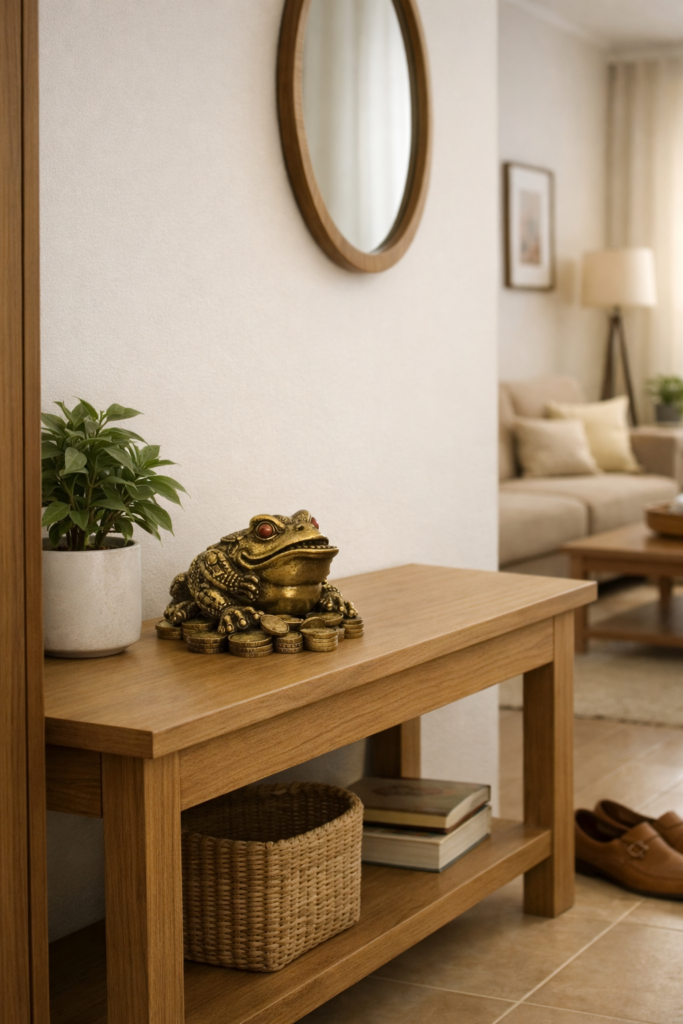
Place the frog:
Just inside the main door
On a low shelf or console
Facing inward, not outward
Avoid shoe piles or delivery clutter nearby.
Result:
A subtle reminder to protect and manage money, not chase it.
2. Living Room – Calm Corner Placement
Living rooms in Indian homes are decision zones.
Family talks happen here.
Planning happens here.
Place the money frog:
In a quiet corner
On a stable surface
Away from TV units or loud decor
Keep the area clean.
This placement supports:
Clear discussions
Reduced financial anxiety
Better long-term thinking
3. Home Office or Study (Inside Storage)
For work-from-home professionals, this is powerful.
However, the frog should not sit openly on the desk.
Better placement:
Inside a drawer
Inside a cabinet
Near planners or financial files
This keeps the cue private and intentional.
As a result, money decisions feel calmer and more deliberate.
Where NOT to Place the Money Frog (Very Important)
Incorrect placement weakens its effect.
Avoid these areas:
❌ Kitchen
This is a consumption zone.
Money cues here create mental conflict.
❌ Bedroom
The brain needs rest here.
Money symbols increase alertness.
❌ Bathroom
Symbolically and psychologically draining.
❌ High-Traffic Walkways
Constant movement breaks focus and intention.
In Indian homes, traffic zones are already overstimulating.
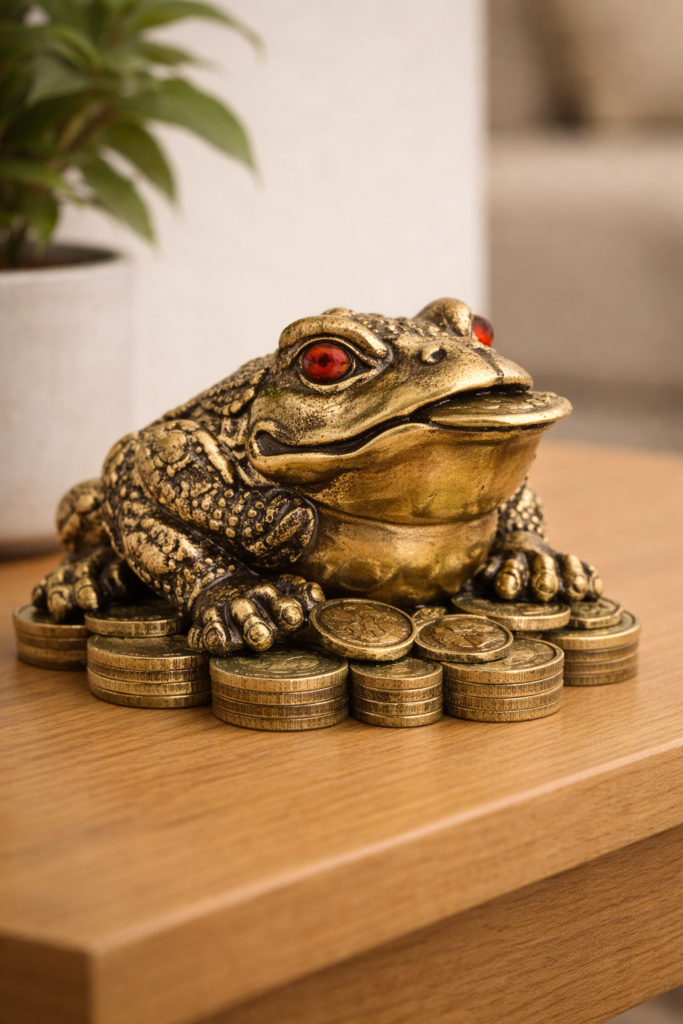
Feng Shui Money Frog
Feng Shui Money Frog (Indian Homes – Subtle Placement)
A Feng Shui money frog is commonly used in Indian homes as a visual cue for money awareness and discipline, not as a decoration.
For Indian flats and apartments, a compact resin or brass money frog works best.
It fits easily in:
Living room shelves
Entryway cabinets
Work desks (inside drawers)
From a psychological perspective, small, intentional symbols are more effective than large, attention-grabbing objects. They reinforce consistency without adding visual noise.
👉 Explore a simple Feng Shui money frog suitable for Indian homes
Money Frog Placement for Flats & Apartments (India-Specific)
In 1 BHK and 2 BHK flats, space is limited.
So placement must be subtle.
Use these rules:
One frog only
One placement only
Hidden is better than decorative
Less visual clutter = stronger impact.
Common Money Frog Mistakes Indians Make
These mistakes are very common.
Using multiple frogs
Treating it as decor
Placing it with other symbols
Ignoring clutter around it
Feng Shui works best when minimal.
One cue.
One intention.
One place.
Does the Money Frog Really Help With Wealth?
Not directly.
It helps by:
Reducing money anxiety
Reinforcing saving habits
Improving decision clarity
Over time, these behaviors compound.
That is how results appear.
How to Use This Guide Practically
Start small.
Today, do just one thing:
Choose one placement
Clear the area
Place the frog intentionally
Observe how your relationship with money feels over the next week.
That awareness is the real shift.
Internal Navigation (Next Reads)
This fits into the broader Feng Shui for wealth and focus framework
Where to Place a Wealth Bowl at Home or Office for Best Results
Feng Shui Tips for Small Indian Apartments
Frequently Asked Questions
1. Can I keep the money frog if I follow Vastu?
Yes.
Vastu defines structure.
Feng Shui refines behavior inside that structure.
They work together.
2. Should the money frog face inside or outside?
Inside.
Facing inward reinforces retention, not chasing.
3. How many money frogs should I use?
One.
More than one creates visual noise.
4. Can I place it openly on my desk?
Better inside a drawer.
Private cues work stronger for habits.
5. Is belief required for Feng Shui to work?
No.
Behavioral cues work even without belief.
Affiliate Disclosure
Some links on this page may be affiliate links.
If you choose to make a purchase through them, I may earn a small commission—at no extra cost to you.
All recommendations are optional and focused on clarity, not promises.
Disclaimer
This content is for educational purposes only.
It does not replace financial, medical, or psychological advice.
If financial stress or anxiety is severe or persistent, seek professional support.