
Why Your Brain Resists Positive Affirmations (And What It Means)
Why Affirmations Don’t Work—and How to Stop Your Brain From Rejecting Them
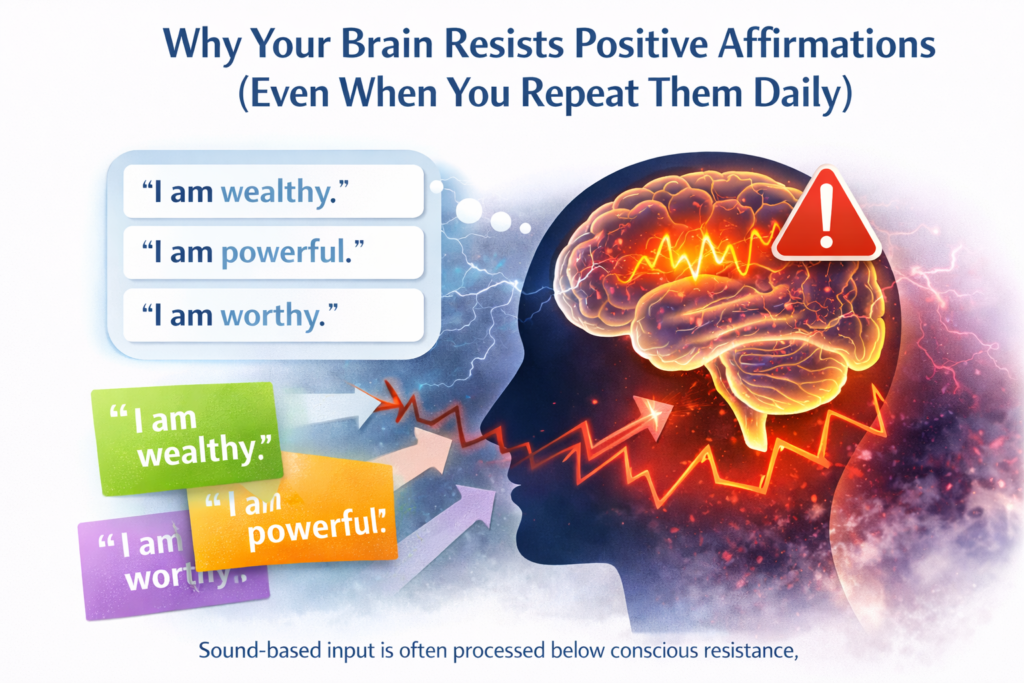
Many people don’t struggle with affirmations because they lack discipline.
They struggle because something inside them tightens every time they repeat the words.
They say the affirmation.
And immediately feel resistance.
Not loud resistance.
Quiet resistance.
The kind that shows up as tension in the chest, a subtle doubt, or the feeling of “this isn’t landing.”
They repeat affirmations daily.
They stay consistent.
They even believe in the idea.
Yet something feels off.
Instead of ease, there is strain.
Instead of confidence, there is effort.
Sometimes, affirmations feel draining rather than empowering.
This experience is rarely talked about.
When affirmations “don’t work,” people often assume they are doing something wrong. Not positive enough. Not focused enough. Not disciplined enough.
But resistance is not a failure.
It is a signal.
The brain is designed to protect familiar identity patterns, even when those patterns are limiting. When a message conflicts with deeply held assumptions, the mind does not always accept it quietly.
It pushes back.
Understanding why this happens changes the entire conversation around affirmations—from effort to awareness.
If you prefer a visual explanation, this short video explains why affirmations often trigger resistance instead of change.
THE BRAIN’S JOB IS PROTECTION, NOT POSITIVITY
The human brain did not evolve to make people optimistic.
It evolved to keep them safe.
Safety, to the brain, means predictability. Familiar patterns. Known outcomes. Even when those patterns are uncomfortable, they are still recognized.
Positive affirmations can unintentionally challenge this sense of safety.
When a statement contradicts an existing self-image, the brain evaluates it as a potential threat. Not because it is negative—but because it is unfamiliar.
This response happens automatically.
The subconscious does not analyze whether an affirmation is helpful or inspiring. It checks whether the message aligns with existing beliefs and emotional memory.
If there is a mismatch, resistance appears.
This resistance can show up as:
Discomfort
Doubt
Mental fatigue
Subtle irritation
These reactions are often misinterpreted as a lack of belief or effort.
In reality, they are protective signals.
The brain is not rejecting growth.
It is protecting continuity.
Recognizing this reframes the entire experience. Resistance is not an obstacle to overcome—it is information about where alignment has not yet been built.
WHY REPETITION ALONE CAN BACKFIRE
Repetition is often presented as the solution to everything.
Repeat it long enough, and the mind will accept it.
In practice, repetition without state alignment can create the opposite effect.
When an affirmation is repeated in a tense, frustrated, or effort-heavy state, the brain registers the emotional tone more than the words themselves.
The message may be positive.
The state is not.
This creates friction.
Each repetition reinforces the awareness of mismatch between what is being said and what is being felt. Over time, this can strengthen resistance instead of dissolving it.
The subconscious does not respond to language in isolation.
It responds to patterns—emotional, sensory, and contextual.
If repetition is paired with internal strain, the brain learns to associate the affirmation with discomfort.
That is why some people report feeling worse after forcing affirmations.
Not because affirmations are harmful.
But because the conditions were misaligned.
Repetition works best when it lands in a receptive environment. When the nervous system is regulated, and attention is relaxed, repetition integrates differently.
Without that foundation, more effort does not equal more impact.
EMOTIONAL MISMATCH AND IDENTITY CONFLICT
Why affirmations don’t work: Affirmations often fail at the level of identity, not intention.
Every person carries an internal self-image shaped by past experiences, feedback, and emotional memory. This image operates quietly in the background, influencing what feels believable and what feels foreign.
When an affirmation conflicts with this internal image, the brain detects an inconsistency.
This is known as identity conflict.
For example, repeating a statement about confidence or abundance while internally identifying with struggle creates emotional mismatch. The words aim upward. The identity pulls downward.
The brain prioritizes coherence.
When coherence is threatened, resistance appears—not to sabotage growth, but to maintain internal stability.
This is why affirmations that feel “too far ahead” often trigger discomfort. The issue is not the content of the affirmation, but the gap between language and lived experience.
Change tends to integrate more smoothly when it moves in steps that the nervous system can tolerate.
Bridging identity is often more effective than attempting to replace it.
Understanding this dynamic explains why some affirmation practices stall and why gentler, state-supported approaches are often explored instead.
HOW MENTAL STATE CHANGES THE WAY SUGGESTIONS ARE RECEIVED
How Mental State Explains Why Affirmations Don’t Work
Suggestions are not received in a vacuum.
They are filtered through the mental state present at the moment they are introduced.
When the mind is rushed, defensive, or emotionally guarded, it tends to evaluate incoming messages more critically. Even supportive language can feel intrusive in this state.
When the mind is calmer, more regulated, or inwardly focused, the same message can feel neutral—or even helpful.
This difference is subtle but decisive.
The subconscious does not ask whether a statement is logical.
It asks whether the environment feels safe enough to allow change.
Mental state acts as the gatekeeper.
This is why timing, context, and internal conditions matter more than the exact wording of an affirmation. The same phrase can be rejected or accepted depending on how the nervous system is functioning.
Understanding this helps explain why affirmations sometimes “work” for a period and then stop.
The issue is rarely the words themselves.
It is the state in which those words are delivered.
This insight shifts the focus away from forcing belief and toward creating conditions that support receptivity.
Affirmations often fail at the level of identity, not intention.
Every person carries an internal self-image shaped by past experiences, feedback, and emotional memory. This image operates quietly in the background, influencing what feels believable and what feels foreign.
When an affirmation conflicts with this internal image, the brain detects an inconsistency.
This is known as identity conflict.
For example, repeating a statement about confidence or abundance while internally identifying with struggle creates emotional mismatch. The words aim upward. The identity pulls downward.
The brain prioritizes coherence.
When coherence is threatened, resistance appears—not to sabotage growth, but to maintain internal stability.
This is why affirmations that feel “too far ahead” often trigger discomfort. The issue is not the content of the affirmation, but the gap between language and lived experience.
Change tends to integrate more smoothly when it moves in steps that the nervous system can tolerate.
Bridging identity is often more effective than attempting to replace it, which helps explain why affirmations don’t work when they push the mind too far, too fast.
Understanding this dynamic clarifies why some affirmation practices stall and why gentler, state-supported approaches are often explored instead.
WHY RESISTANCE IS INFORMATION, NOT FAILURES ARE RECEIVED
Resistance is often treated as something to eliminate.
In reality, it is something to interpret.
When the mind pushes back against a message, it is signaling a mismatch between current patterns and proposed change. That signal contains useful information about identity, emotional safety, and readiness.
Ignoring resistance or trying to overpower it usually increases friction.
Listening to it changes the approach.
Resistance often points to the need for a different entry point—one that works with mental state rather than against it. This is why state-based approaches are frequently discussed alongside language-based tools like affirmations.
When the mental environment shifts first, suggestions encounter less internal opposition.
This does not make affirmations obsolete.
It reframes how and when they are used.
For a deeper explanation of how mental states influence receptivity, see the breakdown in Brainwave Entrainment Explained: How Sound Reprograms the Subconscious Mind.
WHEN AFFIRMATIONS START TO WORK DIFFERENTLY
Affirmations tend to work differently when the focus shifts from force to alignment.
Instead of trying to override existing beliefs, the process becomes one of gradual integration. The nervous system feels less threatened. The mind becomes more receptive.
This often happens when:
The mental state is calmer
Emotional pressure is reduced
Expectations are realistic
In these conditions, affirmations no longer feel like demands.
They feel like suggestions.
Language begins to land without triggering immediate rejection.
This does not mean affirmations suddenly “work” in a dramatic way. The changes are usually subtle—less resistance, more neutrality, occasional moments of openness.
That subtle shift matters.
It creates space.
Over time, repetition delivered in a receptive state can reinforce new associations without activating the brain’s protective response.
Affirmations are not ineffective.
They are sensitive to context.
Understanding this difference allows people to use them more intentionally and with far less frustration.
When affirmations create resistance, the issue is rarely effort or belief.
It is timing, state, and internal readiness.
The brain protects familiar patterns until it senses safety to change. Once that safety is present, repetition feels lighter and more natural.
This is why many people explore supportive tools that help regulate mental state before working with language. These approaches do not replace affirmations—they create conditions where affirmations are received differently.
If you want to understand how state-based methods are commonly used alongside affirmations, this guide on brainwave and subliminal programs for wealth explains the approach in more detail.
Frequently Asked Questions
Q1. Why do affirmations feel uncomfortable sometimes?
Affirmations can feel uncomfortable when they conflict with existing identity patterns or emotional memory. This discomfort is often a protective response from the subconscious, not a sign of failure.
Q2. Does resistance mean affirmations don’t work?
No. Resistance usually indicates that the mental state, timing, or delivery of the affirmation needs adjustment so suggestions can be received more easily.
Disclaimer: This article is for educational and informational purposes only. It is not intended to diagnose, treat, or replace professional psychological or medical advice. Individual experiences with mindset practices may vary.
Why Your Brain Resists Positive Affirmations (Even When You Repeat Them Daily)