
Most Homes Place Laughing Buddha Wrong (And Quietly Block Wealth)
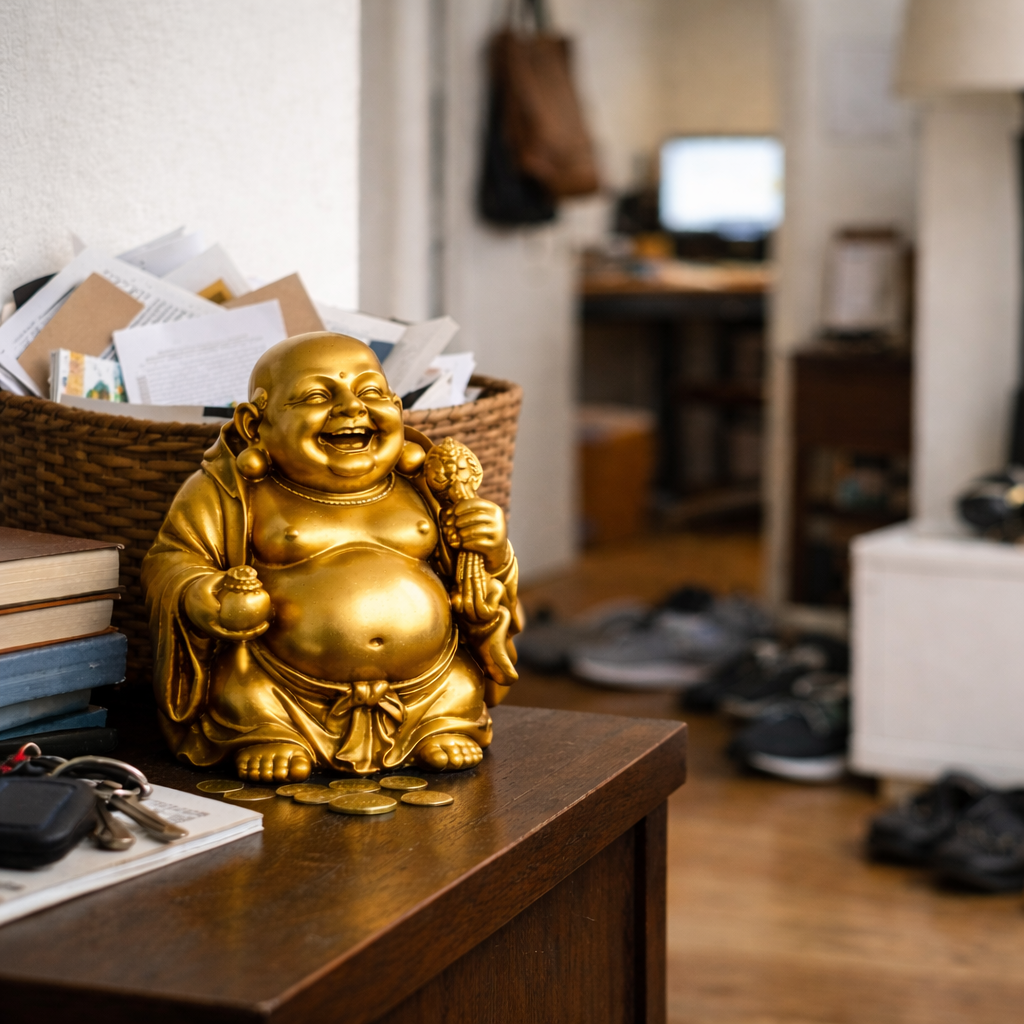
The Feng Shui Laughing Buddha is not ignored.
It is often overused.
Placed casually.
Surrounded by clutter.
Treated as decoration instead of a cue.
That’s where the problem begins.
When Feng Shui symbols are placed without intention, they don’t become neutral.
They become noise.
And noise quietly disrupts focus, emotional regulation, and follow-through—especially around money and work.
This article explains why most homes unintentionally weaken the Laughing Buddha’s effect, and how subtle environmental mistakes shape behavior more than people realize.
No superstition.
No fear tactics.
Just psychology, attention, and environment.
Why “Wrong Placement” Is a Psychological Issue (Not a Feng Shui One)
Most people assume Feng Shui works through belief.
It doesn’t.
It works through repetition, attention, and emotional association.
The Laughing Buddha is meant to act as a visual anchor—a consistent reminder of ease, optimism, and emotional abundance.
When that anchor is weakened, the brain stops responding.
Over time, this creates friction instead of support.
The issue is not where the statue sits.
The issue is how the mind experiences it daily.
Mistake #1: Surrounding the Laughing Buddha With Visual Clutter
Clutter competes for attention.
The brain does not prioritize symbols—it prioritizes contrast.
When the Laughing Buddha is placed among:
• Piles of paper
• Unsorted objects
• Decorative overload
• Random trinkets
Its signal is diluted.
Instead of reinforcing calm optimism, it becomes part of the background.
From a behavioral psychology perspective, clutter increases:
• Cognitive load
• Stress reactivity
• Decision fatigue
That stress quietly bleeds into financial decisions.
A symbol meant to soften anxiety ends up sitting inside it.
Why This Matters for Wealth Psychology
Financial behavior is stress-sensitive.
Under cognitive strain, the brain defaults to:
• Avoidance
• Short-term thinking
• Over-control or impulsivity
When a wealth symbol is placed in a cluttered environment, it cannot counteract those patterns.
It becomes visually present—but psychologically inactive.
Mistake #2: Treating the Feng Shui Laughing Buddha as “Just Decor”
Decor is passive.
Feng Shui symbols are interactive cues.
When the Laughing Buddha is treated like an aesthetic object—chosen only for size or color—the brain never assigns meaning to it.
Meaning is what activates behavior.
Without meaning:
• The eyes pass over it
• The nervous system ignores it
• The association never forms
This is why many people report “nothing changed.”
Nothing was reinforced.
Environmental Cues Shape Identity
The brain learns identity through environment.
Objects placed intentionally reinforce:
“I am supported.”
“I am safe.”
“I am capable.”
Objects placed casually reinforce nothing.
Over time, the difference compounds.
Mistake #3: Facing Direction That Creates Psychological Tension
Facing direction matters—not mystically, but emotionally.
When the Laughing Buddha faces:
• A wall
• A cramped corner
• A chaotic space
The subconscious association shifts.
Instead of openness and receiving, the mind registers:
• Restriction
• Confinement
• Visual resistance
This subtle tension affects how opportunity is perceived.
People feel “busy but stuck.”
Effort increases.
Results lag.
Not because of fate—but because the environment trains the nervous system to brace instead of receive.
Mistake #4: Placing the Symbol Where It’s Rarely Seen
A symbol cannot influence behavior if it is rarely noticed.
Many homes place the Laughing Buddha:
• On a high shelf
• In a side corner
• In a decorative niche
Out of sight is out of mind.
Behavioral conditioning requires repetition.
If the symbol does not enter your visual field daily, it cannot reinforce emotional patterns tied to money or work.
The brain responds to what it repeatedly sees—not what exists somewhere in the room.
Mistake #5: Mixing Conflicting Emotional Signals
This mistake is subtle.
And common.
The Laughing Buddha represents ease and optimism.
When placed near:
• Bills
• Stress reminders
• Broken items
• Electronics overload
The emotional message becomes mixed.
The brain cannot hold contradictory signals cleanly.
Instead of calm confidence, the result is mild internal tension.
Not dramatic.
Just enough to affect consistency.
Why These Mistakes Quietly Block Wealth (Behaviorally)
Wealth is not attracted.
It is allowed through clarity and follow-through.
Environmental friction reduces:
• Focus
• Emotional safety
• Willingness to take aligned action
When symbols that should reduce friction instead add noise, progress feels harder than it needs to be.
This is not spiritual failure.
It is environmental misalignment.
How to Use the Laughing Buddha as a Supportive Cue (Without Repeating Placement Rules)
The goal is not perfection.
The goal is psychological clarity.
Ask three questions:
Is the symbol visually calm?
Is it noticed daily without effort?
Does the surrounding environment reinforce ease or tension?
If the answer is unclear, adjustment is needed.
Small changes matter.
The nervous system responds to subtle shifts more than dramatic rearrangements.
If you haven’t read the foundational guide yet, start here:
→ Read the complete Feng Shui for Wealth & Focus guide
For a deeper breakdown of correct Laughing Buddha placement principles:
→ Why This Laughing Buddha Placement Attracts Money Within 30 Days
Optional Support Item
For readers who prefer a tangible visual cue, a Laughing Buddha statue can serve as a consistent environmental reminder of calm focus and emotional abundance.
Then:
👉 Explore a Feng Shui Laughing Buddha option suitable for home or workspace
Affiliate Disclosure: Some links on this page are affiliate links. If you purchase through them, I may earn a small commission at no extra cost to you. As an Amazon Associate, I earn from qualifying purchases.
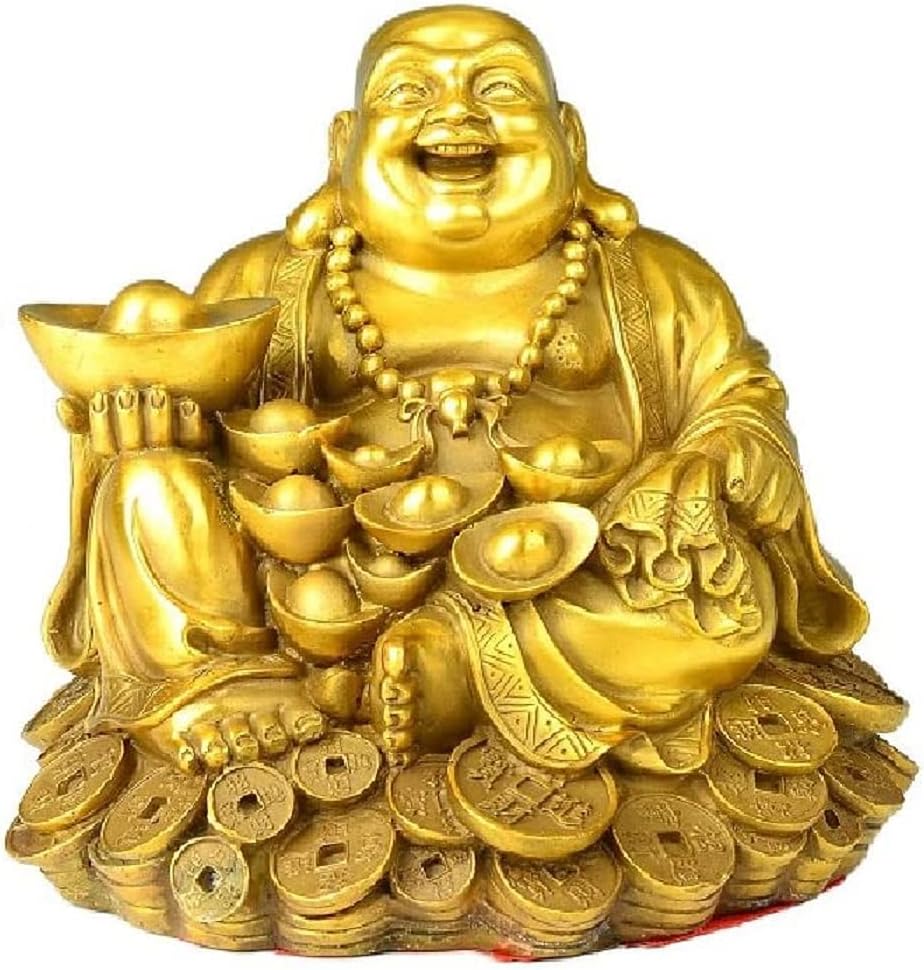
Feng Shui Laughing Buddha (Hotei with Gold)
The Feng Shui Laughing Buddha represents contentment, optimism, and emotional abundance. In Feng Shui, it is associated with easing financial anxiety and reinforcing a positive relationship with success.
From a behavioral perspective, symbols of joy reduce stress-driven decision making, helping the mind approach work and opportunity with calm confidence.
Final Insight
The Laughing Buddha does not “attract” wealth.
It conditions the mind toward ease, optimism, and openness.
When placed poorly, it conditions nothing.
When placed intentionally, it quietly supports better decisions, calmer focus, and consistent action.
That’s how environments shape outcomes.
And that’s why this symbol deserves more respect than decoration.
Frequently Asked Questions
Can placing the Laughing Buddha incorrectly actually cause harm?
Not harm—friction.
Poor placement increases cognitive noise, which affects emotional regulation and decision quality.
Does Feng Shui require belief for results?
No.
It works through environmental cues and behavioral reinforcement, not belief systems.
How long does it take to notice changes?
Most people notice emotional shifts within days.
Behavioral changes compound over weeks.
Is one Laughing Buddha enough?
Yes.
Multiple symbols often dilute attention rather than strengthen it.
Affiliate Disclosure
Some links on this website may be affiliate links.
This means that if you choose to make a purchase through these links, we may earn a small commission at no additional cost to you.
We only recommend products and resources that align with the themes of this site—such as focus, environment design, and intentional living—and that we believe may support clarity and consistency when used thoughtfully.
Affiliate relationships do not influence our content, analysis, or recommendations.
All opinions expressed are our own and are shared for informational purposes only.
Your support helps keep this site running and allows us to continue publishing in-depth, research-driven content.
Disclaimer
The content on this website is provided for educational and informational purposes only.
Articles, guides, and recommendations related to mindset, environment design, Feng Shui, or behavioral psychology are not intended as financial, legal, medical, or professional advice.
No specific outcomes—financial or otherwise—are guaranteed.
Individual experiences may vary based on personal circumstances, choices, and actions.
Concepts discussed on this site focus on environmental influence, attention, habit formation, and psychological framing.
They should be viewed as supportive tools rather than substitutes for effort, skill development, or professional guidance.
By using this website, you agree to take full responsibility for your decisions and actions.