
Binaural Beats vs Isochronic Tones: Which Works Faster for Wealth?
Binaural beats and isochronic tones are often grouped together.
But they work in very different ways.
Both are used to influence focus, mental state, and repetition.
Yet the brain responds to each one differently.
Speed is not about intensity.
It’s about how easily the method fits into your routine.
Understanding this difference makes choosing simpler—and more sustainable.
What Are Binaural Beats?
Binaural beats work through immersion.
Two slightly different frequencies play through each ear.
The brain processes the difference.
That difference creates a perceived rhythmic pattern.
This pattern influences mental state.
Because each ear receives a separate signal, headphones are required.
Many people describe binaural beats as:
Calming
Absorbing
Subtle
They tend to support longer listening sessions.
Especially during:
Relaxation
Meditation
Sleep preparation
What Are Isochronic Tones?
Isochronic tones work through direct stimulation.
A single tone pulses on and off at a regular rhythm.
The brain synchronizes with that pulse.
No headphones are required.
The sound is more pronounced.
The effect is often faster.
Many users describe isochronic tones as:
Energizing
Focus-enhancing
More noticeable
They are commonly used during:
Daytime focus
Short sessions
Task-oriented work
This response is explained by the principles of brainwave entrainment, where rhythmic input influences mental state over time.
Curious about the mechanism behind this shift? The following article may help you:
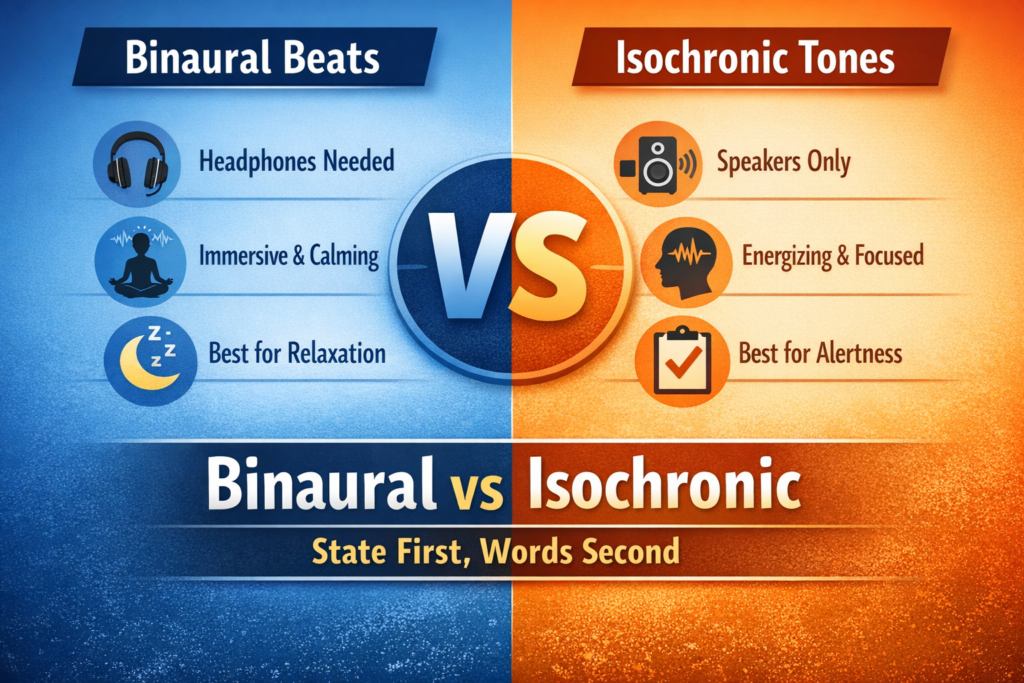
Key Differences at a Glance
Binaural Beats
-
Require headphones
-
More immersive
-
Gentler stimulation
-
Often used for relaxation
Isochronic Tones
-
Work through speakers
-
More stimulating
-
Clear rhythmic pulses
-
Often used for focus
Neither method is “better” by default.
They simply engage the brain differently.
Both methods are commonly used within structured brainwave programs designed to support consistency through repetition.
Looking for grounded tools that support this process? Check out the the following blog:
→ Money Page: Subconscious Support Resources
Which Works Better for Wealth Conditioning?
Wealth conditioning depends on repetition and receptivity.
Not intensity.
Not belief.
Not effort.
If the nervous system feels calm and open, repetition integrates more easily.
If the mind feels overstimulated, resistance increases.
This is why results vary.
Some people absorb patterns faster through calm immersion.
Others respond better to alert focus.
The question is not which method works faster.
The question is which state your mind enters more easily.
When Binaural Beats Make More Sense
Binaural beats often fit better when:
You prefer subtle input
You use audio before sleep
You stay engaged for longer sessions
They support:
Reduced mental chatter
Lower resistance
Passive repetition
For many, this environment feels safer.
Safety increases absorption.
When Isochronic Tones Are a Better Fit
Isochronic tones often work better when:
You struggle to stay focused
You prefer short sessions
You listen during the day
They support:
Alert attention
Task engagement
Consistency without long sessions
For some nervous systems, this clarity matters.
The Hybrid Approach (Authority Recommendation)
The most effective approach is often contextual.
Not exclusive.
Many people use:
Isochronic tones during the day
Binaural beats at night
This supports:
Focus when needed
Absorption when relaxed
State first.
Repetition second.
This sequence matters more than the tool itself.
Conclusion: Choose Based on Response, Not Hype
Binaural beats and isochronic tones both influence mental state.
They simply take different paths.
Wealth conditioning improves when repetition meets receptivity.
The right choice is the one your nervous system accepts most easily.
That acceptance—not effort—is what creates momentum.
Disclaimer:
This content is for educational and informational purposes only.
Subliminal audio and affirmations are not medical or psychological treatments.
Individual experiences may vary, and no outcomes are guaranteed.