
Why Audio Tools Work Faster Than Affirmations Alone
Affirmations fail most often for one quiet reason.
They rely on effort.
The subconscious relies on state.
Repeating positive language can feel productive.
Acceptance, however, does not depend on words alone.
It depends on emotional readiness.
It depends on nervous system safety.
It depends on how much resistance is present.
When the mind feels tense or defensive, repetition triggers evaluation.
Not absorption.
That evaluation slows change.
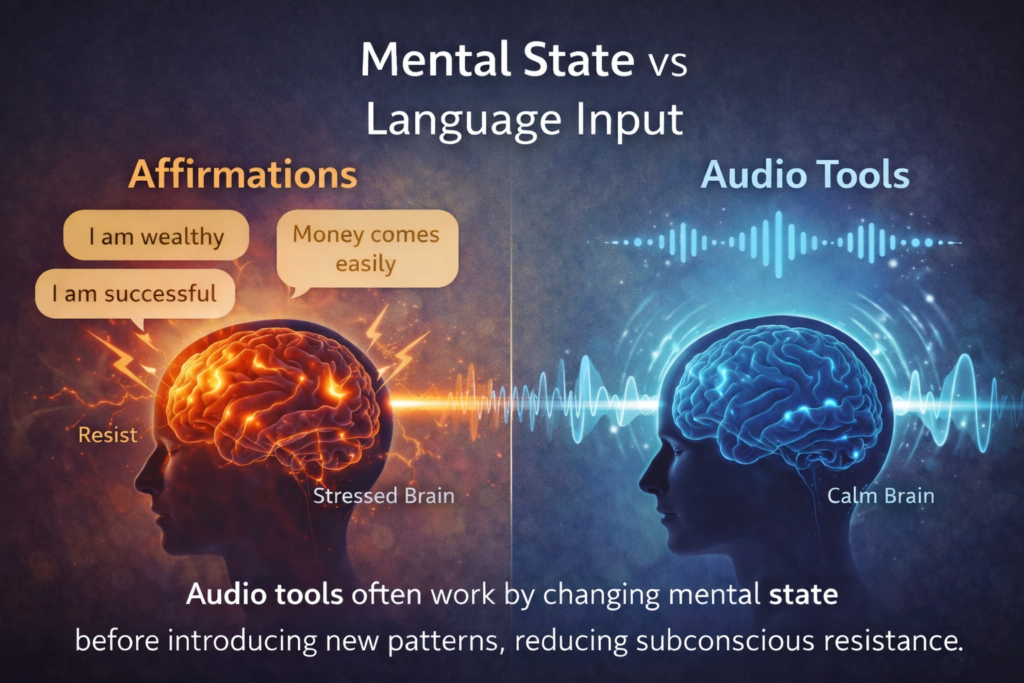
Audio-based tools work differently.
Instead of asking the mind to believe something new, they influence mental state first.
As resistance lowers, repetition becomes easier.
Language no longer feels forced.
Patterns update with less friction.
This difference explains why affirmations often feel exhausting on their own.
It also explains why combining them with audio tools tends to produce faster, more sustainable shifts.
The Conscious “Critical Filter”
The conscious mind acts as a filter.
It evaluates.
It questions.
It compares new information against existing beliefs.
This process protects identity and stability.
When affirmations pass through this filter, they are assessed immediately. If a statement conflicts with lived experience, the mind flags it as unrealistic or unsafe.
That reaction often feels like:
Doubt
Resistance
Mental fatigue
This is not negativity.
It is protection.
The critical filter evolved to prevent sudden belief changes that could disrupt functioning. As a result, language-based repetition alone often struggles to pass through without friction.
Effort increases awareness of the conflict.
Awareness strengthens resistance.
This is why people can repeat affirmations daily and still feel stuck. The message reaches the conscious mind—but never settles into the systems that govern habit and behavior.
State Matters More Than Words
The subconscious responds to state, not argument.
Calm states reduce analysis.
Heightened states increase evaluation.
This distinction matters.
When the nervous system feels safe and regulated, the mind becomes more receptive. Suggestions encounter less internal debate and more passive absorption.
Language works best after the state shifts.
This explains why affirmations feel easier:
Before sleep
After meditation
During relaxed focus
It is not the words that change.
The mental environment does.
How Audio Tools Alter Mental State
Audio tools work by influencing mental state first.
Sound patterns affect attention, rhythm, and internal pacing. Over time, these elements guide the brain toward calmer or more focused states.
In those states:
Analytical filtering decreases
Emotional reactivity softens
Repetition becomes less effortful
This does not bypass thinking.
It quiets unnecessary resistance.
Once resistance lowers, repetition works as intended.
That sequence—state first, suggestion second—is the key difference between audio-based methods and language-only approaches.
Passive vs Active Reprogramming
Affirmations require active participation.
Audio tools allow passive exposure.
This difference matters for consistency.
Active methods depend on:
Motivation
Discipline
Attention
Passive methods depend on:
Repetition
Environment
Routine
When effort drops, consistency improves.
Consistency—not intensity—drives long-term pattern change.
When Affirmations Still Play an Important Role
Affirmations are not ineffective.
They are incomplete when used alone.
Once mental state aligns, language reinforces direction. Affirmations help clarify identity and intention.
Used together:
Audio supports receptivity
Language supports meaning
This combination reduces friction and increases follow-through.
Balance matters.
If you prefer a gentle, practical example, this short session focuses on calming the nervous system before repetition.
It’s designed to support relaxation and emotional balance, not to force belief.
Conclusion: Tools Support State, Not Willpower
Change does not require more effort.
It requires better conditions.
Audio tools support mental state.
Affirmations support identity.
Repetition integrates both.
When pressure decreases, absorption increases.
If you want to understand why this works and how the brain shifts money patterns without force:
Brainwave Entrainment & Subconscious Change
(A clear, science-grounded breakdown of how awareness rewires financial behavior.)
When you are ready to see the practical tools this awareness supports—
→ Visit Best Brainwave & Subliminal Programs for Wealth Manifestation
(A calm overview of programs and resources designed to reinforce subconscious change.)
Understanding comes first.
Action becomes easier after.
Disclaimer
The information provided in this article is for educational and informational purposes only. It is not intended to diagnose, treat, cure, or prevent any medical or mental health condition.
Audio-based tools, affirmations, and relaxation techniques may support awareness, reflection, and emotional regulation, but individual experiences can vary. These methods are not a substitute for professional medical, psychological, or therapeutic care.
If you are experiencing persistent distress, anxiety, or health-related concerns, please seek guidance from a qualified healthcare professional.